Hope you all like millennium-old Church Music.
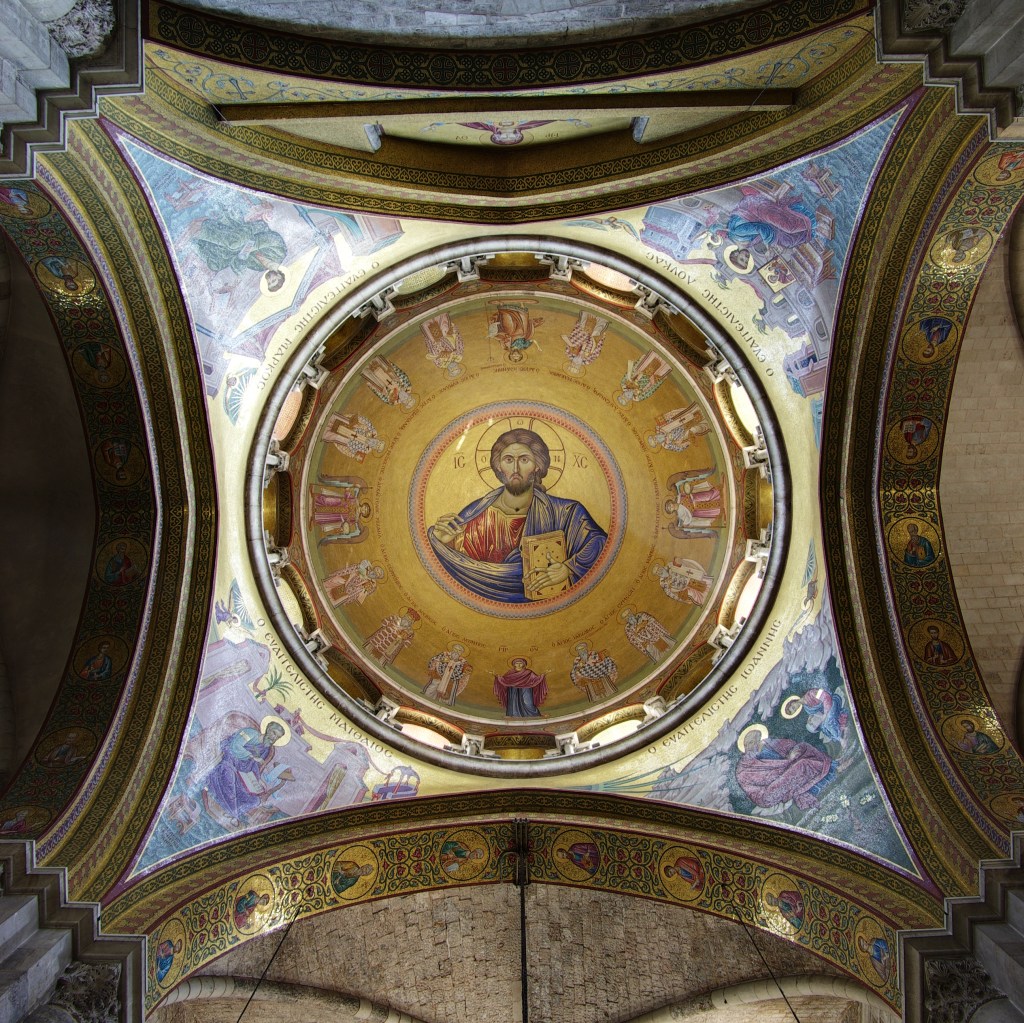
Image by Berthold Werner, via Wikimedia Commons.
Used under Creative Commons Attribution-Share Alike 3.0 Unported, 2.5 Generic, 2.0 Generic and 1.0 Generic license.
Today, October 7 is, in the Roman Calendar, the Feast Day of Our Lady of the Rosary, originally instituted by Pope Pius V as the Feast of Our Lady of Victory to commemorate the Christian coalition victory over the Ottoman navy at the battle of Lepanto in 1571.
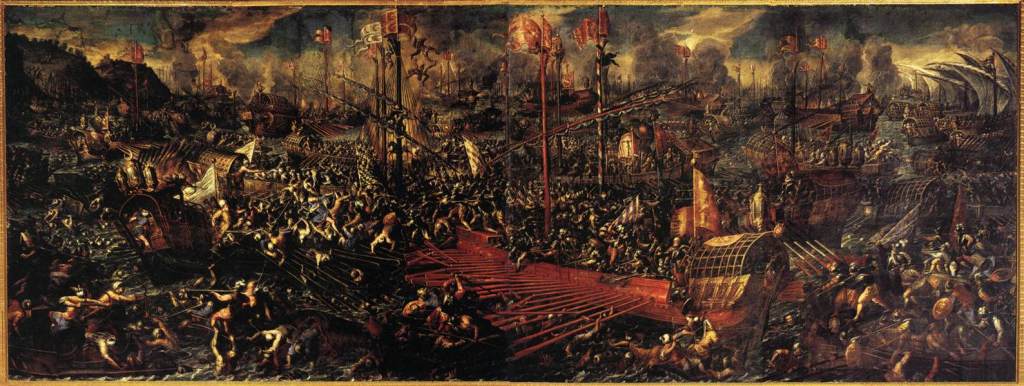
Image via Wikimedia Commons. Public Domain.
The victory at Lepanto was attributed to the intercession of the Virgin Mary, and Pope Pius V sent out instructions for the entire Catholic population of Europe to pray the rosary on the eve of the battle. Pius is reported as having been miraculously made aware of the victory at Lepanto as soon as it occurred, despite being about 1000 miles away from the actual battle.
All of this is to say, attributing decisive victories to Mary is not a particularly rare occurrence in the history of Christendom.
In the Latin Rite, January 1 is the Solemnity of Mary, Mother of God. In Eastern Christianity — the most well-known being the Eastern Orthodox, but also including the Oriental Orthodox, the Church of the East, and the sui iuris Eastern Catholic Churches — the equivalent term to “Mother of God” is either the Greek “Theotokos” (Θεοτόκος; literally “the one who gave birth to God”) or a translation of “Theotokos” into whichever liturgical language the particular in church uses most often.
This provides some key context into the music for today, as it is one of the most famous and enduring Greek hymns to the Theotokos in history.
“Out of the ten sieges that occurred during its [Constantinople; present-day Istanbul] time as a city-state and while it was under Roman rule, six were successful, three were repelled and one was lifted as a result of the agreement between the parties …
Of all the sieges that took place from its founding by Constantine the Great till 1453 only three were successful, twenty one were unsuccessful, and three were lifted by reaching mutual agreements.”
Those three successful sieges were the capture of the city during the Fourth Crusade, the eventual Byzantine re-taking of the city, and, most famously and consequentially, the conquest of the city and subsequent end of the Byzantine Empire under Mehmed.
However, the most immediately relevant siege of Constantinople for today’s purposes is the 626 siege undertaken by the Avars and Sasanians.
In brief, a string of stunning successes had seen the Sasanians conquer basically the entire Byzantine Near East, culminating in laying siege to the Byzantine capital of Constantinople with the help of their Avar allies.
The siege ended in failure, the Byzantines regained most of their lost territory thanks to the efforts of Emperor Heraclius, won a decisive victory over the Sasanians, plundered several major Persian cities, and ended nearly 400 years of warfare between the Byzantines and Sasanians.
Unfortunately, both empires were left fatally weakened and proved unable to resist the expansion of the newly-ascendant Rashidun Caliphate…
That aside, the 626 siege of Constantinople came to be memorialised as a miraculous victory ultimately attributed to the intercession of the Blessed Virgin Mary. Divine intervention and/or the intercession of Mary would also be credited for Byzantine victories in many of the later sieges on Constantinople in the following centuries.
This specific version of the Kontakion comes from the video game Civilization VI, as the cultural theme for the DLC Byzantium faction.
Now, Civilization has one of the steepest learning curves I’ve ever seen in a video game. It feels like the game presupposes you’ve been playing since 1991 and already understand its systems.
I haven’t, so I don’t, so I could never really get into it.
On the other hand, I loved the production-related aspects of the game.
Every civilisation (note the proper Canadian spelling when not referring to the game itself) has a leader (some have two possible leaders to choose; a handful of leaders can play two different civilisations) who is animated in a vaguely cartoony Pixar-esque style.
Although your interactions with the other leaders will be fairly minimal, largely limited to the game’s diplomacy mechanics, Firaxis has managed to give the leaders a lot of personality even with limited screen time.
Cleopatra and Dido are alluring, Alexander and Gilgamesh are hot-blooded, Suleiman is better than you and he knows it, Kristina is a nerd, Tomyris looks like she goes around shoving people like Kristina into lockers…
And the music. The music is so good. Unironically, it’s my favourite part of the game because I couldn’t get into, you know, the actual game.
Every civilisation has a recurring leitmotif for a theme that develops and progresses as your civilisation does. For the most part, the civilisation themes are well-known national folk songs: England has Scarborough Fair, Scotland has Scotland the Brave, Australia has Waltzing Matilda, Greece has the Seikilos epitaph (FYI, the oldest surviving piece of music for which the notation survives), Japan has the Lullaby of Takeda, Canada combines a English Canadian folk song with a Quebecois folk song to represent the whole Two Official Languages/Les Deux Langues Officielles thing we’ve got going on.
Which brings me to Byzantium.
Byzantium’s civilisation theme is the Kontakion of the Mother of God, also known by its first words “Ti ipermaho” (in Greek, Τῇ ὑπερμάχῳ) is part of the the Akathist Hymn — meaning “unseated”, referring to the fact that one stands out of reverence while reciting it.
Like we’ve seen, it commemorates the successful defense of Constantinople to the intercession of the Virgin Mary, describing her as the city and Empire’s foremost champion and defender.
In Greek, it looks like this:
Τῇ ὑπερμάχῳ στρατηγῷ τὰ νικητήρια,
cited from Greek Wikipedia
ὡς λυτρωθεῖσα τῶν δεινῶν εὐχαριστήρια,
ἀναγράφω σοι ἡ Πόλις σου Θεοτόκε.
Ἀλλ’ ὡς ἔχουσα τὸ κράτος ἀπροσμάχητον,
ἐκ παντοίων με κινδύνων ἐλευθέρωσον,
ἵνα κράζω σοι· Χαῖρε, Νύμφη ἀνύμφευτε»
Which translates as follows into English:
O Champion General, we your faithful inscribe to you the prize of victory as gratitude for being rescued from calamity, O Theotokos. But since you have invincible power, free us from all kinds of perils so that we may cry out to you: Rejoice, O Bride unwedded.
translation via the Greek Orthodox Archdiocese of America
And you can listen to the Civilization VI version here:
Man. That was a long one. But, well, that’s what you get when you give an opening to freely talk about medieval Church Music…
Stay tuned for more Realmgard and more music to write it to and follow me here:

This work is licensed under a Creative Commons Attribution-NonCommercial-NoDerivatives 4.0 International License.
The author prohibits the use of content published on this website for the purposes of training Artificial Intelligence technologies, including but not limited to Large Language Models, without express written permission.
All stories published on this website are works of fiction. Characters are products of the author’s imagination and do not represent any individual, living or dead.
The realmgard.com Privacy Policy can be viewed here.
Realmgard is published by Emona Literary ServicesTM

