Cora,
She Who Inflames Hearts
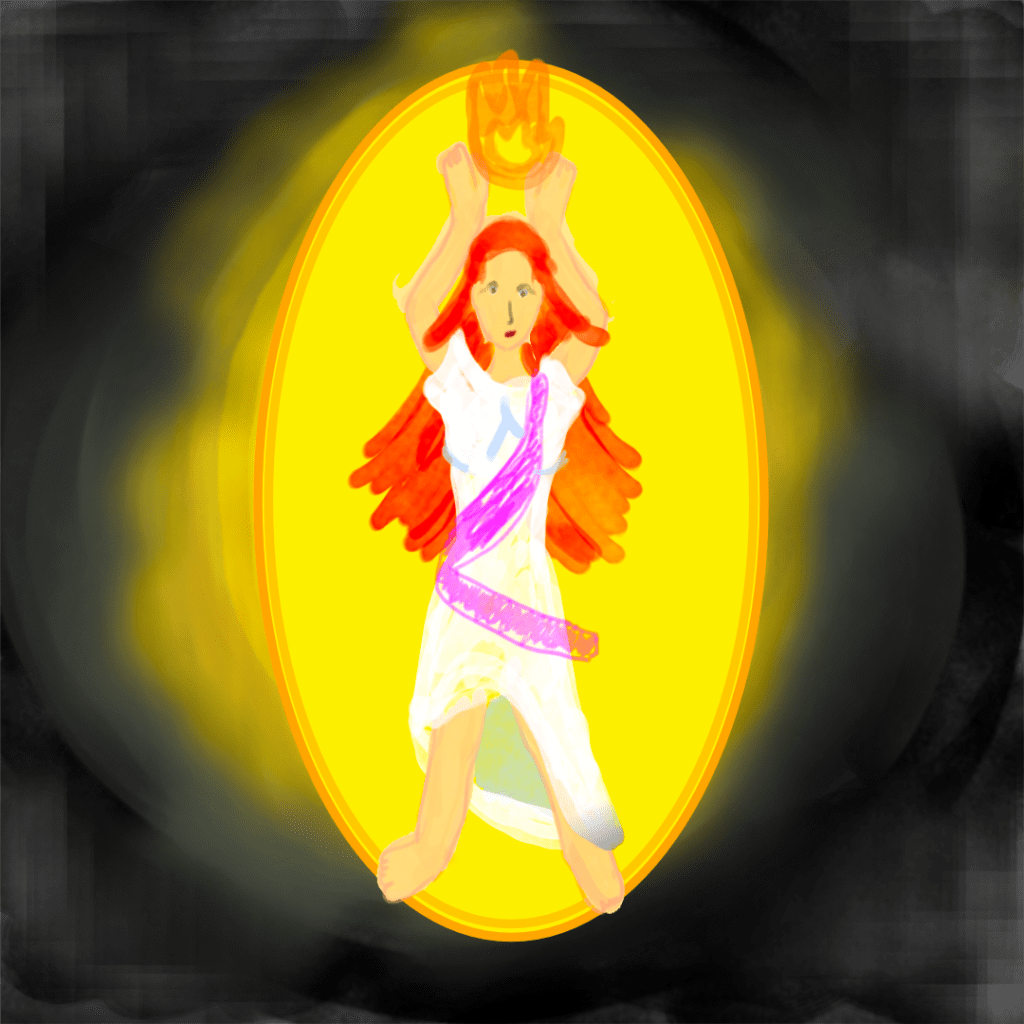
Goddess of love, passion, and courtship, patron of couples in love
One of the three foreign goddesses — along with her mother Treza and sister Misa — to marry into the Ennead to secure an alliance between the two feuding groups of gods, Cora is married to the war god Valhas, and is the stepdaughter of the craftsman god Akmon and elder half-sister of the fire god Azidos.
While associated with strong emotional sensations and attachment in general, Cora is primarily venerated as Realmgard’s goddess of love and seen as the patron of the courtship between young lovers. Along with Aeto and Iona, Cora is frequently invoked during wedding ceremonies. An emblem of Cora is sometimes worn as a sign of romantic availability and the reciprocal exchange of these emblems is a common sign of the beginning of a romantic relationship — these practices were most common in previous centuries, but have not been entirely forgotten in present-day Realmgard.
Cora is most closely associated with her sister and her husband, consoling Misa’s many sorrows and accompanying Valhas into battle in the aspect of a goddess of righteous fury, particularly on behalf of women who had been wronged, particularly unjustly spurned lovers. Due to a shared association with fire — metaphorical and literal — Cora is also often depicted in the company of her younger half-brother Azidos.
Cora’s militant aspects are particularly popular among Realmgard’s Amazons. Although Parthene is the most popular deity among the Amazons and held as their cultural patron and forebear, the worship of Cora as a war goddess is more widespread among the Amazons than elsewhere in Realmgard.
Where Misa is associated with compassion and empathy, Cora is associated with passion and romance. Reflecting this, while Misa is often depicted as sullen and sorrowful, Cora is gregarious and fervent, even to the point of tempestuousness. Although largely benevolent, Cora is one of the deities quickest to anger, though also quick to forgive and forget her previous grievances and to make amends to those who have fallen afoul of her tempers.
Although Cora is quick to spur others into romantic relationships and is recorded as a prolific matchmaker to both gods and mortals, featuring prominently in many popular romantic stories, her only recorded romantic partner in the mythology is her husband Valhas, who is often depicted going into battle with Cora’s kerchief tied around his arm.
While never crossing the line to become outright enemies, Cora and the younger goddess Pherais are often depicted as rivals. As the goddess of love, Cora makes frequent attempts to pair Pherais up with an available male deity with the assistance of Pherais’ numerous half-sisters. Being notoriously and even almost militantly aromantic, Pherais has little time for this perceived meddling — not helped by Cora often taking part in the pranks played by Pherais’ younger sister Anassa.
Like her sister, Cora is a recurring figure in ancient popular theatre, depicted descending from the heavens at the conclusion of many plays in order to divinely sanction the union of the leads in comedic romances or to denounce those who contributed to the tragic fate of the leads in tragedies.
Discover the rest of the Encyclopedia Realmgardica here:
Also, be aware of the Tales of the Sea book giveaway I’m involved in:

US Residents only.
And follow along via social media or my email list:
Sign up for my email list here.

This work is licensed under a Creative Commons Attribution-NonCommercial-NoDerivatives 4.0 International License.
The author prohibits the use of content published on this website for the purposes of training Artificial Intelligence technologies, including but not limited to Large Language Models, without express written permission.
All stories published on this website are works of fiction. Characters are products of the author’s imagination and do not represent any individual, living or dead.
The realmgard.com Privacy Policy can be viewed here.
Realmgard is published by Emona Literary ServicesTM
