Týr is a folk metal band from the Faroe Islands.
The Faroes are a territory of the Kingdom of Denmark, located between Great Britain and Iceland.
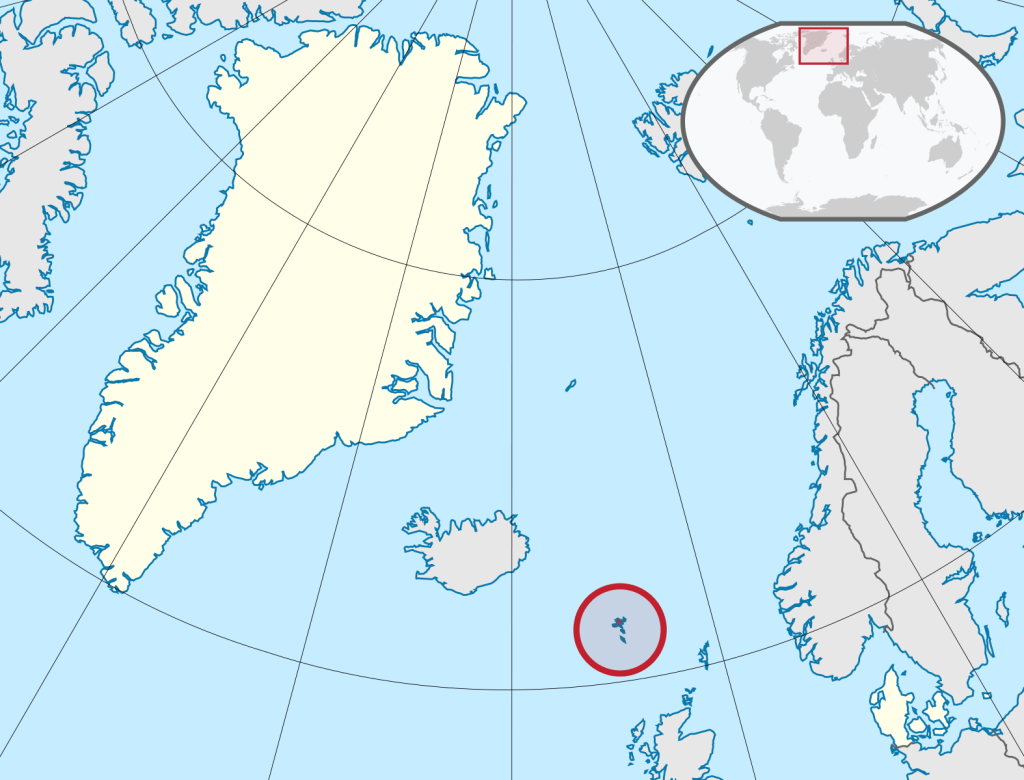
Via Wikimedia Commons. Used under Creative Commons Attribution-Share Alike 4.0 International license.
Regin Smiður, from their 2003 album Eric the Red is, like many of their songs, based on traditional Faroese ballads known as kvæði, themselves drawing on famous episodes from Scandinavian history or mythology.
Notably, actual kvæði have dozens or even hundreds of verses and a repeating chorus. You get a sense of that in Týr’s traditionally-inspired songs, but for obvious reasons, they’re pretty heavily abridged.
The title Regin Smiður translates to “Regin (Black)Smith.” Incidentally, ‘ð’, the letter Eth is historically pronounced as a th sound — though this is apparently not the case in modern Faroese, where it is isn’t voice at all largely only retained for primarily etymological reasons — so, based on my understanding/hearing Smiður sounds like “smee-ur” and not “smee-thur.”
All of this is to say, the relationship between ‘Smiður’ and ‘smith’ becomes pretty clear.
Regin is a major figure in the Völsunga saga, the Norse version of the same story that inspired Wagner‘s Ring Cycle.
Referred to in the chorus, Sigurd (Sjúrður in Faroese), is the central character, the same character as Siegfried in the Ring Cycle. Grani, by the way, is his horse.
“Grani bore the gold down from the heath
With wrath he swung his sword
Sigurd slew the serpent.”
Regin gets a mention in one of the verses, mentioned along side the dragon Fafnir, his (shape-shifted) brother.
“Fafnir is the dragon’s name
That dwells on Gnita-heath
Regin is a good smith,
But to few is he faithful.”
Those lyrics are sort of a composite/extrapolation from a few different versions I’ve seen, but the full lyrics are also available translated here.
As is often the case with mythology, there are variations based on language and geography, but the short version is that the hero Sigmund is slain treacherously by his rival Hunding. Sigmund is ultimately avenged by his other son Helgi, who because of this act, comes to be known as Helgi Hundingsbani (that is ‘Hunding’s Bane,’ the Slayer of Hunding).
Helgi isn’t a major figure in the Völsunga Saga, but does feature prominently in his own myth cycle — doubly so because he’s said to have reincarnated and had subsequent adventures in his new lifetimes at least twice.
Regin Smiður is primarily concerned with the death of Sigmund, though the chorus does hint at the later adventures of Sigurd, who at Regin’s urging will slay the dragon Fafnir. That Regin is “to few faithful” is a reference to the fact that Regin is basically manipulating Sigurd — who is, incidentally, also his foster son in at least some versions of the story — to do the hard work and kill Fafnir (again, his own brother) for him, then conspiring to betray him and steal the gold for himself. Luckily, accidentally swallowing some of Regin’s blood also Sigurd to understand the speech of birds, learn of Regin’s and kill him first.
The gold is, of course, cursed and Sigurd’s subsequent misfortunes because of it form the bulk of the Völsunga saga, though this is left unsaid in Týr’s version of the ballad, which basically ends with Sigurd carrying off the gold.
You can listen to it here:
Incidentally, Tolkien did a version of the story in alliterative verse which was published posthumously as The Legend of Sigurd and Gudrún – which is probably my favourite non Middle-earth thing in Tolkien’s body of work.
Check out the official Music to Write Realmgard to playlist here:
If you’ve enjoyed my content, please consider supporting me through Ko-fi or Patreon, or through Paypal by scanning the QR code below:
Follow Realmgard and other publications of Emona Literary Services™ below:
Subscribe to the Emona Literary Services™ Substack newsletter here.

This work is licensed under a Creative Commons Attribution-NonCommercial-NoDerivatives 4.0 International License.
The author prohibits the use of content published on this website for the purposes of training Artificial Intelligence technologies, including but not limited to Large Language Models, without express written permission.
All stories published on this website are works of fiction. Characters are products of the author’s imagination and do not represent any individual, living or dead.
The realmgard.com Privacy Policy can be viewed here.
Realmgard is published by Emona Literary ServicesTM
