Misa,
Woman of Many Sorrows
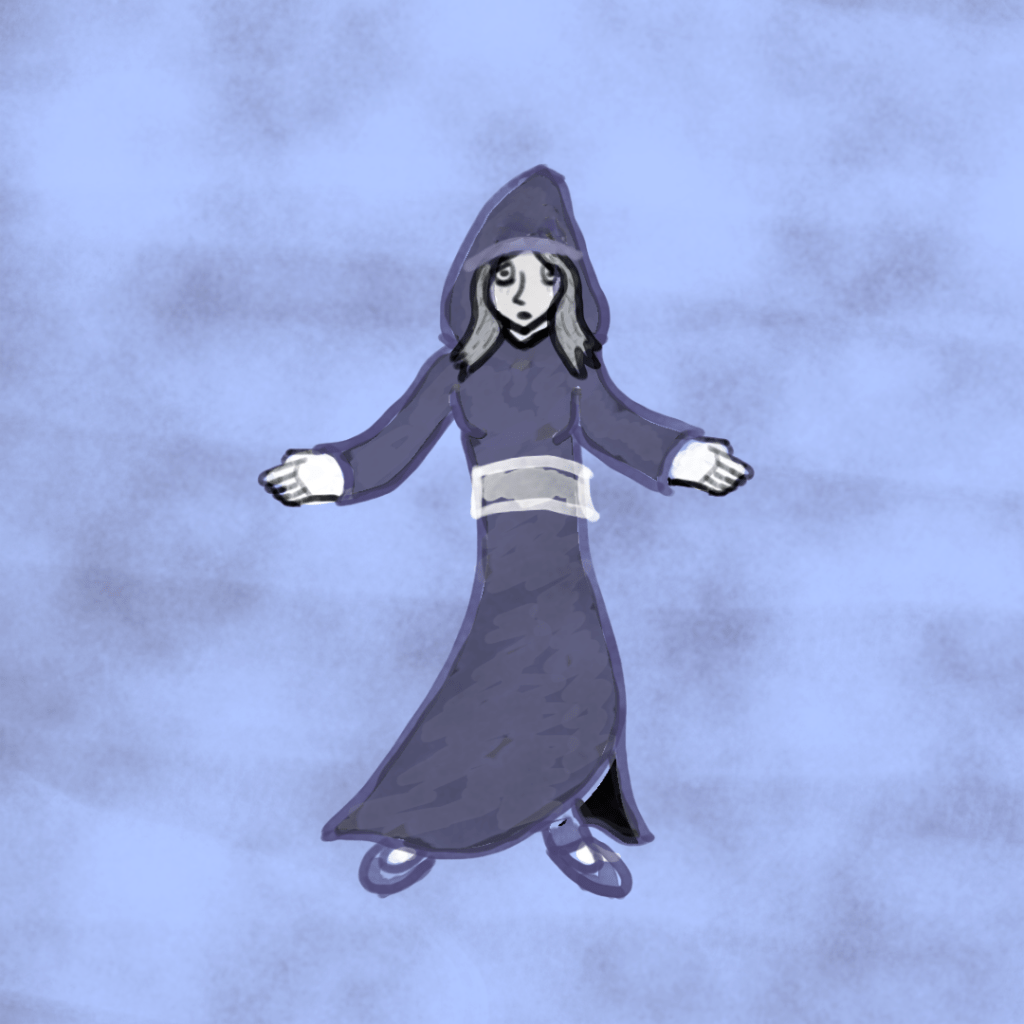
Goddess of mercy, compassion, mourning, and forgiveness, patron of funerals and mourners
The daughter of Treza, sister of Cora, stepdaughter of Akmon, half-sister of Azidos, and wife of Sephas, Misa first enters the mythological accounts accompanying her mother and sister to the Terrace from a place of unknown origin.
While Treza and Cora were eager to go to war to the gods of Ennead for control of Terrace, Misa, valuing mercy and forbearance and grieving over conflict, spoke against this and came in peace before the gods of the Ennead to reconcile the two groups of gods. With the aid of her eventual husband Sephas, Misa was able to arrange a truce between the two groups and secure peace via the marriage of Treza to Akmon, Cora to Valhas, and herself to Sephas.
Misa is best known for her role as the goddess of mercy and compassion. In most images, she is depicted as sullen or sorrowful, though symbolic images of a jubilant Misa have been used in allegorical images to commemorate notable historical peace treaties or particularly notable acts of charity.
Although Misa is very rarely, if ever, depicted as taking an active role in punishing mortals, she is often depicted as urging the other gods to intervene on behalf of innocent victims. There are, however, a few stories about Misa sending forth three spirits to teach evildoers the true meaning of Wintermorn.
Similarly to the ancient Elven Empire’s practice of opening the doors of the temple of Valhas during times of war, the priests of Misa would turn the sacred image of the goddess to face the inner wall of the temple to signify her mourning over the sorrows of war.
Additionally, a banner of Misa would be flown by Imperial armies as a sign of willingness to offer quarter to the enemy. When the banner was furled, the offer was rescinded and no quarter would be shown from that point. Notably, the great Elven hero Quintus Marcellinus Styracosaurus is said never to have furled the banner of Misa during his campaigns, reflecting his clemency and magnanimity in victory.
Among the other gods, Misa is most closely associated with her sister Cora and husband Sephas. However, she is also associated with Iona for her role as a peacemaker and an elder mentor to the younger goddess Pherais, who are both venerated as teachers of endurance in hardship and sorrow.
While her sister is generally seen as the goddess of love, primarily in the romantic sense, Misa is generally seen as the goddess of familial love and intense, intimate friendship. Similarly, because she is most commonly depicted as weeping, she is viewed as the goddess of mourning and often invoked at funerals.
Misa is also a common figure in ancient Elven drama. As per the ancient theatrical tradition of the deus ex machina, the plots of many ancient plays are brought to a resolution by the timely intervention of a divine figure. In many plays revolving around factional of interpersonal conflict, it will often be Misa who descends from the heavens to demand the mortal characters end their feuds and reconcile.
If you’ve enjoyed my content, please consider supporting me through Ko-fi or Patreon, or through Paypal by scanning the QR code below:

Follow Realmgard and other publications of Emona Literary Services™ below:
Subscribe to the Emona Literary Services™ Substack newsletter here.

This work is licensed under a Creative Commons Attribution-NonCommercial-NoDerivatives 4.0 International License.
The author prohibits the use of content published on this website for the purposes of training Artificial Intelligence technologies, including but not limited to Large Language Models, without express written permission.
All stories published on this website are works of fiction. Characters are products of the author’s imagination and do not represent any individual, living or dead.
The realmgard.com Privacy Policy can be viewed here.
Realmgard is published by Emona Literary ServicesTM
