The Post-Imperial Era
Although the historical records are spotty at best and the truth of the period is difficult to glean, this is one of the most mythologised and romanticised periods of Realmgard’s history.
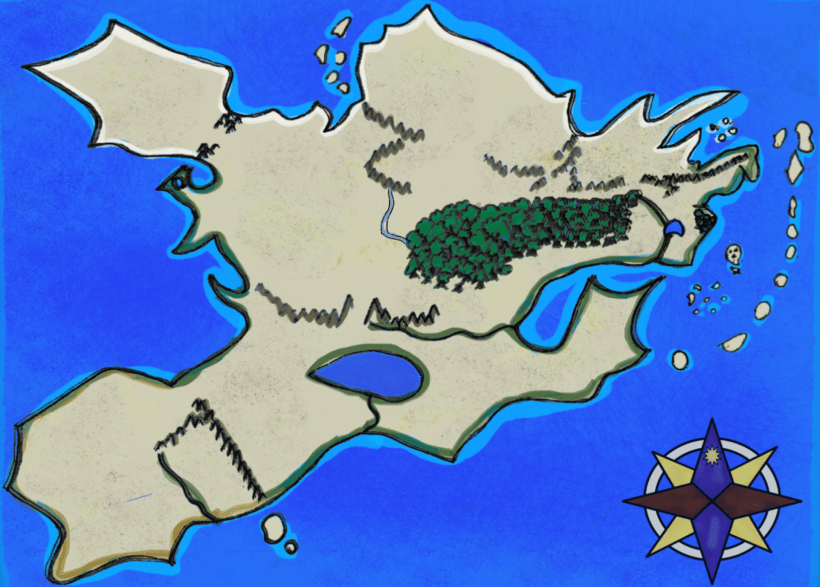
Although the immediate aftermath of the final dissolution of the Elven Empire was a period of upheaval and frequent warfare across much the continent, it was also the period that planted the seeds of the political and cultural developments that led to Realmgard in its current state.
Certain polities, especially in Natalis, continued to cling to the vestiges of the Imperial political and administrative apparatus — notably, various self-styled successors to the Empire would continue to dress in purple in imitation of the Elven Emperors. Notably, the purple dye necessary to do this was costly even at the height of the Empire and its scarcity in this period gave such purple garb the additional significance of symbolising its wearers’ staggering wealth as much their Imperial pretensions.
The near-total collapse of Imperial authority throughout the majority of the continent led to new polities rising across the continent to fill the vacuum. This culminated in the reunification of much of the continent under Emperor Theobald. This, in turn, played a major role in the Gardian language — descended from the Old Midlandic language spoken by Theobald — becoming the most widespread language on the continent.
In the present day, the Duchy of Middlesbrooke and the Kingdom of Gallicantu both claim direct dynastic descent from Theobald and his heirs — and the Kingdom of Aurora claims an indirect connect to the Theobald dynasty, due to the large influx of Gallicantien knights and nobles who aided Aurora against the invasion of Auriwandalo towards the end of this period and were rewarded with lands in Aurora.
The cultural shifts in Realmgard were acutely felt on the Sea’s Edge peninsula. As the Empire withdrew, the descendants of the ancient Tanithites from the Wandering Coast of the southern continent of Arena, crossed into Realmgard and established themselves over much of the Peninsula. The influences of Imperial architecture, politics, language and culture were not completely supplanted, though the synthesis of these influences with the Tanithite culture lead to the emergence of a new and unique culture on the Sea’s Edge.
The ancient scholar Sibylla of Isidorus is the clearest demonstration of this phenomenon. Revered as a saint-like figure since her death during the height of the Elven Empire, even after the conquest, she continued to be respected and revered by the Tanithites. The site of her tomb was renovated in the Tanithite architectural style, becoming one of the most famous buildings on the Sea’s Edge. After the establishment of Pelayo, the shrine was further renovated, though the Tanithite architecture was maintained. Sibylla’s shrine is now a unique blend of three distinct architectural styles that span centuries.
Allowed a period of relative peace due to being removed from the ongoing upheaval in the middle regions of the continent, the Free Cities of Realmgard’s northeast emerged in their earliest form as independent city-states and were therefore able to begin thriving culturally and commercially, due to any of the major kingdoms or empires ruling elsewhere in the continent being unable to extend their reach far enough to exert control over the nascent city-states. However, the Free Cities played a major role in allowing the spread of goods from elsewhere on Terrace throughout Realmgard.
Although the historical records are spotty at best and the truth of the period is difficult to glean, this is one of the most mythologised and romanticised periods of Realmgard’s history. Several of the most famous figures in the history of Realmgard lived in this era: the aforementioned Warrior-King Auriwandalo, Emperor Theobald the reunifier of much of the continent, King Lambert and his warrior niece Adelheid of Gallicantu, King Léonides of Duradero, King Caelin of Middelmere and the Kingdoms of the Sea.
So, reading over some of what I’ve established before, I’m starting to realise some aspects of my timeline don’t work when taken together. Which has me thinking I need to buckle down and work out a definitive version of the timeline.
Discover the rest of the Encyclopedia Realmgardica here:
If you’ve enjoyed my content, please consider supporting me through Ko-fi or Patreon, or through Paypal by scanning the QR code below:

Follow Realmgard and other publications of Emona Literary Services™ below:
Subscribe to the Emona Literary Services™ Substack newsletter here.

This work is licensed under a Creative Commons Attribution-NonCommercial-NoDerivatives 4.0 International License.
The author prohibits the use of content published on this website for the purposes of training Artificial Intelligence technologies, including but not limited to Large Language Models, without express written permission.
All stories published on this website are works of fiction. Characters are products of the author’s imagination and do not represent any individual, living or dead.
The realmgard.com Privacy Policy can be viewed here.
Realmgard is published by Emona Literary ServicesTM
