Capitolina,
Shepherdess of Empire
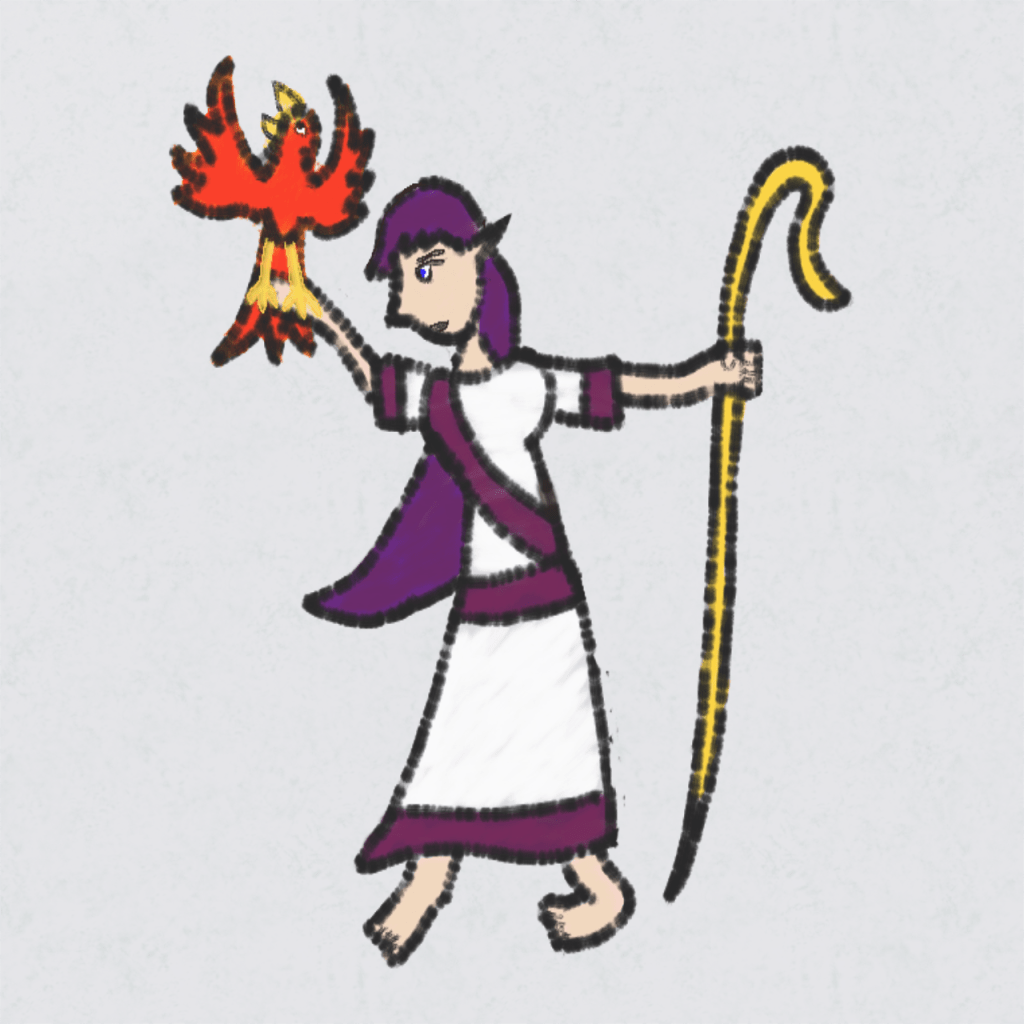
Goddess of imperium and politics, patron of Imperialis, the Elven Empire, and the region of Natalis.
The goddess Capitolina is inextricably connected with the city of Imperialis — and because that city became the seat of the Empire which spread its rule first over the entirety of Natalis and then nearly the entire continent of Realmgard, Capitolina came to be viewed as the patroness of the Elven Empire and remains widely-venerated in its former heartlands of Natalis.
Attested to in the oldest sources as the tutelary deity of the city of Imperialis, the cult of Capitolina was widely-patronised and promoted by the saintly hero-twins Sator and Messor — founders of the city of Imperialis, and first Elven Emperor and Patriarch of the Sacred Republics at the Sea of Origo, respectively.
From there, Capitolina came to also be associated with the Empire at large as it expanded for its capital at Imperialis. Despite the contraction and ultimate collapse of the Elven Empire, due to the indelible mark left Empire’s longstanding cultural influences on Natalis, Capitolina remains one of the most universally-popular deities among the people of Natalis, despite the region being otherwise highly-fragmented into localised city-states.
Capitolina is depicted as a young woman dressed in a toga, usually accompanied by a phoenix (a symbol of the Elven presence in Realmgard even older than the Empire itself) and holding a shepherd’s crook, symbolising both Capitolina’s role as the benevolent shepherd and protectress of the Empire and of the ancient Elves’ self-proclaimed role and right to shepherd the entire continent of Realmgard as its overlords.
The present-day city of Imperialis retains much of these iconography. Though present-day Imperialis lacks much of the territorial ambition of its ancient forebears, the image of Capitolina in Imperial regalia bearing her shepherd’s crook is meant to convey the direct cultural continuity between the ancient Empire and the present-day city.
Though not always depicted dressed in purple, Capitolina is closely-associated with the colour due to its historical status as a symbol of Imperial prestige. For example, she is most commonly depicted with long purple hair. As the hair of Realmgard’s Elves is typically brightly-coloured and ranges in colours beyond the scope of the other peoples of Realmgard, an Elf being born with purple hair is seen as an auspicious omen due to the association both with the ancient Empire and the goddess Capitolina.
In most Natalian traditions, Capitolina is said to be the sister of the river goddess Creusa, from whom all the Elven Emperors claimed descent. Notably, Capitolina is said to have fostered the son of Creusa and her mortal husband Fulmen, establishing a further tangible tie to divine sanction and legitimacy on the part of the Imperial dynasty.
Subject to numerous sieges during its history, the city of Imperialis was said to be invincible so long as it retained the favour of the goddess Capitolina. There are, in fact, many surviving accounts from these sieges telling of a Elven woman dressed in purple walking the battlements of the city. Similar sightings are recorded during times of natural disaster or social upheaval in Imperialis — plagues, earthquakes, fires, or riots — and many witness credit their survival to the aid of this mysterious woman in purple.
These sights are invariably interpreted as apparitions of Capitolina coming to the defence of her city.
The thing I’m least looking forward to about doing this for a month is coming up with enough god days to flesh out the remaining 20-some days of this exercise…
So, naturally, I decided to start with the gods I’ve already written about.
I’ve mentioned Capitolina several times in the context of the history of Natalis and the Elven Empire. To recap “caput” is Latin for top, or head — why, for example, the top part of a column is the capital or why the seat of government is the capital city (or the building that government meets in is the Capitol).
“Capitolina” is also the feminine form of the adjective referring to the Capitoline Hill, one of the Seven Hills of Rome, site of the several major temples, and, as it happens, location of the cliff from which those found guilty of treason were flung to their deaths…
[Sidebar: the Romans were very good at inventing novel, horrifying new ways to kill things]
In the context of my Capitolina, I’m going for something like “the woman of the capital city.”
Quick reminder that imperium is the Latin word for something like “capacity to execute legitimate military and political authority.”
Originally, she was holding an eagle as a reference to real Roman Eagles, but I’ve since changed it to the a phoenix to better represent the established history of the Elven Empire.
Incidentally, that shade of purple is Tyrian Purple (which really is more of a red…). It is indeed historically associated with Roman and Byzantine Imperial prestige. Also, made from crushed snails…
Quick reminder that you can catch up on the entirety of The Treasure of Oake Island:
As always, follow me here:

This work is licensed under a Creative Commons Attribution-NonCommercial-NoDerivatives 4.0 International License.
The author prohibits the use of content published on this website for the purposes of training Artificial Intelligence technologies, including but not limited to Large Language Models, without express written permission.
All stories published on this website are works of fiction. Characters are products of the author’s imagination and do not represent any individual, living or dead.
The realmgard.com Privacy Policy can be viewed here.
Realmgard is published by Emona Literary ServicesTM
