Aeto,
First-Father
God of governance, fatherhood, and creation,
King of the gods.
Numerous myths depict Aeto wandering through the mortal world, subtly aiding the upright and punishing the wicked. In fact, the stories of the creation of Terrace often begin with Aeto’s wanderings through the cosmos.
Departing the paradiscal realm of the Distant Verdant Star for reasons that are not elaborated upon in the myths, Aeto became the first god to arrive at the as-yet unformed world of Terrace. Returning to lead his wife, siblings, and eldest children to settle this new world, Aeto initiated the shaping of Terrace. Aeto is therefore recognised as the primary creator god in the mythology of Realmgard.
Aeto is one of the nine major gods of the traditional Elven Empire, known historically as the Imperial Ennead — consisting of the first and second generation of Realmgardian gods. Aeto is generally understood as the primary authority figure among the Ennead due to being the eldest and father of the most significant second-generation deities.
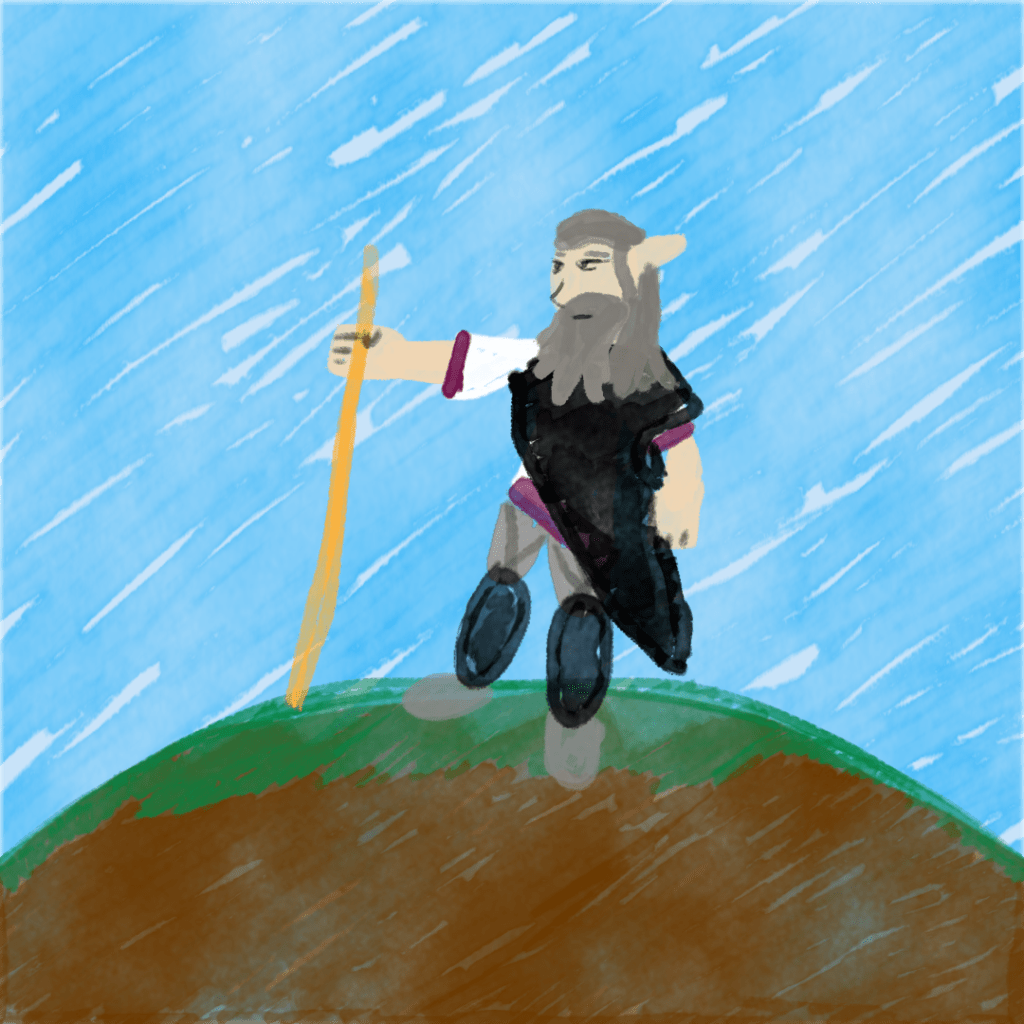
As is the case with most of the gods of the Ennead, Aeto is usually (thought not universally) depicted as an Elf. Due to his role in the earliest creation of the world of Terrace, he is depicted as a grandfatherly old man. Despite the longstanding misconception that Elves cannot grow beards, Aeto has been depicted as bearded from the very oldest iconographic depictions.
The two most common depictions of Aeto reflect the two most common aspects of his character: either as the majestic and powerful king of the gods or as a wizened, hermit-like wanderer.
Despite his role as the king of the gods, Aeto is often a comedic figure. Many of the stories of his wanderings culminate with him outwitting demons, monsters, or evil mortals in novel, elaborate fashion. Many of these myths became the basis for popular ribald plays during the Imperial period.
Nevertheless, Aeto remains understood to be a stern yet just figure of political authority when not wandering in secret through the world. Whereas Capitolina came to be viewed as the Empire’s patron goddess, Aeto was seen as the god of political authority and legitimacy in a broader sense. Over time, Capitolina came to be viewed as one of Aeto’s daughters to further legitimise the authority of the Empire. As this was a fairly late development, Capitolina is therefore not viewed as one of the nine deities of the Ennead.
Many other Realmgardian gods are noted for their numerous love affairs with other gods or mortal paramours, and thus counted as the parents of numerous younger gods and demigod heroes of legend by multiple romantic partners. Aeto, however, is known in the myths as one of the few purely monogamous gods. Though the father of many of second-generation deities, all of Aeto’s children are also the children of his wife Iona.
As a consequence of this, Aeto and Iona are one of the few divine couples to have a consistently stable and content marriage throughout the myths and are often held up as both the ideal example and patrons of happy marriages.
My original plan was to give the main Realmgardian gods purely Fantasy-y names to represent that they’re basically cross-cultural figures. But as any writer knows, names are hard.
Ultimately, I decided to use, or at least evoke, Proto-Indo-European words. In this case, “Aeto” is based on “átta“, a purported Indo-European stem meaning “father”, which survived in Latin and Greek as “atta”, a sort of generic term of respect for an older man — comparable to how some cultures use “Grandfather” to refer to any older man, or “Auntie” to refer to any older woman.
“Aeto” has the added bonus to resembling the Greek “aetos“, meaning eagle, historically a symbol of both Zeus and Roman (also general) Imperial authority. That wasn’t on purpose.
Moving onto Aeto himself, he’s basically a combination of Zeus and Odin, though probably markedly more benevolent than either of them. That Aeto is known to be monogamous isn’t really any sort of moral statment, it’s just a way to differentiate him from Zeus the notorious philanderer.
Finally, I think narrowing down the major Realmgardian pantheon to nine gods will be helpful at least insofar as defining the scope of the project. Ennead is the Greek word for “group of nine”, “ennea” being the word for nine.
While Greek mythology is known for the Twelve Olympians (though the list of the main Greek gods can probably be considered to be somewhere around fourteen of fifteen — Hestia and Dionysus are variably considered Olympians or not and Hades is not one of the Twelve, by virtue of not residing on Olympus, he was nevertheless on the major gods), one of the most common accounts of the major Egyptian gods is the Ennead (though given how long the Ancient Egyptian period was, different gods were emphasised or de-emphasised at different times, so there are multiple groups of the most important Egyptian gods at different times and places).
Incidentally, the major work of the Neo-Platonist philosopher Plotinus is known as the Enneads, due to being divided into sets of nine.
And that’s a week. Recap to follow.
Follow me here:

This work is licensed under a Creative Commons Attribution-NonCommercial-NoDerivatives 4.0 International License.
The author prohibits the use of content published on this website for the purposes of training Artificial Intelligence technologies, including but not limited to Large Language Models, without express written permission.
All stories published on this website are works of fiction. Characters are products of the author’s imagination and do not represent any individual, living or dead.
The realmgard.com Privacy Policy can be viewed here.
Realmgard is published by Emona Literary ServicesTM
