Anassa,
Little Empress
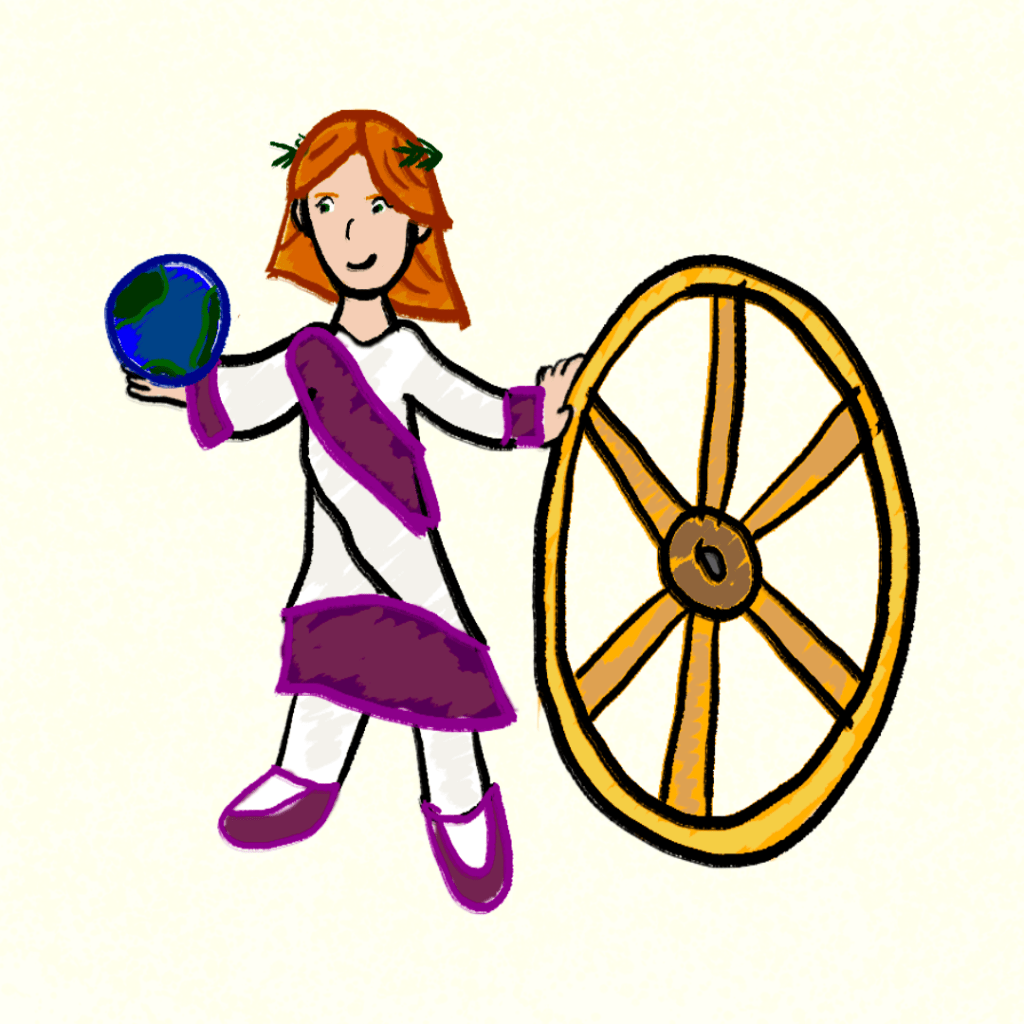
Goddess of luck, mischief, and cheese, patron of children
Daughter of Aivas and Erha and sister of the hero-goddess Pherais, Anassa is generally viewed as the youngest of the gods of the Ennead and is therefore universally depicted as an eternal youth, or even as a little girl.
Anassa and her sister are often venerated as a pair to account for any of life’s eventualities. Whereas Anassa is associated with good luck, Pherais is often seen as the patron of endurance in the face of ongoing bad luck.
Shared association with luck notwithstanding, Anassa and Pherais as a pair are also venerated as patron deities of the sibling bond, particularly that between sisters.
Invariably depicted in the myths as immature, unpredictable, and easily-bored, Anassa often functions as a trickster god and prankster figure, finding amusement in making herself a nuisance (albeit a largely harmless one) to the elder gods — particularly her sister Pherais.
While Anassa is often depicted as outwitting the wicked, this usually occurs unwittingly, with the young goddess’ interlocutors unable to follow the twists and turns of her childlike logic.
The most common epithet of Anassa is “Little Empress” — that is, of the world — a reference to the whole cosmos being subject to twists and turns of luck and chance.
Although capricious and inconstant, Anassa is rarely viewed as actively malevolent, reflecting the common depiction of the goddess as an adolescent or child. Dramatic reversals of fortune are understood to reflect the ever-changing mind and opinions of a youthful and immature goddess, rather than an actively cruel deity toying with mortals.
In this, the Realmgardian conception of a goddess of fortune is novel, decidedly more sympathetic and benevolent. In most other cultures, such deities are almost universally understood to be much more hostile to mortals.
Anassa is one of the Realmgardian gods most closely-associated with child, hardly surprising given the common image of the goddess herself as a child. There are many prayers for newborns directed at Anassa, meant to bring lifelong good luck to the child.
A longstanding, though poorly-understood ritual custom dating to the earliest periods of established worship of the gods of the Ennead holds that Anassa is to be placated with libations of cheese. Attempts to explain this by tying it into the customs and culture of the early Elven Empire have thus far been unsatisfactory and it is generally accepted that the simplest answer is the best: Anassa’s favourite food is cheese.
Thus, the wheel associated with Anassa to represent the random turns and ever-shifting nature of luck is often drawn as a wheel of cheese.
During the Imperial era, cheesemakers were held in perhaps disproportionately-high esteem due to Anassa’s fondness for their craft and many cheesemakers competed in — perhaps surprisingly cutthroat — rivalries for the honour of making an offering of their product to Anassa
Incidentally, some of these cheesemaking dynasties have continued through the centuries to the present day. Although less common than during the height of the Eleven Empire, offering libations of cheese is still viewed as the most surefire way to gain the favour of the Little Empress.
“Anassa” is the feminine form of Anax, a very old Greek word for King, which survives in modern Greek (at least as modern as the early 1900s) at least in poetic use — used to refer to the Blessed Virgin Mary in the Orthodox hymn Angi Parthene.
This is meant to invoke the whole “Fortuna, Imperatrix Mundi” thing, basically the idea that capricious Fate controls everything, perhaps best known via the poem medieval poem O Fortuna, from the Carmina Burana — basically the medieval equivalent of a fratboy lamenting blowing all his money on booze and gambling — itself probably best known via Carl Orff‘s version.
Now, if Anassa looks like Dunstana, that’s on purpose. I’ve been toying with the idea of having Dunstana turn out to be, like, the reincarnation, or the avatar, or a soul fragment, or… something of the goddess of luck. None of this post should be interpreted as canonically declaring that she is at this point, but I do think I want the fact that everything seems to go Dunstana’s way to have some supernatural origin.
For now, I’m just giving myself enough wiggle room to thread that particular needle, if I so choose.
The whole “goddess of cheese” thing is mostly just for the sake of humour, but there are pretty well-attested gods of things that are either oddly-specific — Ullr, the Norse god of skiiing; Cloacina, the Roman goddess not of sewers in general, but the patron deity of one specific (though all in all, fairly significant) sewer; the Four Sons of Horus protector the individually embalmed internal organs — or of combinations of things that are pretty incongruous, : Hermes, as we’ve discussed, is the patron of merchants and thieves; Poseidon is god of the sea, but also earthquakes and horses; Artemis is a fertility goddess despite being almost militantly virginal; Ishtar is goddess of love and war (I wonder if she’s an anime fan…).
Also, I mostly just wanted to write the phrase “libations of cheese.” Also also, being easily won over by her favourite food seems pretty in character for a god who’s eternally a little girl.

This work is licensed under a Creative Commons Attribution-NonCommercial-NoDerivatives 4.0 International License.
The author prohibits the use of content published on this website for the purposes of training Artificial Intelligence technologies, including but not limited to Large Language Models, without express written permission.
All stories published on this website are works of fiction. Characters are products of the author’s imagination and do not represent any individual, living or dead.
The realmgard.com Privacy Policy can be viewed here.
Realmgard is published by Emona Literary ServicesTM
