Valhas,
The Outrider
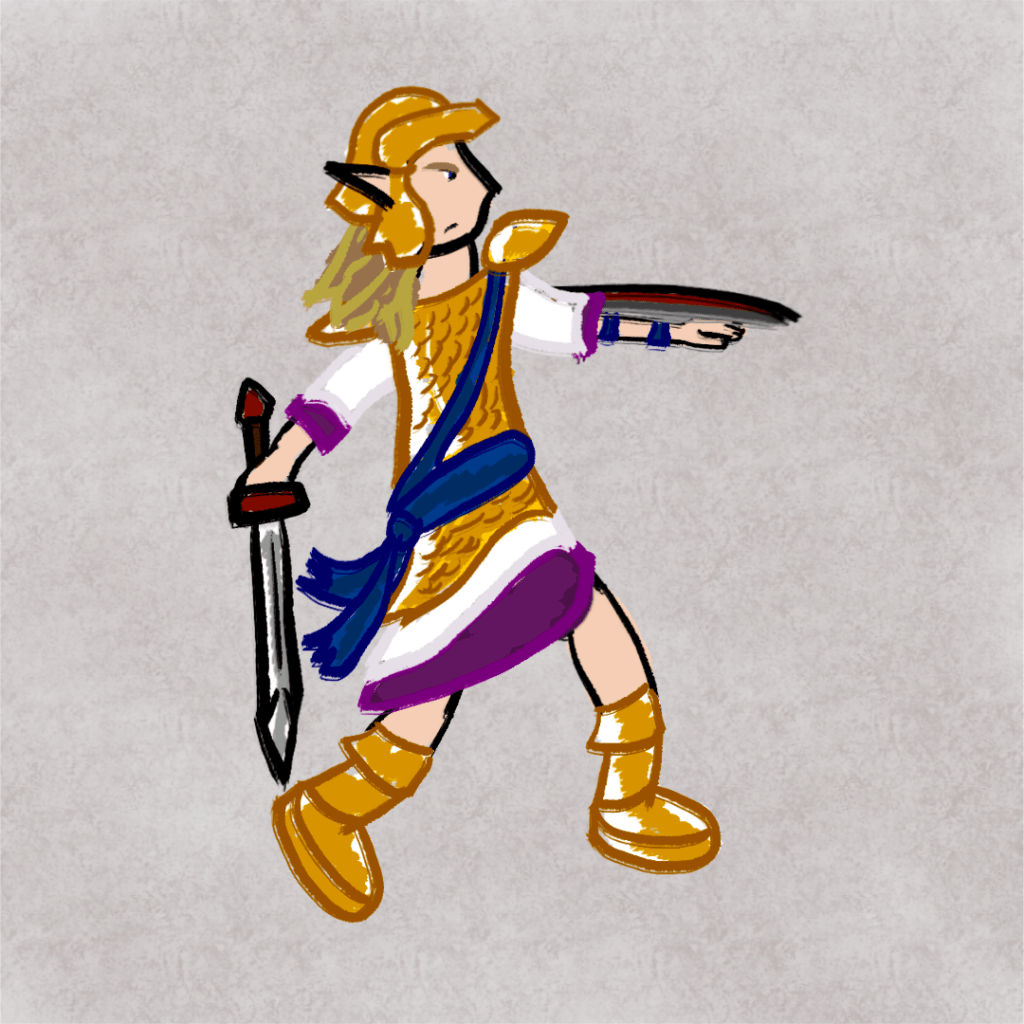
God of war, bravery, chivalry, and farming,
patron of soldiers and farmers
Elder twin son of Aeto and Iona, brother of Sephas, and the eldest of the second-generation gods of the Ennead, Valhas is mostly commonly associated with the title Prodromos, an ancient word meaning something like “Forerunner” or “Outrider”, referencing both that he is the eldest of the second-generation gods and that, as the god of war, he is the first to enter battle.
Like many of the gods of Ennead, Valhas is paired off with a counterpart deity. In this case, his twin brother Sephas, the god of wisdom and knowledge. Symbolically, this reflects that the two gods represent what was considered to the two aspects of the ideal man in the Elven Empire: strength and bravery tempered and complimented by wisdom and restraint.
Given the highly-militaristic nature of Imperial culture, Valhas was one of the most popular deities of the era. Formerly the patron god of the army of the Elven Empire, Valhas gradually came to be associated with chivalrous conduct in the centuries following the collapse of the Empire and the rise of formalised rules of chivalry and knighthood throughout the continent. Most frequently, Valhas is depicted in either the arms and armour of an ancient Imperial soldier, or that of a present-day knight.
Even during the Imperial era, Valhas was associated with dutiful service. Reflecting the Imperial army’s pattern of ending campaigns at the onset of the fall to allow soldiers to carry out the harvest during the fall, Valhas is also widely-venerated as a patron and protector of farms and agriculture.
Fittingly for a war god, Valhas is consistently portrayed in the mythology as the most prolific hero-god. Valhas frequently engages in battle with the forces of evil and often lends his aid or his divine panoply to questing mortal heroes.
Although the two are understand as having a familial bond rather than a romantic one, Valhas is commonly depicted battling alongside Pherais, a goddess also associated with heroic errantry and striving against evil.
Although fierce, Valhas is viewed as benevolent protector-god. Although severe, he is not without mercy to defeated enemies. He is specifically the god of just and honourable conduct in warfare, not a god of simple violence for its own sake.
In the ancient Elven capital of Imperialis, there was a temple dedicated to Valhas whose doors were symbolically opened when the Empire was at war, and ceremonially closed with great pomp and celebration when peace had been achieved. It was said that the opening of the temple doors allowed Valhas to sent forth his righteous wrath against the Empire’s enemies, while the closing of the gates allowed his protective presence to remain over the city.
The temple still exists in present-day Imperialis and is still functional, though the current Senate of the city-state of Imperialis has had the Doors of Valhas permanently sealed shut as a symbolic statement of the city’s peace, prosperity, and independence. Several smaller entrances at the sides and back of the building allow for free entrance and exit of the temple.
Despite this, Imperialis has been involved in several wars since this decree was made…
As it happens, “Valhas” is one of the first Fantasy-y names I ever dreamed up.
And, no, the similarity to Valhalla is not deliberate. Valhalla is “hall of the slain“, ultimately from a Proto-Indo-European root for “wound”.
Valhas, is, like I said, pure J.B. Norman, though repurpose here thanks to trying to give all my god-names plausible etymological roots. In this case, the Proto-Indo-European for “strong.” That it resembles words like “valour” is a consequence of the shared etymology.
The h is mostly there to differentiate the two syllables.
Valhas is probably most directly based on the Roman Mars. Unlike Ares, who’s basically just the god of killing the other guy, Mars is more associated with military and civic service and is decidedly more benevolent — though still not necessarily particularly nice.
The ceremonial gates that open during war and close during peace are a reference to the real life Gates of Janus, who, while not a war god, is the god of beginnings and endings.
The Gates of Janus are one of my favourite Roman rituals and this isn’t the first time I’ve included a parallel in a Fantasy world I’ve been writing. Also, Augustus boasting of closing the Gates of Janus three times is one of my clearest memories of working on a Latin text — specifically Augustus‘ Res Gestae, literally his “Things Have Been Accomplished”.
Finally, the pose and outfit in that depiction of Valhas is broadly based on the painting of Aeneas and Turnus I’ve used previously:
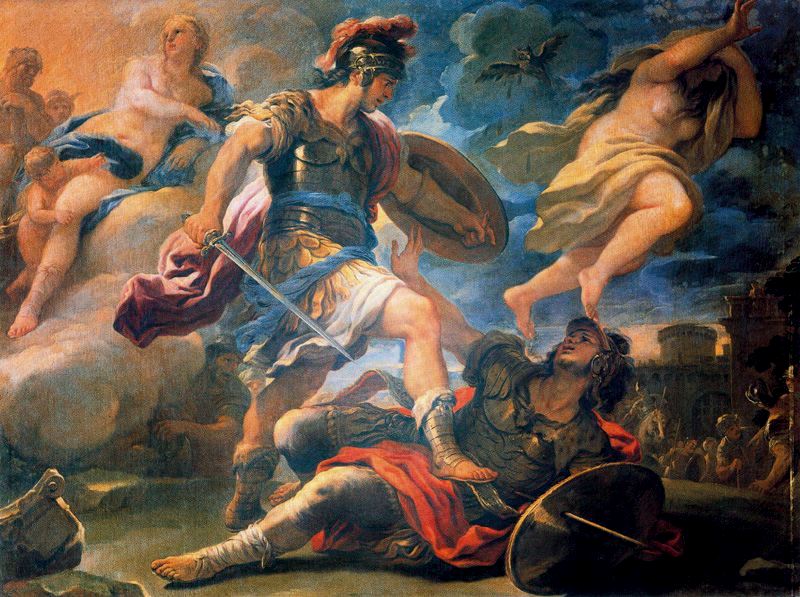
Aeneas and Turnus: Luca Giordano. via Wikimedia Commons. Public domain.
