Treza,
Mistress Ever-Turning
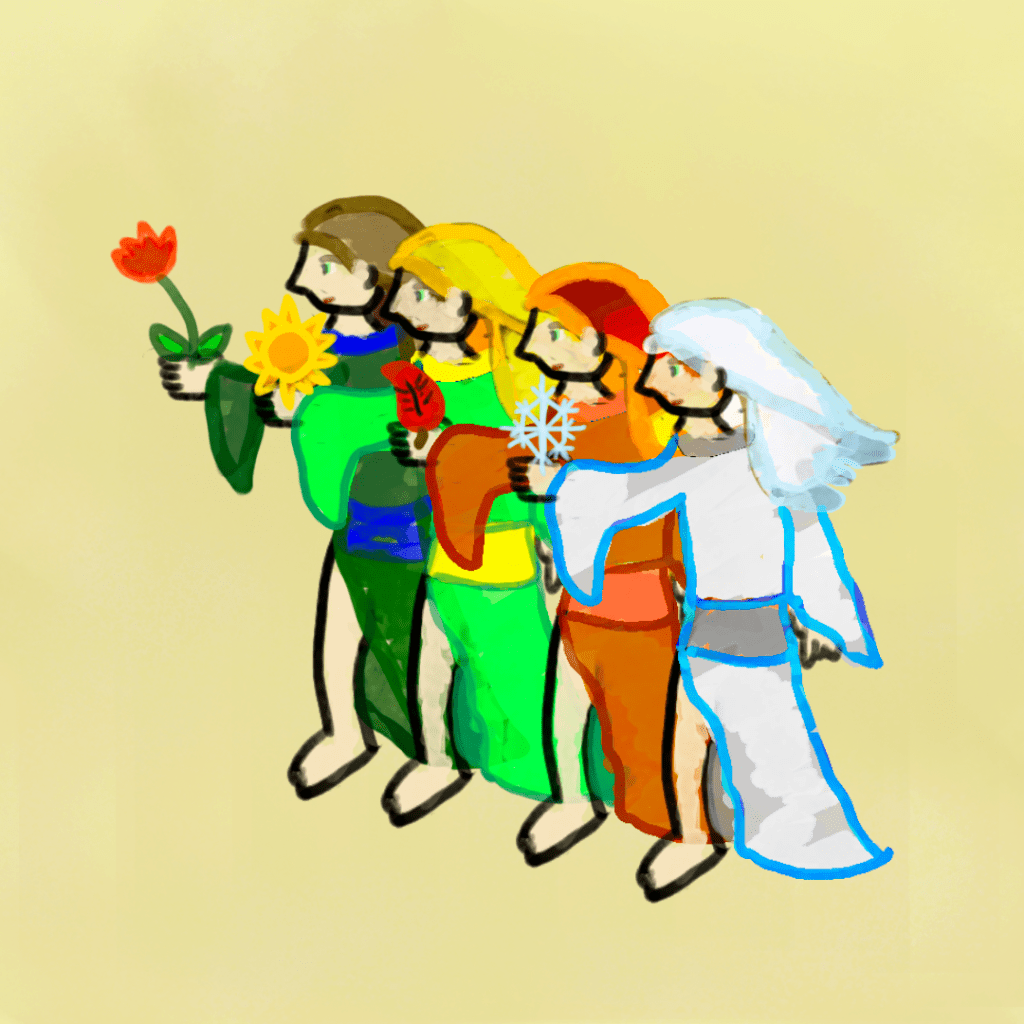
Goddess of the seasons, new beginnings, the wild, the harvest, and hunting, patron of farmers, herdsmen, and hunters
Originally entering the mythological accounts as adversaries to the Ennead, the origin of the nature goddess Treza and her daughters Misa and Cora are vague and uncertain. It is simply established that the three goddess arrived to the world of Terrace from elsewhere. While coming from the Distant Verdant Star as the gods of the Ennead originally did is likely most probable, it is never made clear in any existing account.
Upon arriving in Terrace, the three nature goddess prepared to contend with the gods of the Ennead for mastery of the world. Ultimately, the looming conflict was averted when it was agreed that the two groups of deities would enter into a marriage alliance. Treza married Akmon the blacksmith god, Misa married Sephas the god of wisdom, and Cora married Valhas the war god.
Some scholars suggest that this is meant to reflect ancient Realmgardian civilisation adopting worship of foreign deities as was, for example, the case with the spread of worship of the Melkartite sky goddess Malketa. However, this is complicated by the fact that Treza and her daughters cannot be easily identified with any known foreign deities. It is thus suggested that Treza and her daughters were deities introduced by an ancient culture which was ultimately absorbed and subsumed into the wider ancient Realmgardian culture.
This is, however, purely speculative.
The three nature goddess are not considered members of the Ennead, though they are worshipped as major deities throughout Realmgard and are, of course, united with the Ennead via marriage. Incidentally, Treza was the deity with the most festivals held in her honour on the calendar of the Elven Empire, thanks to her association with the changing seasons, each individual season, and many seasonal activities.
Among Treza’s numerous minor patronages are such things as: the first sowing of the year, the growth of grain, the olive harvest, the grape harvest, the waterlemon harvest, the trees losing their leaves, the first snowfall of the year, snowball fights, skiing, ice fishing, New Year’s Eve, New Year’s Day, and the shearing of sheep.
Due to her association with the changing seasons, depictions of Treza vary widely to reflect her as the patroness of each individual season. Sometimes, the goddess is symbolically depicted with four faces, one for each season, or as four individuals.
As goddess who are all themselves mothers, Treza, Iona, and Erha are sometimes venerated as a triad of patrons of motherhood.
However, Treza’s two most prominent domains are the harvest and hunting and she is invoked to bring bounty from both. Treza allows the mortal peoples of Realmgard to take what they need from nature, but is ruthless in her wrath against those who wantonly despoil the natural world out of greed.
Treza is understood as a force of both generation and destruction, an endless cycle not unlike the turning seasons of which she is also patron. To reflect this, Treza’s son by Akmon, Azidos is the god of forest fires, who clears away old forests to allow for new growth.
Now, I’m basically treating “Treza” as basically being pronounced like “Theresa” with one less syllable — like tres-ah. Incidentally, “Theresa” is apparently derived from the Greek word for Summer, which is apropos for the goddess of seasons, but not deliberate.
The etymology here is a combination of the Proto-Indo-European root for “turn”, combined with the root for “to create or give birth”, has was come down to several later languages — primarily Iranian and Iranian-influenced langugages; for example, ancient Parthian and Sogdian and modern Kurdish and Persian — as a za-stem, rather than the ge-stem more common in European languages.
Like I mentioned yesterday, Treza and her daughters first appearing as rivals to the Ennead is based on the Aesir-Vanir War, which is actually pretty poorly-articulated in the mythology for how important is apparently was.
The whole “depicted as four people” isn’t supposed to mean that Treza actually is four people simultaneously. It really is supposed to be an artistic way to represent that she is the goddess of all four seasons.
I actually mostly got the idea from the Warhammer Wood Elves, who are closely associated with the seasons within the in-game lore. In fact, I remember reading an article on the Games Workshop website years ago focusing on how to implement different painting schemes to incorporate the whole “powers change with the seasons” thing.
Incidentally, that Tereza has a son who is the god of forest fires was inspired by an examination into the etymological origins of the name Loki, as well as those of his parents — suggested to be a tree goddess and a lightning god — suggest that Loki was at some point associated with the phenomenon of fires started specifically by lighting strikes on trees.
Quick sidebar: despite the Pop Culture conception, largely thanks to Marvel, Laufey is actually Loki’s mother, not his father…
Though, for what it’s worth, that Loki is called “Laufeyjarson” is unusual, given that basically ever other instance of “Somebody, Somebodyson” refers to that Somebody’s father…
Quick reminder: new chapter went live earlier today:
Follow me here:

This work is licensed under a Creative Commons Attribution-NonCommercial-NoDerivatives 4.0 International License.
The author prohibits the use of content published on this website for the purposes of training Artificial Intelligence technologies, including but not limited to Large Language Models, without express written permission.
All stories published on this website are works of fiction. Characters are products of the author’s imagination and do not represent any individual, living or dead.
The realmgard.com Privacy Policy can be viewed here.
Realmgard is published by Emona Literary ServicesTM
