Vysa,
Mistress of the
Twenty Black Birds
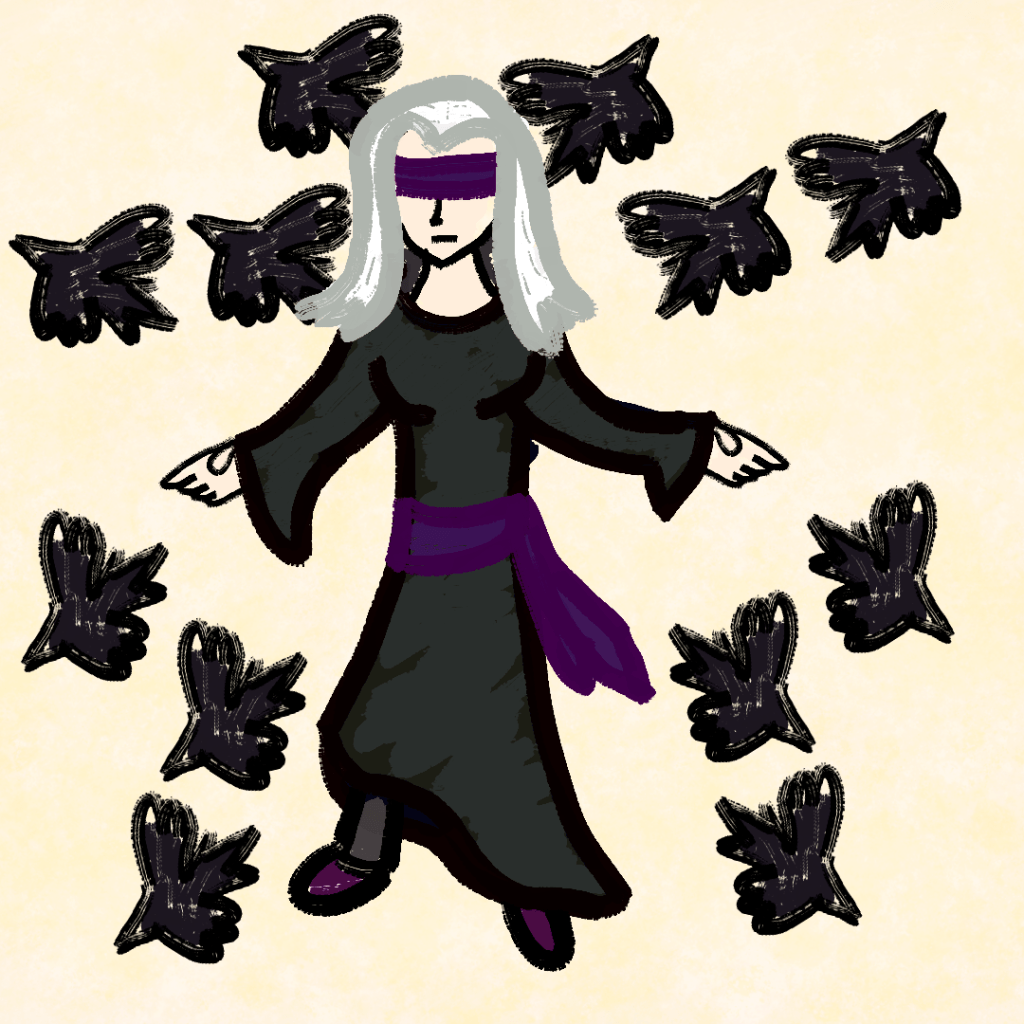
Hrimfaxi goddess of magic, wisdom, secrets, and strategy & tactics, head of the Hrimfaxi gods
Mother of Thonadis and Bhela, and chieftess of the Hrimfaxi gods, Vysa is primarily associated with magic. Magic, in turn, is viewed in traditional Hrimfaxi society as a feminine pursuit — albeit less so in recent times, though it remains viewed as a less honourable craft than straightforward strength of arms, especially when studied by men.
Even so, like the majority of the gods worshipped in Hrimfaxi, Vysa has a warlike aspect. Specifically, she is the patron of strategy and tactics and the use of deception and cunning in battle. While underhanded tactics are disdained in personal combat among Hrimfaxi warriors, clever stratagems in warfare are seen as an inevitable aspect of making war and particularly audacious or clever tactics are often memorialised in Hrimfaxi songs and sagas.
In this aspect of her character, Vysa is said to be the inventor of the chess-like wargames popular in Hrimfax, the so-called Table Games. While less well-known than traditional chess on the continent, due to the vast breadth of Hrimfaxi trade routes, conquests, and settlements, these Table Games have spread throughout Realmgard at large.
Generally depicted as a mature woman with grey or greying hair, Vysa is often described — and portrayed in visual artistic depictions — as either blindfolded or with blind (and sometimes even missing) eyes, representing that the goddess’ greatest strength is her knowledge of magical secrets not widely known to mortals. There is little mythological evidence that Vysa is to be understood as actually blind — and if she is, it is only because she emphasises vision of the arcane, spiritual world over the material plain.
While magic is her primary domain, Vysa is associated with the pursuit of knowledge in general. She is said to be attended by a flock of twenty black birds — whether this means literal blackbirds or merely birds with black plumage, perhaps crows or ravens, is unclear. Similarly, the number “twenty” is not usually interpreted literally and is taken to be shorthand for “a flock of birds.” Nevertheless, twenty is thus considered an auspicious number in Hrimfaxi culture.
Vysa sends out these birds every morning to observe the world and they report back every night with tidings.
Similarly, many Hrimfaxi myths tell of Vysa adopting the guise of an unassuming wizened old woman to travel the mortal world to glean what secrets she can from the minds and hearts of mortals. She is often said to test the mettle and honour of mortal heroes in this guise by sending them on heroic quests, or else presenting herself as a helpless old woman in need of aid.
Those who succeed in these tests of character are rewarded with power, glory, and the sharing of Vysa’s secret wisdom. Those who fail or else displease her are said to languish for the rest of their days under inexorable curses brought forth by her powerful magic craft.
Much as Thonadis is generally understood as the Hrimfaxi name of Pherais, Vysa is usually identified with Iona — though Realmgardian scholars have struggled to reconcile the discrepancy this creates due to the fact that Pherais is Erha’s daughter, not Iona’s.
In Norse culture, magic (seiðr; that ð is basically “th”, so it’s pronounced something like “say-thur”) was basically viewed as an inherently womanly thing. Nevertheless the primary god of magic was Odin. Consequently, there’s at least one instance of Loki making fun of Odin for dressing up like a woman and prancing around doing magic.
Incidentally, Odin’s rebuttal is that this is cheap talk coming from the guy who is the mother of his horse.
It’s, uh, it’s a long story…
All of this is to say is that, under such a worldview, it almost makes more sense for the primary deity of magic to be female. And, indeed, the other Norse god most associated with magic other than Odin is Freya (who may or may not be supposed to be the same individual as Odin’s wife Frigg; but that’s neither here nor there).
And all of that is to say that Vysa is basically Female Odin in the same way Thonadis is Female Thor.
“Vysa” is from the Proto-Germanic for “wise“, and given the whole ‘blind sorceress’ angle, consciously trying to avoid looking too much like Knights of the Old Republic character Visas Marr — whose name is apparently derived from the phrase “Vision Marred”. As it happens, the Proto-Germanic word for “wise” is ultimately derived from in turn the Proto-Indo-European for the verb for “to see”, which is ultimately the etymology of “vision”…
Again, the parallel isn’t really deliberate, especially because, like I’ve established in the write-up, Vysa being blindfolded is mostly a metaphor.
Hrimfaxi chess is a reference to the real life Tafl Games — “tafl” just means “table”; I translated it for ease of pronunciation. While the Tafl games are not the same game as standard chess, there are also well-known examples of Norse chess sets — most famously the Lewis Chessmen, most famously the Berserker rook biting his own shield.
While Vysa having sending out black birds to learn about the world is a reference to Odin’s ravens, and her having twenty of them ultimately stems from I joke I’ve made that if I were a knight, my coat of arms would be twenty crows, and my primary tactic in battle would be to tell my enemies that there weren’t twenty and then stab them while they were counting…
Finally, the line about interpreting Vysa as Iona not making sense is inspired by the fact that the intrepatatio graeca doesn’t always make sense. For example, Thor was associated with Zeus/Jupiter and Odin with Hermes/Mercury. The problem with that interpretation is that Zeus is Hermes’ father, but Odin is Thor’s father.
