Bhela,
Shining One
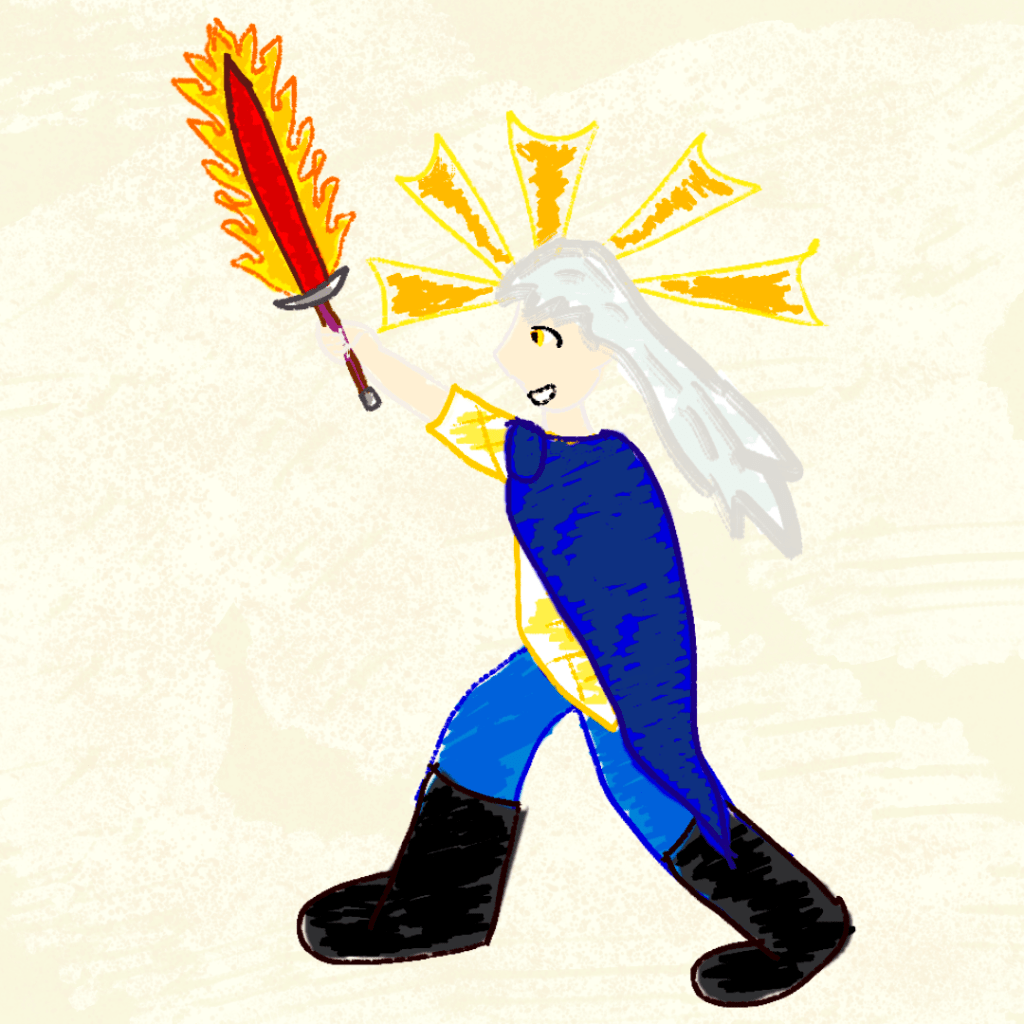
Hrimfaxi god of light, beauty, love, art, poetry, and valour
Son of Vysa and brother of Thonadis, as well as the father of numerous minor deities and demigods by various mothers, Bhela is generally regarded as the most benevolent of the Hrimfaxi gods. Although depicted in the myths as gentle and compassionate, Bhela is not soft or weak. Like the majority of the Hrimfaxi gods, Bhela is a warrior-god and is venerated as the ideal model of Hrimfaxi manhood and martial conduct. He is strong and brave, yet compassionate and just. He is handsome and good-natured, yet fierce in battle against his enemies. He is a master of both arms and artistry.
The minor deities representing the various aspects of warfare and strength of arms are said to be the children of Bhela by his sister’s Valkyries. Similarly, many Hrimfaxi noble families claim descent from a demigod hero sired by Bhela in ancient times — while many others have contrived largely-implausible genealogies to tie themselves to the bloodline of such heroes, whether real or imagined.
Perhaps because of his own prolific success where romance is concerned, Bhela is also venerated as the Hrimfaxi god of love and traditional Hrimfaxi wedding ceremonies take place at the feet of a statue in his likeness.
Where oak trees are considered sacred to his sister, Bhela’s sacred plant is mistletoe. It is said that the Giant sorcerer Strangur the Undying magically compelled oaths from every substance in the world never to cause him harm. Thus invincible, he came close to overthrowing the Hrimfaxi gods, until Bhela felled him with an arrow carved from mistletoe. In his arrogance and perceived invincibility Strangur had neglected to extract such a vow from the unassuming plant, thus leaving mistletoe as the one thing capable of doing him harm.
Although Thonadis is recorded in more mythological accounts doing battle with the Giants and other evil creatures than her brother, Bhela is also known for his errantry throughout the mortal world. Much like Thonadis does battle with her golden axe, Bhela wields a flaming sword named Logatonn, which he is said to lend to particularly worthy mortal heroes.
Conversely, Bhela is also associated with artistic pursuits. Also reckoned the Hrimfaxi god of beauty, Bhela is as frequently depicted as a poet and singer — the Hrimfaxi word is “skald”, roughly equivalent with “bard” — as he is a warrior. Bhela is as closely associated with his harp as with his flaming sword and his skill with his harp is emphasised just as much, if not moreso, as his skill with his sword.
Invariably depicted as handsome and finely-dressed, Bhela is also venerated as a god of personal grooming and aesthetics. Despite the reputation of Hrimfaxi Vikings as crude, unkempt barbarians, the truth of the matter is that Hrimfaxi men have historically been known as fastidiously committed to personal grooming and good hygiene. In fact, the most common item to be found in ancient Hrimfaxi graves is combs, and during the period of Hrimfaxi dominion over Middelmere, there are numerous written accounts by Middelmerish men fretting over the possible Middelmerish women being seduced by handsome, well-groomed Hrimfaxi Vikings, rather than settling down with good, honest, hardworking Middelmerish men.
Though, on the other hand, there are also numerous accounts of Middlemerish men courting young Hrimfaxi maidens…
Like Thonadis being associated with Pherais and Vysa with Iona in scholarly attempts to fit the Hrimfaxi gods into the context of the Realmgardian religion, Bhela is understood as being the Hrimfaxi name for the Realmgardian war god Valhas.
Essentially, Bhela is Frey, Freya, and Baldur combined into one god.
Frey and Freya are both love and fertility gods — not shocking that there’s overlap given that they’re twins. And Baldur is light, beauty, and goodness/justice/virtue, essentially.
Baldur is described and depicted as being almost pure white. We’ve established that I’m not good at pinning down skintones using RGB colour codes, but I did try to make Bhela look pale and fair-skinned.
Also shiny. Baldur also often has what is basically a halo.
Baldur was famously killed by a mistletoe spear/dart/implement of hurting. Bhela killing a giant with a mistletoe spear/dart/implement of hurting is sort of a meta in-joke based on that. With maybe a bit of Lugh killing Balor of the Baleful Eye in Irish mythology…
The flaming sword isn’t really a reference to anything mythological (though the Fire Giant king Surt does have a flaming sword, possibly the same one as Loki’s…), it’s mostly just there because it’s cool.
“Bhela” is ultimately inspired from the Proto-Germanic for “brave“, instead from the Proto-Indo-European for either “to speak (loudly)” or “to embiggen” — which is, incidentally, ultimately the etymology for Baldur.
“Bhela” doesn’t really resemble a Norse masculine name. There are Germanic (particularly Visigothic) male names that end in -a, but not really Norse names that do. Fundamentally, I’m treating it as the Hrimfaxi equivalent of a masculine First-Declension Latin noun — basically, a word that looks grammatically feminine but is grammatically masculine, like, for example, agricola, which is also a name…
Really, my reasoning here is that I liked the way “Bhela” sounds without adding a consonant to the end. Plus, “Bhelen” is already a Dragon Age name…
I was tangentially inspired by the name “Bleda“, Attila the Hun‘s brother, but really only in so far as the sound of the name than anything to do with Bleda himself…
Finally, combs actually are the most commonly-found artifact in Viking graves.

This work is licensed under a Creative Commons Attribution-NonCommercial-NoDerivatives 4.0 International License.
The author prohibits the use of content published on this website for the purposes of training Artificial Intelligence technologies, including but not limited to Large Language Models, without express written permission.
All stories published on this website are works of fiction. Characters are products of the author’s imagination and do not represent any individual, living or dead.
The realmgard.com Privacy Policy can be viewed here.
Realmgard is published by Emona Literary ServicesTM
