Raudfjall,
Lord of Burning Mountains
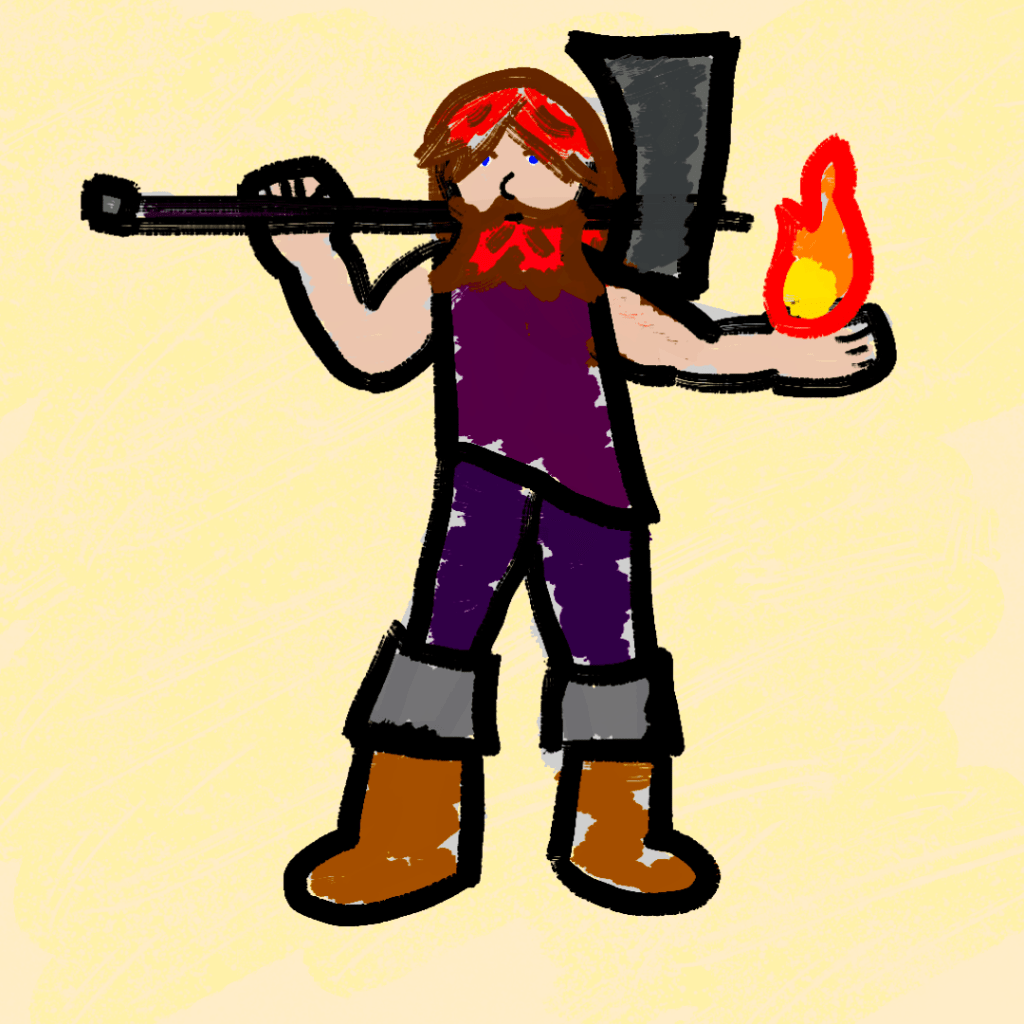
Hrimfaxi god of the forge, fire, volcanoes, metal & minerals, heat, warmth, and summertime
A kinsman of some description to Thonadis, Vysa, and Bhela, though the exact relation is unclear and contradictory, Raudfjall is a prominent god in Hrimfaxi mythology and folklore given his association with volcanos (abundant in and around the island of Hrimfax) and the forging of arms and armour (abundant among the warriors of Hrimfax).
As the god of fire, Raudfjall is understandably portrayed as an especially bitter opponent of the Frost Giants who constantly harry mortals and gods alike. Viewed as the god best-suited as keeping ice and cold at bay, Raudfjall is also venerated among the Hrimfaxi as the god of summertime — and while he is associated in particular with things made of metal, through his connection to heat and warmth in general, even warm blankets have come to be associated with Raudfjall.
Given how long and cold Hrimfaxi winters are, this has led to Raudfjall becoming a very popular, very frequently-invoked god among the people of Hrimfax. However, Raudfjall is depicted as having a rather complicated relationship with mortals.
Aloof and hot-tempered, earthquakes and volcanoes are attributed to Raudfjall one way of another: either the echoing of his hammer sounding on his anvil in his subterranean forge deep in the heart of the earth, or else the outpouring of his fiery temper and indignation.
On the other hand, he is said to have a certain soft spot for mortals, though he is by no means a particularly gentle god. Although volcanoes and earthquakes are dangerous and destructive and Raudfjall is generally said to leave mortals to their fate, these natural calamities are said to be how Raudfjall tests the wills of mortals and in return, these very volcanoes bestow fertile volcanic soil and valuable, useful minerals and materials upon mortals with the strength of will to harness them.
Most mythical objects are said to have been forged by Raudfjall and given to the other gods: Thonadis’ hammer, Bhela’s flaming sword and harp, the Valkyries’ arms and the bridles of their horses. Several of Hrimfaxi folklore’s most prominent mortal smiths are said to have been taught their craft by Raudfjall himself, allowing them to create peerless masterworks of arms and armour.
Similarly, various striking natural features of Hrimfax’s geography are said to have been created by Raudfjall, chiselled out of the living rock of the island by his hand and eye as a testament to his skill. The largest volcano on Hrimfaxi is known as Raudfjall’s Throne and is set to lead directly to his forge beneath the earth. Though, for obvious reasons, there is no way to test the truth behind this myth.
Raudfjall has perhaps the clearest parallels to a Realmgardian god, being easily interpreted by Realmgardian scholars as the Hrimfaxi name for the god Akmon of the Realmgardian Ennead. Indeed, there is much clearly overlap between the two deities and few of the contradictions and inconsistencies are present when associating Raudfjall with Akmon, which are commonly found elsewhere in such attempts to filter the Hrimfaxi gods through Realmgardian custom and practice.
Most languages don’t really have a word for “volcano”, it’s either a descriptive noun translates to something like “fire-mountain” or it’s just the Latin “volcano” rendering into the local language.
All of this is to say “Raudfjall” is literally (mostly via Icelandic, albeit with certain linguistic liberties) “Red Mountain“, which seems like a decent word for “volcano” considering the above. Incidentally, the real Icelandic word for volcano is either “eldfjall” (“fire mountain”) or “eldstöð” (literally “fire station”, but based on the etymology, I think it’s conceptually something like “thing on fire which is standing”).
To clarify, in most languages other than English, J is pronounced like Y, so “fjall” goes something like “fee-all” in Old Norse (the translation I’m basing the name on) and incidentally, something like “fee-ought” in Icelandic.
The real Norse forge god is Wayland (exact spelling varies between languages and translation choices), who is not an especially major figure in the mythology. My main inspiration here is the fact that there are a lot of volcanoes in Iceland.
Since Hrimfaxi is basically Iceland embiggened to the size of Scandinavia as a whole, I started with the volcano angle and sort of worked backwards from there to establish what else a volcano god would be god of.
As always, follow me here:

This work is licensed under a Creative Commons Attribution-NonCommercial-NoDerivatives 4.0 International License.
The author prohibits the use of content published on this website for the purposes of training Artificial Intelligence technologies, including but not limited to Large Language Models, without express written permission.
All stories published on this website are works of fiction. Characters are products of the author’s imagination and do not represent any individual, living or dead.
The realmgard.com Privacy Policy can be viewed here.
Realmgard is published by Emona Literary ServicesTM
