Lassflyja,
She Who Has
Never Been Caught
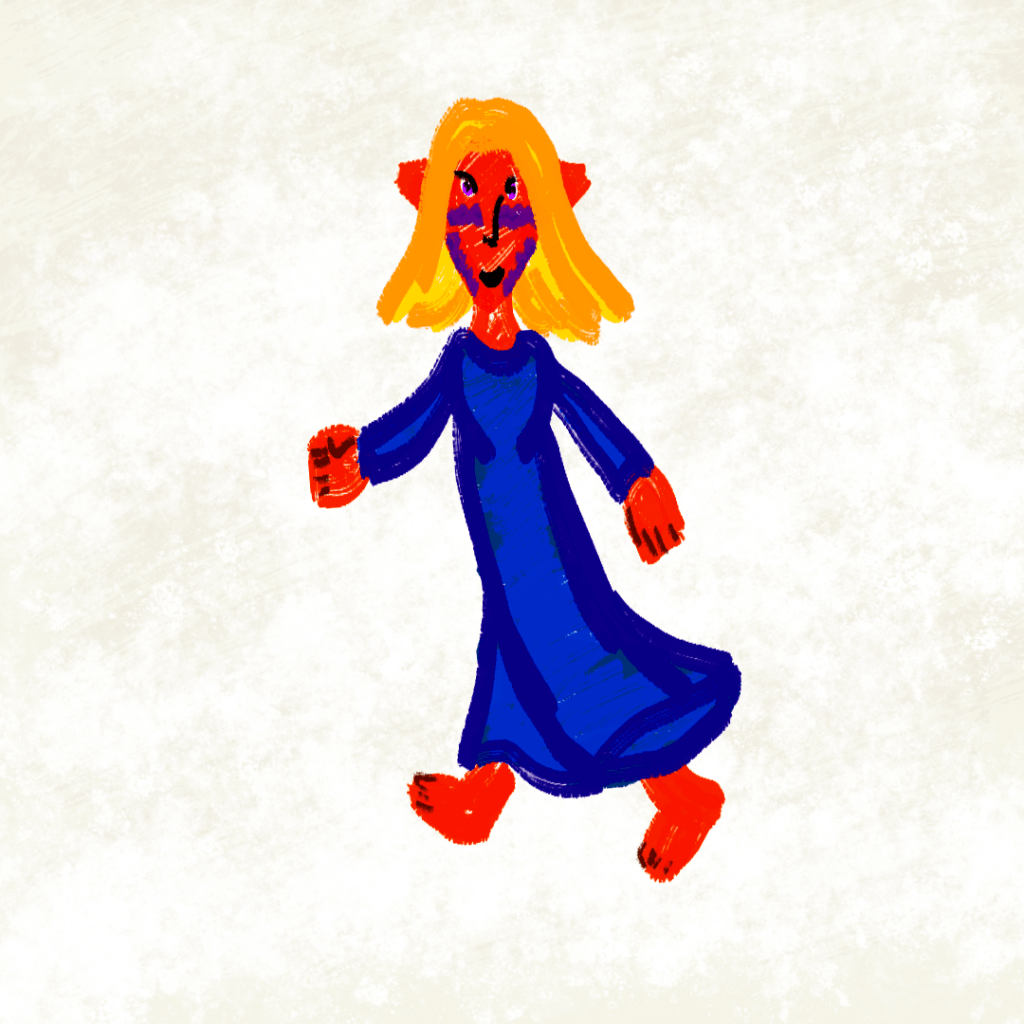
Hrimfaxi god of mischief and trickery
Understood not to originally be a member of the tribe of the Hrimfaxi gods, Lassflyja is often depicted as a Troll woman, though her exact origins are unclear in the mythological accounts, further complicated that the mythological term “Giant” is unhelpfully vague. Thus, even defining Lassflyja as being of Giant origin does not really help to elucidate the matter.
Irrespective of her exact origins or nature, it is established in Hrimfaxi mythology that Lassflyja came to counted by the other Hrimfaxi gods as one of their own, being essentially adopted into the tribe of the gods.
While neither married nor related by blood to any of the other gods, Lassflyja is depicted as a friend, companion, and gaming partner to chieftess of the gods Vysa, due to their shared affinity for elaborated strategy and tactics. Notably, Vysa is the only one of the gods consistently depicted as able to influence Lassflyja to behave herself, if only briefly.
A mischievous and capricious, though not especially malicious, figure, Lassflyja delights in pranks and acts of trickery, occasionally making a nuisance of herself to the other gods. However, the most common targets of her chicanery are the Giant enemies of the gods. Lassflyja’s name is Hrimfaxi for something like “She Who Slips Locks”, referring to the fact that she is constantly portrayed as evading capture or imprisonment by her pursuers — again, most often vengeful giants, but occasionally the other gods when they have lost patience with her.
Associated with the colour red (and, due to being understood as a Troll, often depicted with red skin) and with sly cunning, it is not surprising that Lassflyja is associated with foxes and is said to take on the form of a fox as she travels throughout the mortal world for her own inscrutable ends.
In Hrimfaxi myths, Lassflyja is depicted as the deity who most frequently interferes in mortal affairs, largely as a means of amusing herself through upending mortal affairs. While rarely malevolent, Lassflyja is known to rescind her aid to mortals just as freely and easily as she gives it in the first place. Conversely, there are also certain myths which depict her as an unambiguously benevolent figure, using her wiles to aid innocent mortals against their oppressors, or else giving mortals the means to do so themselves.
A dish consisting of fermented shark is considered a delicacy in Hrimfaxi, well-known as culinary oddity — and source of nausea — through Realmgard at large. The origin of this is ultimately attributed to Lassflyja; the only explanation for burying the carcass of a shark on the beach for several weeks for the purposing of human consumption generally being a prank played on mortals by the intervention of a mischievous goddess.
While her status as an outsider who joined the tribe of the gods parallels Realmgardian myths of Treza, Misa, and Cora, Lassflyja is most often viewed as the Hrimfaxi form of the capricious and cheese-loving Realmgardian goddess Anassa — an association which has, in turn, led to her being seen as a patron of Hrimfaxi cheesemakers and cheese-sellers.
She’s basically a kinder, gentler Loki.
“Lassflyja” is slightly modified Icelandic and/or Old Norse combining the words for “lock” and “to flee“. It’s pronounced something like “Loss-Flee-Ya.”
Again, it should have accents, but I think that over-complicates things, especially when I can just explain the pronunciation.
“She Who Slips Locks” may be a prosaic translation, but it is the semantic sense I’m trying to convey with the name, establishing that she’s basically uncatchable. The “She Who Has Never Been Caught” title is a kinda-sorta reference to Tom Bombadil, who boasts of — in addition to some snazzy yellow boots — the fact that “none has ever caught him yet.”
And, honestly, Lassflyja, probably skews more Tom Bombadil “Bewildering but helpful” than Loki “Killed Baldur for kicks”…
Her being (depicted as) a Troll is a reference to Loki being a Jötunn — which is usually rendered in English as “Giant”. The explanation that “Giant” is an ill-defined term is also true of Norse mythology in real life — the lede of the Wikipedia articles note that “Jötunn”, “Troll”, and “Giant” are all applied to the same species and the categories between species in Norse Mythology aren’t always clear (cf. how exactly Dökkálfar, Svartálfar, and Dwarves are or aren’t different names for the same thing).
Notably, while there are big Jötnar (that’s the plural, FYI), not every Jötunn is inherently big as a matter of course, and there are female Jötnar who are famously beautiful.
The fact that humans draw her as a Troll doesn’t necessarily mean that she is actually a Troll. Incidentally, I think I need to work out a better process for drawing Trolls.
As it happens, fermented shark is a delicacy in Iceland — that apparently smells like death and tastes like grievous injury.

This work is licensed under a Creative Commons Attribution-NonCommercial-NoDerivatives 4.0 International License.
The author prohibits the use of content published on this website for the purposes of training Artificial Intelligence technologies, including but not limited to Large Language Models, without express written permission.
All stories published on this website are works of fiction. Characters are products of the author’s imagination and do not represent any individual, living or dead.
The realmgard.com Privacy Policy can be viewed here.
Realmgard is published by Emona Literary ServicesTM
