Sauvaherra & Tulva,
Song-Lord & Maiden of the
Smoking Waters
Auroean Folk-Heroes
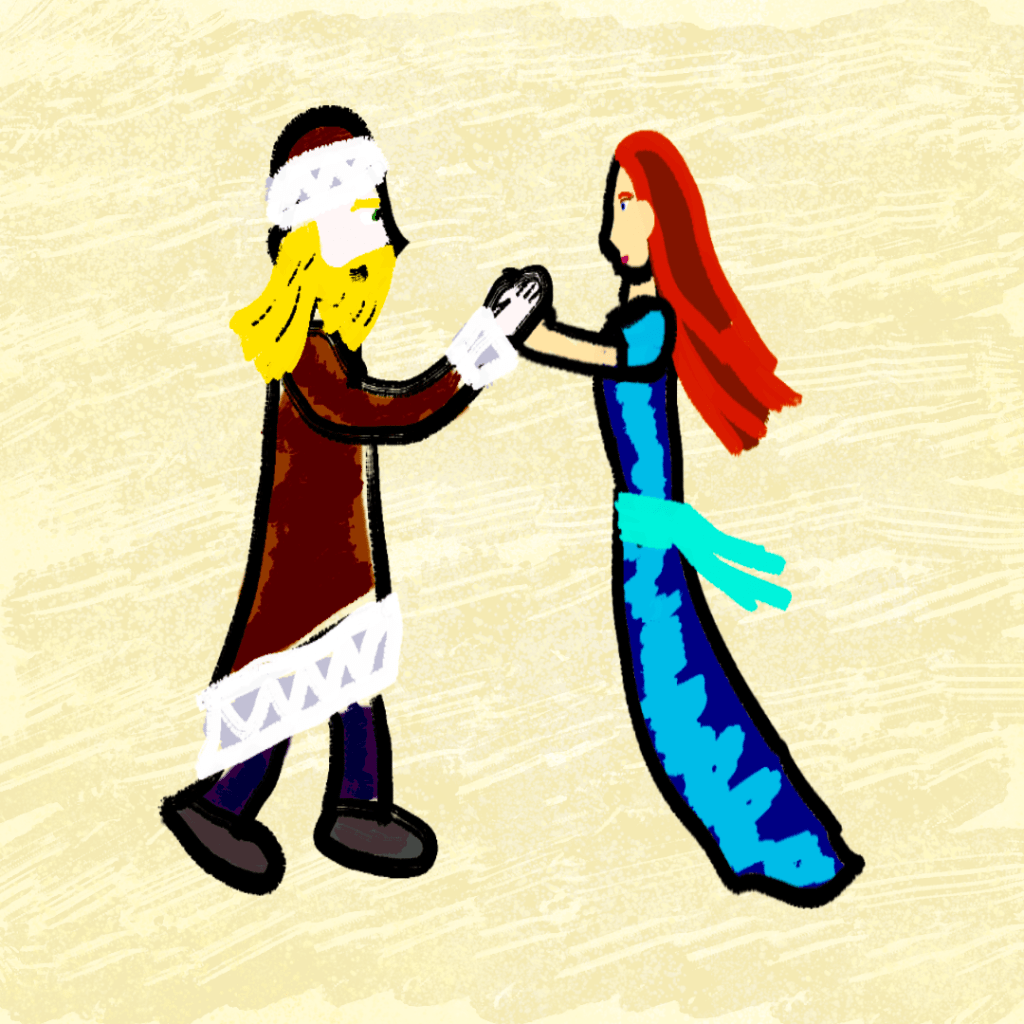
Two of the central figures in the best-known cycle of Aurorean folklore, Sauvaherra and Tulva are depicted as a pair of lovers who must overcome great adversity and calamity before finally getting their happy ending.
Sauvaherra is a demigod hero, a wanderer who sings magic songs. The son of a minor sky deity described as one of the handmaidens of Nainen and either miraculously born without a father or fathered by the natural forces of the world, Sauvaherra was tutored in magic and song by various elemental deities, particularly the goddess of the air and sea, bestowing him with superhuman wisdom and ability.
Tulva is a fairly minor local deity, the daughter of the goddess residing on Mount Goldhorn and associated with the waterfall which pours down the side of the mountain. Despite this rather specific domain, Tulva’s place as the major heroine of Aurorean folklore allows her to loom large in the Aurorean pantheon.
Although Tulva is not widely worshipped as a major deity, Mount Goldhorn has become a site of pilgrimage and religious significance due to its association with her. It is considered auspicious for betrothed couples and newlyweds to make the hike up to the summit of Goldhorn to visit the mountain pool where Tulva is said to dwell.
The story at is most simple tells of how Tulva heard Sauvaherra’s song and was instantly smitten with the wandering wizard, but being a proud and haughty goddess, was unwilling to be the first to admit her feelings and thus attempted through various means to coax Sauvaherra into confessing first.
Before this could happen, Tulva was spirited away by the wicked Witch of the North Winds, herself jealously smitten with Sauvaherra. In the form of a great vulture, the Witch snatched Tulva from Mount Goldhorn and carried her off to the Lands Beyond Ice.
With the aid of the three major Aurorean gods — Nainen, Meren-Keihas, and Lumivittaa — as well as that of the Great Moon Bear, Sauvaherra was outfitted with magic arms and armour and set out for the Lands Beyond Ice. The Witch of the North Winds was defeated, Tulva was rescued, and the kingdom of Epäonninen sank into the sea — though the few innocents of the kingdom were rescued and brought to safety in Aurora by Meren-Keihas.
Against the backdrop of his quest to rescue Tulva, Sauvaherra features in various other adventures, encountering the various other famous heroes of Aurorean folklore and contending with all sorts of monsters and wicked creatures.
Outside of the quest to rescue Tulva, Sauvaherra’s most famous exploit is his capture of the great pike of the Silverstream River, which had alluded all other attempts to capture it and was a fish of such size and ferocity that it had become a threat to the villages of fishermen along the river. Using an enchanted iron fishhook, Sauvherra was able to reel in the great pike, which is said to have fed the villages along the Silverstream for the next year.
Sauvaherra, in turn, used the bones of the pike to craft his famous harp, which he is rarely depicted without.
Quick note to begin with: by moving on from the Hrimfaxi gods, I’m not implying that those five are the only Hrimfaxi gods. There are others, I’m just running out of days and there are other figures I want to write about before the end of the month.
Lest you have forgotten, Sauvaherra’s name was originally Sauvatonttu, which is “Wand-Elf”, which is “Gandalf.” Which is already spoken for…
I do think “Sauvatonttu” sounds better, but given that Elves are a defined, specific group in Realmgard, the mythological ambiguity of “Elf” doesn’t really apply. Sauvaherra is “Wand–Lord“, which at least does convey the sense I wanted of him being the best Wizard.
“Tulva” is “flood”, which is a good name for a waterfall goddess.
They’re basically a Väinämöinen and Aino (link potentially NSFW; she’s not usually depicted wearing clothes…) that are actually, mutually in love. The short version is that in the Kalevala, Väinämöinen wanted to marry Aino, she didn’t want to marry an ugly old man (he was in utero for 700 years and born an old man), she ran away, died, came back as a fish, and made fun of Väinämöinen…
There isn’t really a clear parallel with the Kalevala here and this really is a fairly generic “Boy Meets Girl” fairy tale that happens to take some cues from Finnish folklore.
Also, “Goldhorn” is actually inspired by Slovenian folklore. Goldhorn is the magic goat (“Zlatorog” in Slovenian; also a beer) that lives on Mount Triglav. There’s also a bit of a Lord of the Rings influence here — [Colour][Pointy Thing] is the basis for the names of several of the peaks in the Misty Mountains.
Stay tuned for a new chapter tomorrow. And follow me here:

This work is licensed under a Creative Commons Attribution-NonCommercial-NoDerivatives 4.0 International License.
The author prohibits the use of content published on this website for the purposes of training Artificial Intelligence technologies, including but not limited to Large Language Models, without express written permission.
All stories published on this website are works of fiction. Characters are products of the author’s imagination and do not represent any individual, living or dead.
The realmgard.com Privacy Policy can be viewed here.
Realmgard is published by Emona Literary ServicesTM
