I’d like to think I’ve made my feelings about J.R.R. Tolkien — the initials, of course standing for “John Ronald Reuel”; “Jonald R.” to his friends — quite exceedingly clear.

Photo by Donald Tong on Pexels.com
And, since the film trilogy based on his books is one of the greatest cinematic achievements of the 21st century, or ever, for that matter (Return of the King won all the Oscars), it shouldn’t really come as a surprise that I’ve been watching a bunch of clips from said movies, or that I’m getting a lot of Lord of the Rings-related recommendations on Youtube.
Now, I don’t usually like podcasts or video essays for two primary reasons: 1) most Internet personalities come across as complete and utter tools —

Photo by Anete Lusina on Pexels.com
— and 2) I learn better in writing. I retain things I read better than things I hear, and most simply, I can read faster than you can talk at me.
Basically, all of this is to establish that I was pleasantly surprised by this video from a Youtube channel called Empire of the Mind:
So, at this point, you’ve either watched or skipped the video itself. So, here’s some of my thoughts on said video.
The video itself snuck up on me outta nowhere.
Not unlike a certain Randal Keith Orton…
But I figured “Hey, I like Lord of the Rings. I like Anglo-Saxon poetry. Let’s give it a shot.”
And, yeah, I’m still not sold on podcasts and video essays in general, but I liked this one. A lot.
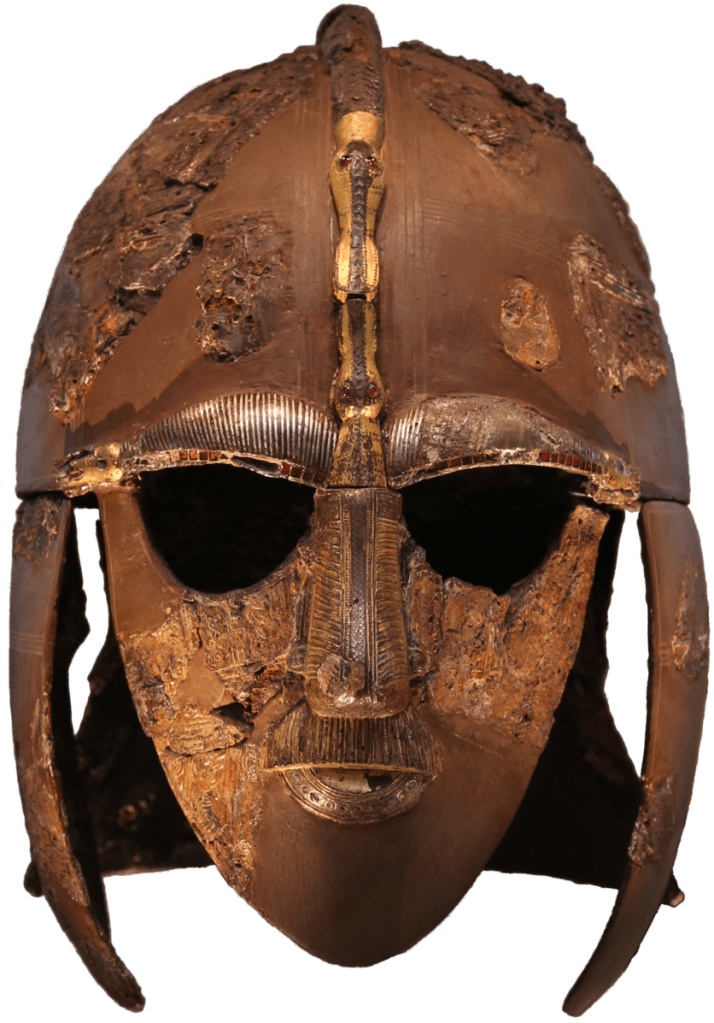
most famous Anglo-Saxon artifacts.
Currently housed at the British Museum.
Image via Wikipedia.
Reproduced under the Creative Commons
Attribution-Share Alike 4.0 International license.
To recapitulate some of the context here, the central thesis here is how Tolkien’s worldview in Middle-Earth reflects the longing and sense of loss in the Old English poem called The Wanderer. The narrator of poem wonders where all the faded glories of his past life before being reduced to lonely wandering have gone.
If that sounds familiar, that’s because Tolkien used basically the exact premise, and even paraphrased the words of the poem itself to capture the state of the Rohirrim:
“Where now the horse and the rider? Where is the horn that was blowing?
‘The Lament for the Rohirrim‘, from The Two Towers.
Where is the helm and the hauberk, and the bright hair flowing?
Where is the hand on the harpstring, and the red fire glowing?
Where is the spring and the harvest and the tall corn growing?”
Of course, it’s not exactly shocking that a professional Old English philologist would be influenced by an Old English poem. And it’s especially not surprising that he’d be influenced by the poem in the context of a fictional people who are themselves directly based on the Anglo-Saxons (I’ve also seen them described as “Horse–Vikings“).
So, TL;DR: pain.
Remember that, it’ll be important going forward…
The video is amazingly insightful for something that’s only 13 minutes long and does an amazing job explaining both Tolkien’s influences in general, and how Lord of the Rings is basically the Anglo-Saxon poem The Wanderer extended to 1200 pages.
One line in particular stuck with me, the idea that Tolkien’s works, despite being masterpieces of Fantasy, feel so real because “Tolkien had a higher dosage of reality than most of us”.
And, yeah, Tolkien did a whole lot of living.
Heck, his real life biography is more interesting than plenty of fictional characters living in larger-than-life Fantasy worlds. His dad died when he was a toddler, his mom got effectively disowned by her family for converting to Catholicism (despite the rolling back of most of the actual legal restrictions, early 20th century England was still not a great place to be Catholic) and then died when Tolkien was 12, he wasn’t allowed to have any contact with the woman who was essentially his one true love (and, incidentally, the reason why the most beautiful women in Middle-earth have black hair and grey eyes) until he turned 21, he almost died in World War I, most of his friends did die, and then he went on to become an influential Oxford scholar, plus, you know, the whole Lord of the Rings thing…
Also, he stole a bus once.

Photo by Oleg Magni on Pexels.com
Now, that’s not really laid out in the video, but the fact that Tolkien can write the human (or Elf, or Hobbit, as the case may be…) condition so well is because he had first-hand experience with most of the human condition is.
Mostly, it’s pain.
(See?)
And that gets tied back into The Wanderer basically being the quintessential Anglo-Saxon statement on the human condition.
So, yeah, watch the video.
It’s great and I’m not gonna lie, it made me tear up a little. And, if you’re curious about what else Empire of the Mind has going on, you can find more here, here, and here.
Check out an ever-growing list of other recommendations here.
This week’s chapter is here:
And check out my social media pages and email list below:

This work is licensed under a Creative Commons Attribution-NonCommercial-NoDerivatives 4.0 International License.
The author prohibits the use of content published on this website for the purposes of training Artificial Intelligence technologies, including but not limited to Large Language Models, without express written permission.
All stories published on this website are works of fiction. Characters are products of the author’s imagination and do not represent any individual, living or dead.
The realmgard.com Privacy Policy can be viewed here.
Realmgard is published by Emona Literary ServicesTM
