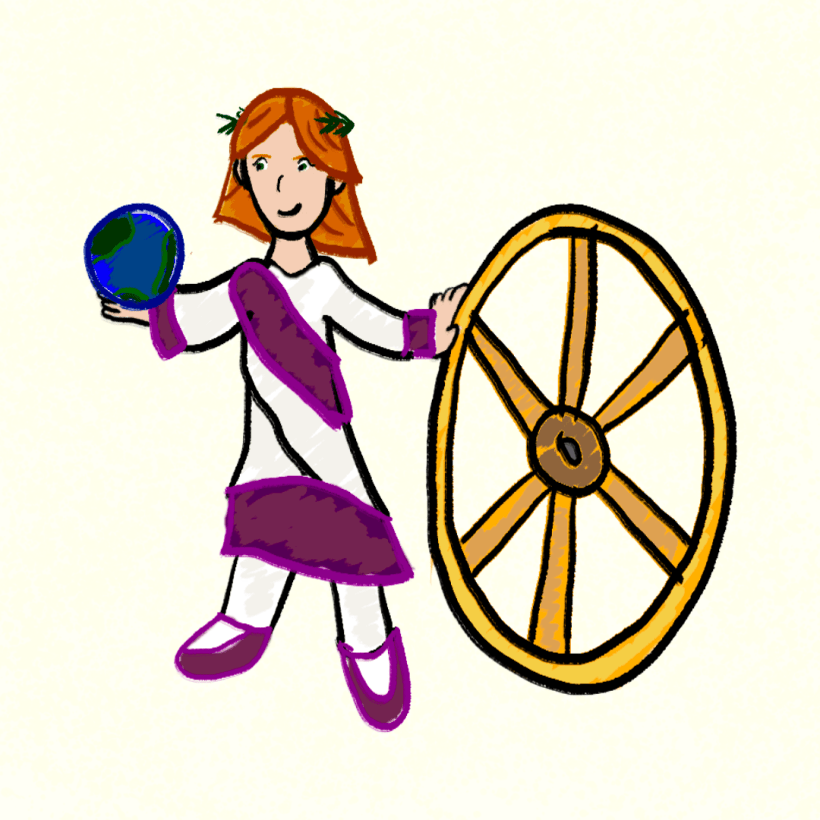
I initially had the idea to do this Music to Write Realmgard to when I was writing about Realmgard’s goddess of luck Anassa, who took more than a few cues from depictions and conceptions about the Roman goddess Fortuna.
An estampie is, quoth Wikipedia, “medieval dance and musical form which was a popular instrumental and vocal form in the 13th and 14th centuries.“
Estampie is a German band that’s been going strong since 1985. Named for the Medieval musical form, it’s not exactly shocking that they mainly play medieval music in a Medieval style with medieval instruments.
There isn’t much medieval music for which the notation survives — Walther von der Vogelweide‘s Palästinalied is notable for being one of the few — and the most common form of Medieval notation really only indicates that the notes are higher and lower than each other, not their objective place on a musical scale.
That being said, there are plenty of surviving examples of at least the lyrics of Medieval songs, along with plenty of poems and narratives meant to be recited in song.
Among the most famous is perhaps the Carmina Burana, a collection of songs from the German town now known as Benediktbeuern, and known as Buria in Latin — “Carmina Burana” literally means “Songs [or ‘poems’; the Latin word is fairly broad] from Buria.”
FYI, the manuscript looks like this:
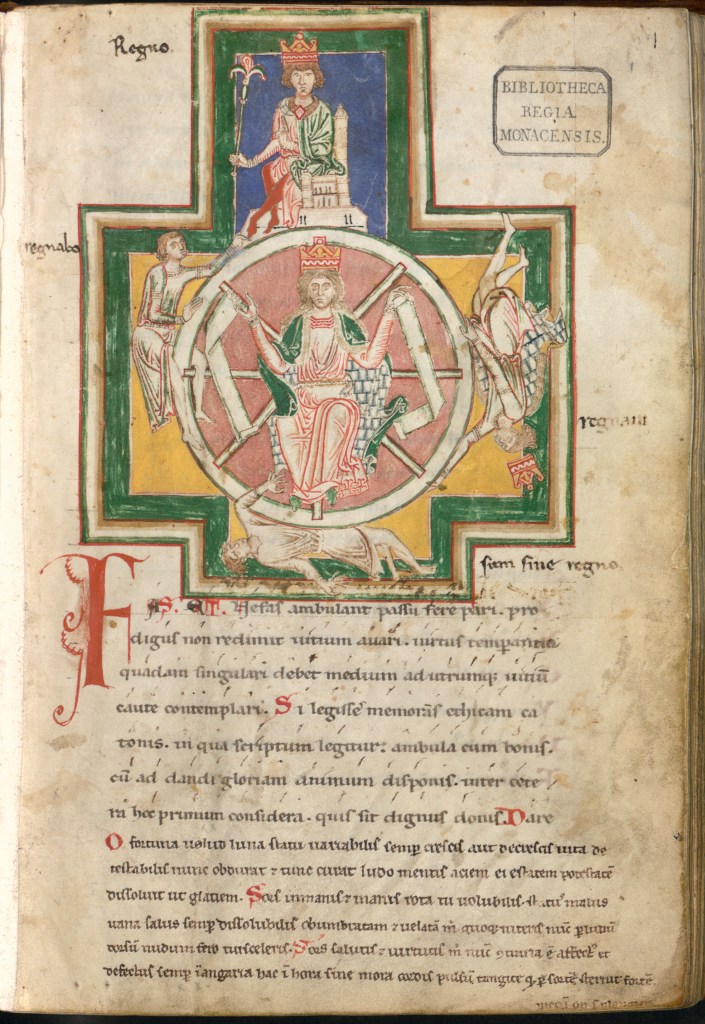
Image via Wikimedia Commons. Public Domain.
If you’ve never heard of the Carmina Burana, you’re probably at least vaguely aware of its most famous poem, O Fortuna. And that’s almost certainly because of Carl Orff‘s ubiquitous orchestral setting of the poem, which shows up pretty much everywhere — these days as likely to be used ironically as played straight…
But I’m not going to be talking about Orff today. But, like, if you’re interested, here’s O Fortuna as conducted by globetrotting Classical conductor and PBS mainstay André Rieu:
I want to focus on Estampie’s version.
For one thing, I think Orff’s version takes itself way too seriously and is too operatically bombastic for its own good — and, again, is everywhere in Pop Culture to the point of being played-out and impossible to take seriously at this point (which admittedly, really isn’t Orff’s fault).
Reading the lyrics, it’s pretty clear that Fortune is a capricious witch-queen who cruelly toys with mortals as her playthings:
“Fate – monstrous
As translated here.
and empty,
you whirling wheel,
you are malevolent.”
Incidentally, O Fortuna is paraphrased with iconic video game boss theme One-Winged Angel — specifically the “Fate monstrous and empty” line, in the original Latin, ” Sors immanis et inanis.”
As it happens, Orff’s epic orchestration of the piece is actually completely at odds with O Fortuna‘s origins as basically a Medieval frat boy being melodramatic about gambling away all his money — Benediktbeuern was basically a university town thanks to the abbey in town.
It’s not nearly as high-mindedly philosophical as it seems out of context. It’s pretty much the Medieval equivalent of a series of melodramatic Tweets…
For another thing, they didn’t have orchestras like Orff is using back in the 13th century when the Carmina Burana was written. As established above, we don’t necessarily know what the version in the actual Carmina Burana actually sounded like, so Estampie’s version isn’t necessarily not entirely predicated on Artistic Liberties. That being said, they’re using actual Medieval instruments, so it’s at least stylistically and conceptually closer to an actual Medieval song than Orff’s decidely 20th-century Orchestral version is.
And you can listen to it here:
The official Music to Write Realmgard to playlist has been updated to include this latest entry:
And follow me here:

This work is licensed under a Creative Commons Attribution-NonCommercial-NoDerivatives 4.0 International License.
The author prohibits the use of content published on this website for the purposes of training Artificial Intelligence technologies, including but not limited to Large Language Models, without express written permission.
All stories published on this website are works of fiction. Characters are products of the author’s imagination and do not represent any individual, living or dead.
The realmgard.com Privacy Policy can be viewed here.
Realmgard is published by Emona Literary ServicesTM
