Fundamentally, I still need to figure out the best way to actually re-watch the series, but Mysticons is still worth talking about for the many novel ways it manages to set itself apart as a Fantasy story.
Admittedly, this is probably one of my least fleshed-out recommendations. That’s in part because it’s been a while since I’ve been able to rewatch Mysticons for the purposes of expanding on this recommendation and I’m currently trying to track down the best way to watch it.
But, seriously, though, I miss the days when everything was just on Netflix…
That being said, once I work that out, I am going to work on expanding this recommendation.
In the meantime, I think that the premise of Mysticons is still interesting enough that it merits being brought to your attention.

and legendary Pro Wrestlers.
Photo by Daniel Joseph Petty on Pexels.com
The basic premise of Mysticons is pretty straightforward — and, to be fully honest, something we’ve already seen a hundred times before (that’s not necessarily a bad thing).
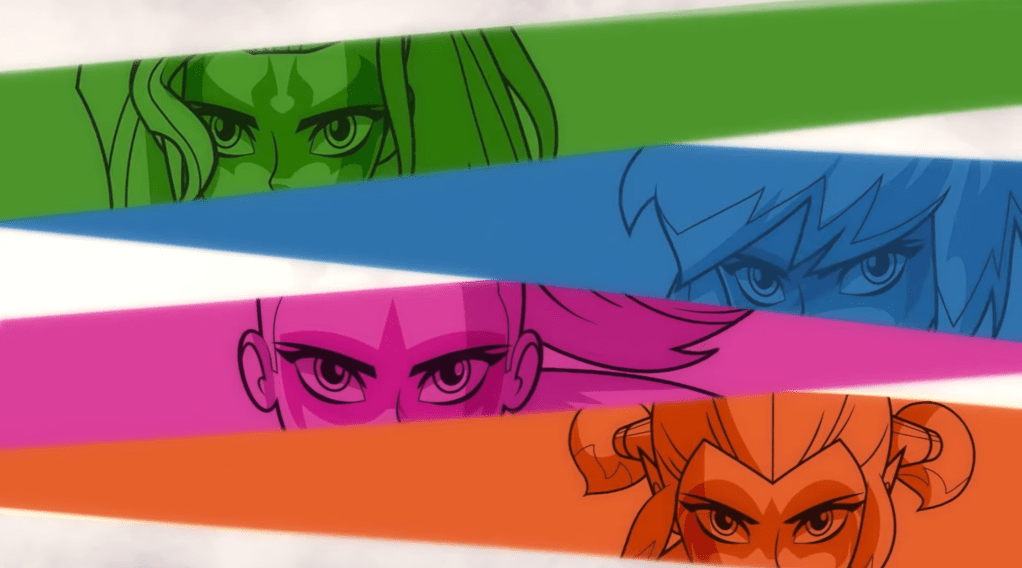
They’re a team of transforming superheroes that fight bad guys and learn valuable life lessons each episode. And, yes, they’re all Teenagers with Attitude — and, as it happens, all female, as seen here:
And, yes, Teenagers with Attitude been pretty played out since the original Power Rangers. But, like, it’s a kid’s show, having a young protagonist is, like, Rule 1 of kid’s media — well, except for The Hobbit, but when you’re Tolkien, you can get away with writing a kid’s book with a middle-aged, bourgeois hero…
The character archetypes of the team members are all tread pretty familiar ground (again, that’s not a bad thing; why mess with what works?). There’s the naturally-talented but insecure princess, her childhood friend bodyguard, the tough streetwise orphan, and the funny streetwise orphan.
The writing and plotting isn’t always great, but it probably succeeds on the whole as an example of Strong Female Role Models.

Photo by Elly Fairytale on Pexels.com
The art style actually kinda reminds of me my own: flat and angular, with lots of solid colours. Except, you know, done by competent artists and animators…
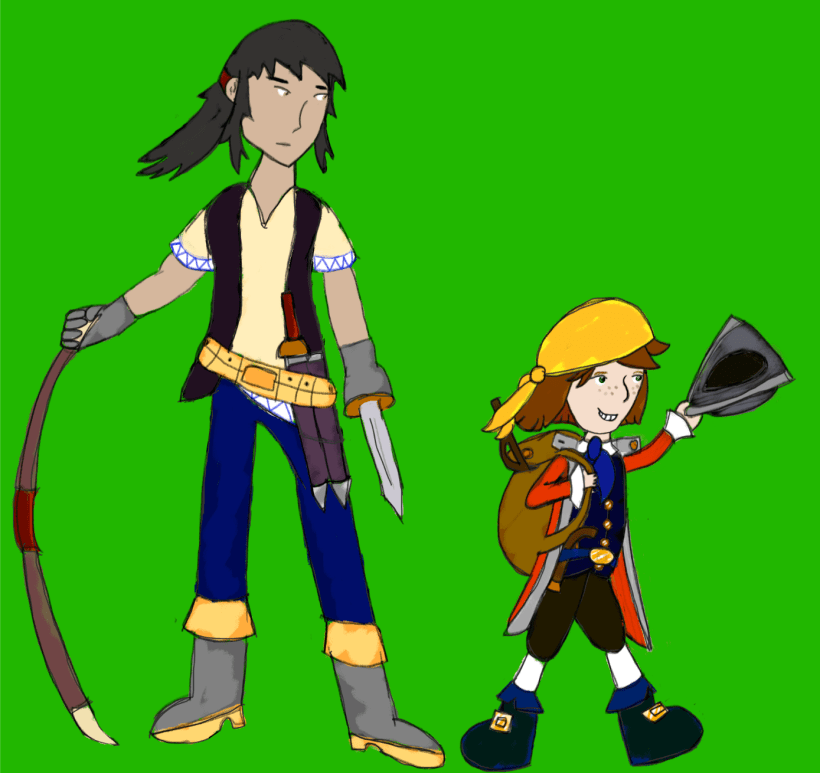
Art by me.
As is often the case with digital animation in Current Year, it can feel too clean and smooth and even sterile — compare to, for example, a 90s cartoon like Gargoyles. Don’t get me wrong here, this isn’t a “The Past Was Always Better” thing. I’m not going to fault animators for using tools that make their jobs easier — especially not a job as tedious as animation, but I think there is a pretty widespread consensus that the digitisation of animation has led to a loss of a lot of the personality that’s able to shine through in older techniques — cf. Current Simpsons vs. Classic Simpsons
I think the most interesting thing about Mysticons is its setting and Worldbuilding. Basically, it’s what TvTropes (by way of, as I understand it, Final Fantasy) calls “Magitek.”
On the most fundamental level Mysticons is a fairly typical Fantasy world: there’s Elves and Dwarves and magic and monarchic government. But in terms of the characters’ day-to-day life, the world the magical equivalent of 21st century North America: they have computers and cell phones and video games and Instagram (incidentally) and public transit and pizza joints, but also, to remind you that this is a Fantasy world, all that technology is powered by pixie tears and unicorn smiles (well, not really, I’m being glib to make a rhetorical point…) and also teleportation and astrology and speeder bikes and sky-boats and prophecies of utmost consequence to our heroines…
Again, the writing doesn’t always live up to the potential, but the setting is novel enough to help Mysticons distinguish itself from other Transforming Hero Team shows that are basically the same premise less an interesting setting.
Overall, the pacing of the plot moves pretty quickly and is delivered pretty well to wrap things up in 40 episodes (two seasons of 20 episodes); whether or not there’s ever going to be more still seems to be up in the air at this point. The overarching struggle against evil is pretty standard for the kind of show that Mysticons is (you know what I’m going to say here), but plenty of the individual episodes manage to make the most of the uniqueness of the setting. Some of the long-term story arcshave one or two too many twists for their own good, but ultimately, even these things end up being not quite as good as they could have been, rather than actually bad.
And, ultimately, Mysticons deserves a shout-out from me because CanCon’s gotta stick together.
Much like good waffles.
So, in conclusion, I give this work of CanCon animation a solid Eh-Minus.
I’ve got more recommendations, CanCon or otherwise here.
Follow me here:

This work is licensed under a Creative Commons Attribution-NonCommercial-NoDerivatives 4.0 International License.
The author prohibits the use of content published on this website for the purposes of training Artificial Intelligence technologies, including but not limited to Large Language Models, without express written permission.
All stories published on this website are works of fiction. Characters are products of the author’s imagination and do not represent any individual, living or dead.
The realmgard.com Privacy Policy can be viewed here.
Realmgard is published by Emona Literary ServicesTM
