Tarandarii
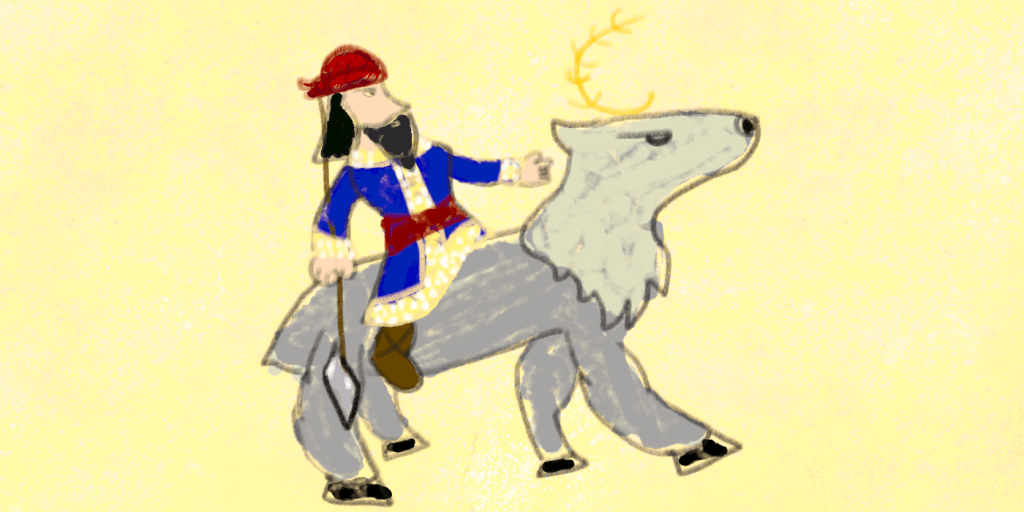
The semi-nomadic indigenous people of northern Realmgard (including the present-day Kingdom of Aurora) are most commonly known by the Elven-derived name “Tarandarii” — Tarandarius in singular form — meaning “Reindeer People”, referring to their use of reindeer as domesticated animals providing food, clothing, and transportation.
Within the dialects of their own language, the most common name for the traditional homeland of the Tarandarii translates to “Land of the Ten Fathers”, referring to the mythical accounts of their own origins as the descendants of the ten tribes founded by ten semi-divine heroes. Although the Tarandarii are viewed as a singular group in most of the rest of Realmgard — Aurora being an exception — the ten Tarandarii tribes are better understood as ten distinct groups sharing certain cultural commonalities.
At various points in history, the Tarandarii have faced destructive invasion and war, particularly during the expansion and consolidation of the Kingdom of Aurora. This, combined with periodic waves of persecution, discrimination, and forced assimilation, has reduced the population of Tarandarii, though in recent generations the Aurorean monarchs have enacted laws to protect and culture, livelihood, and safety of the Tarandarii within the Kingdom.
I feel like I wrote myself into a corner by making Aurorean poetry have the same metre as the Kalevala, which made Aurora a lot more Finnish than my original intent of making Aurora Realmgard-Canada. The Tarandarii were always inspired by the Sámi, who have traditionally herded reindeer, and still do — in fact, in Norway and Sweden, only Sámi are legally allowed to farm reindeer.
And at least in the visual components of the clothing, there’s some inspiration from the Ainu, whom I’ve been learning a lot about lately thanks to the anime Golden Kamuy — incidentally, the Ainu sea god was my major inspiration for the Auroean sea god.
Also, I’ve read that when Old Norse authors described somebody as “Half-Troll“, what they actually meant was “Half-Sámi.” Which is kinda… yeah.
Apparently, there was an association on the part of medieval Scandinavians of the Sámi — as there was with Trolls — with witchcraft and magic. Which is still kinda… yeah.
If you’ve enjoyed my content, please consider supporting me through Ko-fi or Patreon, or through Paypal by scanning the QR code below:
Follow Realmgard and other publications of Emona Literary Services™ below:
Subscribe to the Emona Literary Services™ Substack newsletter here.

This work is licensed under a Creative Commons Attribution-NonCommercial-NoDerivatives 4.0 International License.
The author prohibits the use of content published on this website for the purposes of training Artificial Intelligence technologies, including but not limited to Large Language Models, without express written permission.
All stories published on this website are works of fiction. Characters are products of the author’s imagination and do not represent any individual, living or dead.
The realmgard.com Privacy Policy can be viewed here.
Realmgard is published by Emona Literary ServicesTM
