Week 2 is in the books, so now seems like a good time to start pivoting to the geography of Realmgard and Terrace as a whole.
Archipelago
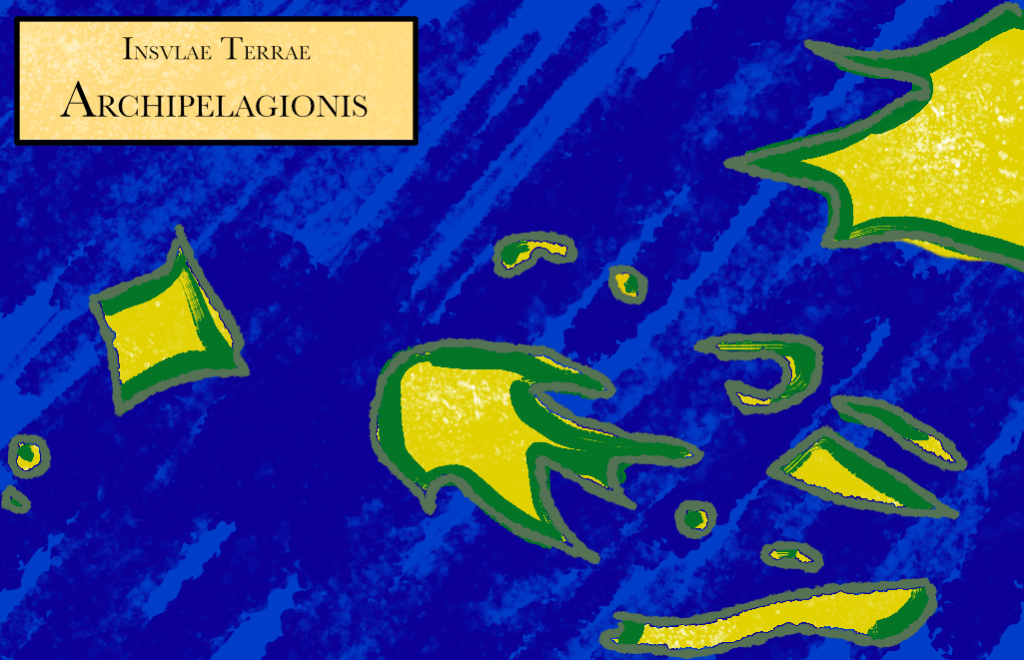
Generally regarded as the cradle of Realmgardian civilisation, Archipelago is the homeland of the Elven refugees who laid the earliest foundations of the Elven Empire in Realmgard. Recorded Archipelagian history goes back more than two thousand years and there is evidence of cultures predating even that by millennia.
Due to the similar climates, Archipelagian agriculture was imported by the Elves, most notably the cultivation of olives, which remain a staple in southern Realmgard.
During the reign of Cassandros, who unified the islands of Archipelago before launching a long and startlingly successful campaign on the eastern continent of Laodike, Archipelagian domination covered the majority of the continent’s landmass. Cassandros died young and his empire did not long outlive him, though after being partitioned by his generals, the successor states maintained Archipelagian culture and language throughout Laodike, until much of these kingdoms were reunified by the Realmgardian Elven Empire and the Archipelagian Empire in its current however.
In recent centuries, much of the mainland holdings of the Archipelagian Empire has been lost to the ascendant Arslani Dynasty, with the notable exception of the Archipelagian capital of Chrysokeras, whose impressive walls have thus far been able withstand the Arslani’s sieges and able to be supplied with manpower and food stores via the Empire’s island domains.
Notably, the Arslani armies have resorted to increasingly large cannons to attempt to breach the walls. In turn, the Archipelagians have responded by fortifying their cities with sizeable of their owns, often imported from Natalian foundries and crewed by Natalian mercenaries.
There’s an obvious Greek influence here. One, “Archipelago” (“main/primary sea”) is the ancient Greek name for the Aegean. Two, the outline of most of the islands is basically consistent with different regions of Greece — the Peloponnese, Crete, Euboea, Attica, Sicily (not technically part of Greece, but part of the Greek world for centuries).
Three, Cassandros is Alexander, but with the meaning of his name reversed. Alexander — “Alexandros” in Greek — is (ironically) “protector of men”; Cassandros, more common in the feminine, is apparently usually parsed as “shining upon men”, but I’m more familiar with the etymology “destroyer of men”, which I can’t actually fine that many citations for…
“Laodike” (that’s lao-dee-kay) as the name for the eastern continent is a reference to the fact that Europe is also named for a mythological woman. Plus, it has the bonus of meaning “customs of the people”, which I’m thinking is meant as a sort of posturing on the part of the Archipelagians to convey something like “people from here live in a society of law and order, the barbarians in the other continents don’t.”
Basically, at this point, Archipelago is the Byzantine Empire if it managed to survive into the 1600s. Conversely, the Arslani are the Ottomans — notably one of the major keys to the Ottomans finally conquering Constantinople was really big cannons, which allowed the Ottomans to finally breach the impressive defensive walls of the city.
If you’ve enjoyed my content, please consider supporting me through Ko-fi or Patreon, or through Paypal by scanning the QR code below:

Follow Realmgard and other publications of Emona Literary Services™ below:
Subscribe to the Emona Literary Services™ Substack newsletter here.

This work is licensed under a Creative Commons Attribution-NonCommercial-NoDerivatives 4.0 International License.
The author prohibits the use of content published on this website for the purposes of training Artificial Intelligence technologies, including but not limited to Large Language Models, without express written permission.
All stories published on this website are works of fiction. Characters are products of the author’s imagination and do not represent any individual, living or dead.
The realmgard.com Privacy Policy can be viewed here.
Realmgard is published by Emona Literary ServicesTM
