The Kingdoms of the Sea
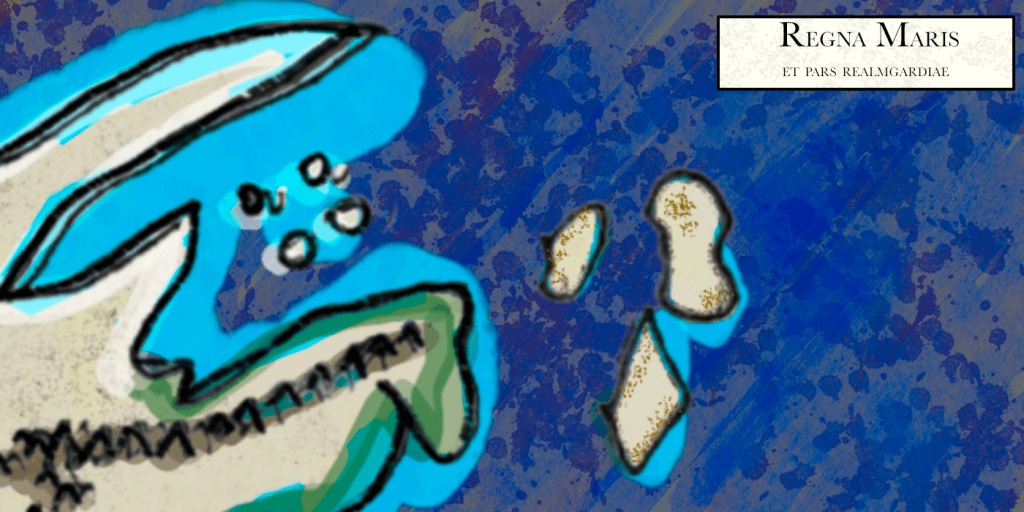
While geographically separate from the continent of Realmgard, the island nations known as the Kingdoms of the Sea are generally considered part of the Realmgardian cultural sphere — the current Gardian language is closely related to the Middelmerish language. Due to their close geographic proximity as well as their long shared history. Because of this, and because of Middelmere’s historical status as the most prominent of the Kingdoms of the Sea, inhabitants of the other Kingdoms — Morfilod, Carog, and Makeland — are often stereotyped or misidentified as being Middelmerish, a constant source of consternation, at best.
Middelmere also shares culture and linguistic ties to Hrimfax, thanks to large-scale migration to Middelmere by Hrimfaxi sailors in the period following the Elven Empire’s retreat from the island. Other large-scale incursions by Hrimgfaxi Vikings would occur in later centuries, with the struggle againt Hrimfaxi invasion and occupation serving as a major factor in establishing the Middelmerish national identity.
While the three islands themselves are called the Kingdoms of the Sea, in a political context, the number of Kingdoms varies between three and four, due Morfilod not always being counted due to having been conquered and incorporated into Middelmere centuries ago. Middelmere has, at points in history, also controlled most or all of the territory of Makeland and Carog, leading to various Middelmerish Kings since the period of the legendary King Caelin claiming the title “Emperor of the Isles”, with varying degrees of legitimacy.
Middelmere itself would spend the better part of a century under Gallicantien dominion during the Century’s War, with the victorious King Hereward IV re-asserting Middelmerish independence.
The Kingdoms of the Sea are fundamentally Great Britain split into multiple landmasses, and Ireland.
Middelmere is England, specifically an Anglo-Saxon England that was never conquered by the Normans and retained a largely Anglo-Saxon culture rather than evolving into the British culture of latter Middle Ages and beyond. I haven’t really had an opportunity to explore that, because I haven’t really done any stories outside of Realmgard proper.
Makeland is Scotland and is probably the one of I’ve actually world-built the least. At this point, I have a name derived from an Old Norse word for sword, a reference to the fact that there was historically a pretty big Viking presence in Scotland.
In fact, Shetland is pretty open about its Norse heritage, and Orkney was part of Norway until 1472 (for reference, the Viking Age is generally held to have ended at Stamford Bridge in 1066 and that’s twenty years after the Fall of Constantinople and/or the end of the Middle Ages)
Carog is Ireland, as we’ve previously learned from everyone’s favourite Half-Goblin Gentlewoman Thief Niamh — from whom we’ve also learned that name is pronounced “Neev.”
Morfilod is Wales, and FYI, the word “Morfilod” is the Welsh word for “whales” — a young J.B. Norman was really confused about why the heir to the Throne was the Prince of Large Marine Mammals. Admittedly, the multilingual pun behind joke has at least one too many layers to actually be funny, but I love it.
If you’ve enjoyed my content, please consider supporting me through Ko-fi or Patreon, or through Paypal by scanning the QR code below:
Follow Realmgard and other publications of Emona Literary Services™ below:
Subscribe to the Emona Literary Services™ Substack newsletter here.

This work is licensed under a Creative Commons Attribution-NonCommercial-NoDerivatives 4.0 International License.
The author prohibits the use of content published on this website for the purposes of training Artificial Intelligence technologies, including but not limited to Large Language Models, without express written permission.
All stories published on this website are works of fiction. Characters are products of the author’s imagination and do not represent any individual, living or dead.
The realmgard.com Privacy Policy can be viewed here.
Realmgard is published by Emona Literary ServicesTM
