Orcs
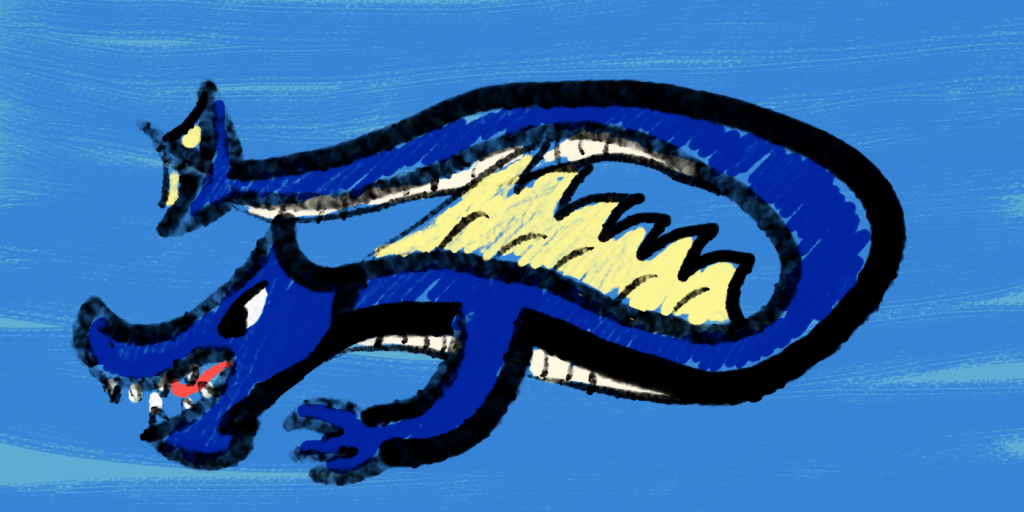
Generally held to be related to terrestrial Dragons, the great sea serpents known as Orcs as also commonly called Sea Dragons. However, the exact degree to which terrestrial Dragons and Orcs are related remains a subject of some debate.
Similar to terrestrial Dragons in overall physiology, though notably only possessing two forelimbs and no rear legs or wings, Orcs have a similar fearsome reputation to their land-bound cousins. In fact, Orcs are famous as one of the few creatures in the oceans of Terrace able to prey on Gigacrabs. Though, of course, Orcs are one of the few creatures in the oceans of Terrace known to be both more aggressive and larger than Gigacrabs.
Perhaps unsurprisingly for a species known to spend most of its time underwater, Orcs do not breathe fire. How exactly Orcs hunt is not well-documented due to most of that hunting occurring in the depths of the Ocean, but it is usually assume that they make use of their impressive teeth and claws and it is widely speculated that they use their massive bodies to constrict their prey like smaller terrestrial snakes. Orcs are not known to be venomous, but are commonly depicted as such — and able to spit venom that is either instantly and lethally poisonous or incredibly corrosive — in art and literature.
Orcs feature prominently in the legends about numerous prominent heroes in Realmgard’s history, most notably Duke Mercurio, the founder of the ruling ducal dynasty of the Natalian Duchy of Mercurio, who famously rescued the Elf woman Flavia from being sacrificed to the Orc ravaging the Natalian coast by slaying the sea serpent.
This is probably my most pointed divergence from Generic Fantasy, establishing “Orc” has meaning something drastically different from the typical Fantasy Orc. I’ve mentioned several times that I don’t like universally evil races and I already had Trolls filling the Big Green Dude archetype and more or less Hrimfax filling the Relentlessly Aggressive Barbarian archetype — at least stereotypically’ Hrimfax is Scadinavia and Pop Culture Vikings are probably the closest real-life notion to typical Orcs.
Though, of course, real Vikings were a little more nuanced than Pop Culture Vikings are made out to be. For one thing, the most common artifact in Viking graves is combs…
All of which is to say, I saw I golden opportunity to shout-out one of my favourite books ever in Ludovico Ariosto’s Orlando Furioso by making my Orcs sea monsters. I’d post a picture for reference, but most of those feature a very naked Angelica…
Now, for what it’s worth, the Wikipedia article about Orcs is terrible and skews way too Tolkien. Notably, it doesn’t mention Ariosto at all, which — rather significantly in my view — predates Tolkienian Orcs by almost 500 years and is probably at least worth a mention.
Though the article does quote a Tolkien letter where Tolkien at least acknowledges that the sea monster definition pre-exists his style of Orcs. But, like, of course he did. Dude taught literature at Oxford…
For as much shorter as it easy, the Britannica article is better at giving an overview of non-Tolkien literary Orcs, pointing out that the modern term is probably influenced both by an Old English word for monsters of unclear exact nature and the Romance Language-derived etymology (as used by Ariosto in Orlando Furioso) for sea monster, while also noting that it probably means something whale-like, or even just an actual whale, which, all things considered, is kind of underwhelming —as in Orca; scientific name “Orcinus Orca”, “Netherworld Sea Monster.”
Also, I originally had Orcs and Sea Dragons as explicitly separate species, but I’ve decided to walk that back, because it feels like it unnecessarily complicates things. Remember, folks, my approach is that everything I write is canon until it isn’t…
If you’ve enjoyed my content, please consider supporting me through Ko-fi or Patreon, or through Paypal by scanning the QR code below:
Follow Realmgard and other publications of Emona Literary Services™ below:
Subscribe to the Emona Literary Services™ Substack newsletter here.

This work is licensed under a Creative Commons Attribution-NonCommercial-NoDerivatives 4.0 International License.
The author prohibits the use of content published on this website for the purposes of training Artificial Intelligence technologies, including but not limited to Large Language Models, without express written permission.
All stories published on this website are works of fiction. Characters are products of the author’s imagination and do not represent any individual, living or dead.
The realmgard.com Privacy Policy can be viewed here.
Realmgard is published by Emona Literary ServicesTM
