Luca Pertico
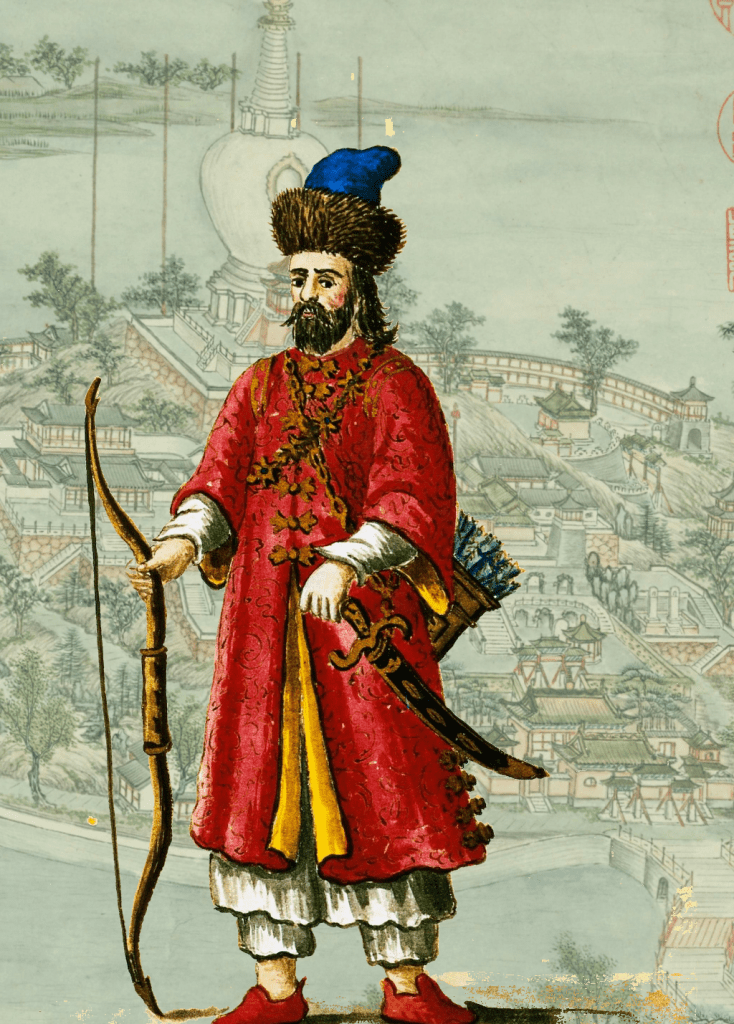
via Wikimedia Commons. Public Domain.
Likely the most famous traveller and explorer, Luca Pertico is known for his lengthy travels across the eastern continents of Laodike and Solar.
Born into a family of merchants in the Republic of Valico at the height of its power and prestige as a transcontinental trade power, Pertico’s first expedition to Laodike came as he accompanied his father, uncle, and aunt on a trade mission to one of Valico’s colonies in Laodike.
Several decades later, when the majority of both Laodike and Solar were unified under the rule of Khatuu Khan, leading to an extended period of peace and stability, Pertico once again accompanied his family east on a mission intended to reach all the way to Khatuu Khan’s capital city, where several other Valican traders had already established a presence.
This is where Pertico’s famous account begins, with the family’s departure from the Archipelagian capital of Chrysokeras and he describes both the geographical and cultural features of the lands through which he passed on the way to Khatuu Khan’s capital.
Upon reaching the capital, the Perticos quickly came to the attention of Khatuu Khan himself after his aunt began a relationship with one the Khan’s trusted bodyguards, precipitated by her overpowering and subduing a thief attempting to steal his horse. Notably, she would marry him and remain in the capital after the rest of the family departed.
The scholarly and intelligent Luca soon impressed Khatuu Khan, renowned as an enthusiast of foreign cultures and learning and was ultimately granted a position as a minor magistrate in the capital, one of only a handful of Realmgardian travellers granted such privilege in Khatuu Khan’s court. In this capacity, Pertico travelled through much of the heartland of Khatuu Khan’s empire, continuing to document his experiences during his travels.
He remained in Khatuu Khan’s court for about a decade, departing and returning to Realmgard after the death of Khatuu Khan and being granted permission to depart by his successor. Whereas his journey east was primarily overland, the return voyage west was taken mainly by ship. While Pertico himself did not personally visit the island realm of Yamatai, what he learned from Khatuu Khan’s sailors and soldiers who had recently been repulsed in their attempts to invade Yamatai are the earliest references to Yamatai in a Realmgardian source.
Indeed, Pertico was likely the first — and perhaps only — Realmgardian to witness many of the places and phenomena he documented in his writings.
Upon his return to Valico, Pertico’s mother is said to have fainted with surprise and relief at the return of her son after more than a decade absent.
Luca Pertico’s account of his travels were published within his own lifetime and instantly proved both enduringly popular and endlessly controversial. Given some of the outlandish things described in his accounts, his reliability continues to be debated by scholars, even as the most salacious aspects of his writings continue to be enjoyed by the general public. Nevertheless, these writings remain among the most thorough accounts of the lands of Laodike and Solar ever written by a Realmgardian author, surpassed only by fairly recent travellers as Realmgardian trade routes across Terrace expand.
If it’s not obvious, Luca Pertico is inspired by Marco Polo, the name coming from another Evangelist (Luke instead of Mark) and Pertico is an admittedly pretty dumb pun stemming from the fact that it’s basically Italian for “pole-o”…
And that picture is, in fact, a depiction of Marco Polo.
As a reminder, Laodike is basically the parts of Europe that Realmgard isn’t — Realmgard basically turning into a combination of English-speaking North America and western Europe the more I wrote. At this point, Laodike is basically the Balkans, Greece, and the wider Hellenistic world.
Solar — I name I’m still not entirely sold on — is supposed to be derived from the Latin/Elvish phrase “Sol oriens”, something like “rising Sun”, conveying the idea that it’s the easternmost continent (or least the easternmost continent people in Realmgard are aware of) and East is where the Sun rises…
It’s basically the same etymology behind Nihon, the Japanese name for Japan…
I try to give my place and people names real-world etymologies, and this feels like the best I’ve got so far. This may end up being one of those things that’s only canon until it isn’t once I come up with a better idea…
FYI, in real life, the word for Asia is most languages is just a variant of the Greco-Latin word “Asia”, itself apparently originating from an ancient Hittite word for what is now Western Turkey, which is what “Asia” meant when Greeks or Romans used the word and was eventually applied to the entire continent.
Given that in real life, Europe and Asia (also, Africa) are one contiguous landmass and because I really haven’t world-built much beyond Realmgard itself, my mental image of where exactly the division between the two continents is, or what the real-world equivalent is, beyond that Laodike is broadly the Hellenistic world and Solar is broadly East Asia.
Follow me here:
If you’ve enjoyed my content, please consider supporting me through Ko-fi or Patreon, or through Paypal by scanning the QR code below:
Follow Realmgard and other publications of Emona Literary Services™ below:
Subscribe to the Emona Literary Services™ Substack newsletter here.

This work is licensed under a Creative Commons Attribution-NonCommercial-NoDerivatives 4.0 International License.
The author prohibits the use of content published on this website for the purposes of training Artificial Intelligence technologies, including but not limited to Large Language Models, without express written permission.
All stories published on this website are works of fiction. Characters are products of the author’s imagination and do not represent any individual, living or dead.
The realmgard.com Privacy Policy can be viewed here.
Realmgard is published by Emona Literary ServicesTM
