30 Days of Biographies: Shogun Tetsuyama Genji
of Yamatai
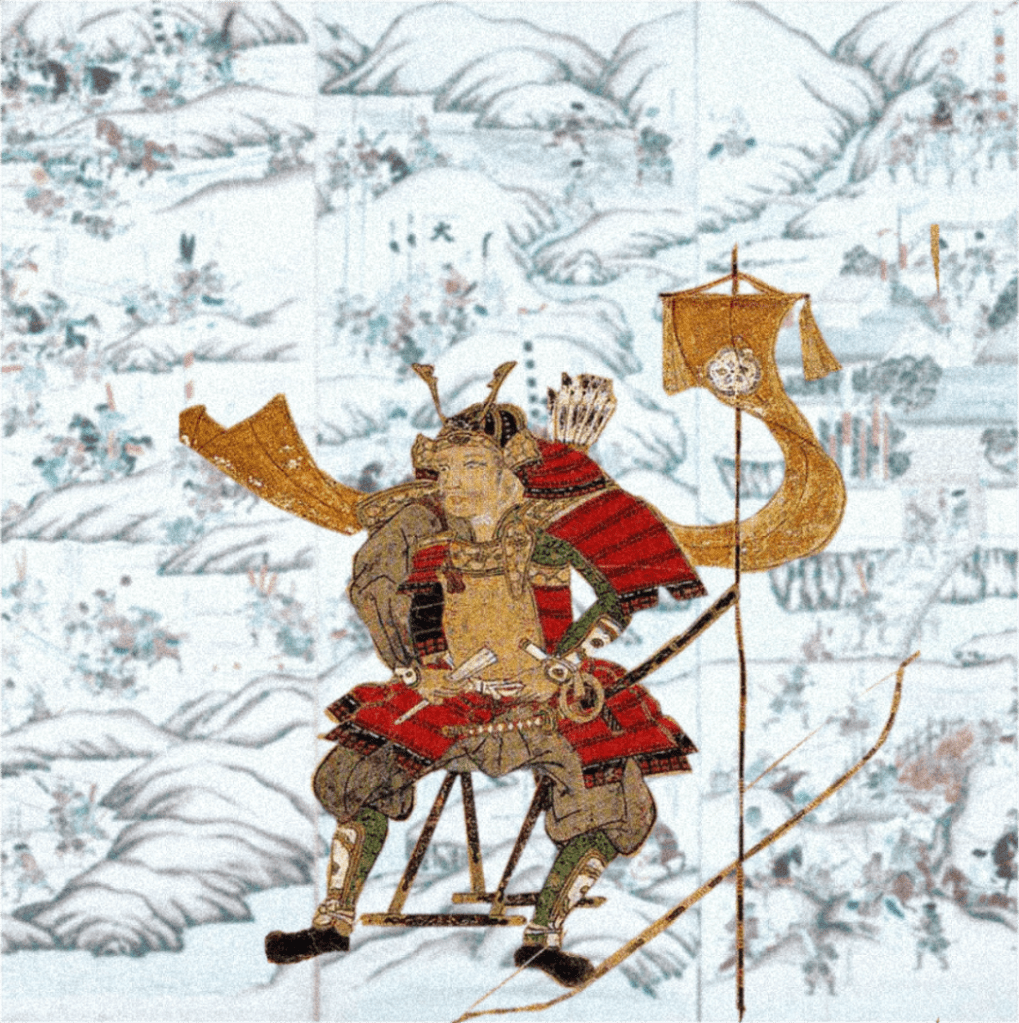
Although Yamatai is ruled by the Emperor — members of a dynasty that is believed to have reigned in an unbroken line for more than two thousand years — actual military and administrative power is executed by the shogun, a position originating as the commander-in-chief of the armies led to subdue the so-called barbarians living outside the sphere of influence of the Imperial court.
A collapse of the powers of the shogun in recent centuries plunged Yamatai into a long period of civil war, from which it has only recently emerged thanks to the campaigns of Tetsuyama Genji, who has unified the regional lords of Yamatai under his power to establish himself as the reigning shogun.
Although Tetsuyama was born the second son of a fairly minor regional lord and was infamous for a youth of excess and erratic behaviour, he was thrust into a position of leadership when his elder brother took monastic vows and renounced the clan’s leadership.
It has been speculated that his elder brother’s example moved the younger Tetsuyama to rethink his life and give up his previous life of excess, or else that his behaviour was a ploy to lure his rivals into complacency. Whatever the true is, when the neighbouring clans moved on the Tetsuyama, hoping to take advantage of its untested, irresponsible leader, they instead found themselves facing a shrewd military who quickly adopted innovative tactics that caught his enemies off guard.
Most notably, Tetsuyama embraced the foreign weapons and tactics that had begun entering Yamatai with the arrival of the first Realmgardian merchants several decades earlier. In particular, Tetsuyama widely adopted firearms and cannons among his armies. Under his leadership, it is now believed that Yamatai possesses the most firearms of any nation on Terrace.
Through a combination of shrewd political maneuvering and sheer military force, Tetsuyama was able to quickly carve out the largest domain of any of the regional lords of Yamatai. Due to his proximity to the capital of Yamatai, rumours were circulated by his rivals that he intended to overthrow the Imperial court, leading to a coalition of other lords being formed against him.
Once again demonstration his shrewdness, he was able through a combination of incentives and threats to convince a substantial number of the coalition’s members to either defect to his side or else remain neutral. Still facing a sizeable enemy army, Tetsuyama moved to engage for the final battle, which was fought on a foggy autumn day in central Yamatai.
Winning a hard-fought but decisive victory, Tetsuyama overcome the last of the opposition to his unification of Yamatai, leading to the Emperor proclaiming him Yamatai’s first shogun in nearly two hundred years.
As shogun, Tetsuyama continues to foster ties with foreign merchants and make use of foreign technology, though access to Yamatai by foreigners is highly regulated and the laws governing foreigners in Yamatai are strictly enforced.
Yamatai is Japan. We’ve been over this.
And that made it kinda hard to write. Shogun just won all the Emmys, so I feel like I had to be extra careful not to make my alternate take on the unification of Japan too much like Shogun‘s alternate take on the unification of Japan…
But I think I managed.
Tetsuyama is the family name, Genji is the personal name. Tetsuyama means “iron mountain”, which I thought sounded cool — though apparently the same characters can also mean “iron mine”. And while it doesn’t appear to be a real name — the only examples I found when I searched were anime characters — it fits with the general trend of Japanese surnames being based on geography — apparently that’s because when the Meiji government mandated family names for everyone, people just looked at what was nearby and rolled with it.
Genji is an alternate name for the Minamoto, the family that established the first shogunate in Japanese history. I mostly chose it as a reference to that.
Famously, the three unifiers of Japan are Oda Nobunaga, Toyotomi Hideyoshi, and Tokugawa Ieyasu. For the most part, Tetsuyama is Nobunaga, if he survived to actually finish the job of unifying Japan himself but with aspects of Hideyoshi (the shrewd diplomacy) and Ieyasu (the back end of Tetsuyama’s biography is basically Ieyasu’s) in there, too to basically make him a composite of all three.
The biggest difference between Yamatai and real-life Japan is that Yamatai is not basically entirely closed off to foreign contact — the truth of the matter is a bit more nuanced than that, delving into those nuances is beyond the scope of the current assignment.
Incidentally, Japan having the most guns in the world at the time? That’s not necessarily true, but it’s certainly been suggested.
Follow me here:
If you’ve enjoyed my content, please consider supporting me through Ko-fi or Patreon, or through Paypal by scanning the QR code below:

Follow Realmgard and other publications of Emona Literary Services™ below:
Subscribe to the Emona Literary Services™ Substack newsletter here.

This work is licensed under a Creative Commons Attribution-NonCommercial-NoDerivatives 4.0 International License.
The author prohibits the use of content published on this website for the purposes of training Artificial Intelligence technologies, including but not limited to Large Language Models, without express written permission.
All stories published on this website are works of fiction. Characters are products of the author’s imagination and do not represent any individual, living or dead.
The realmgard.com Privacy Policy can be viewed here.
Realmgard is published by Emona Literary ServicesTM
