30 Days of Biographies:
King Caedmon of Westhus
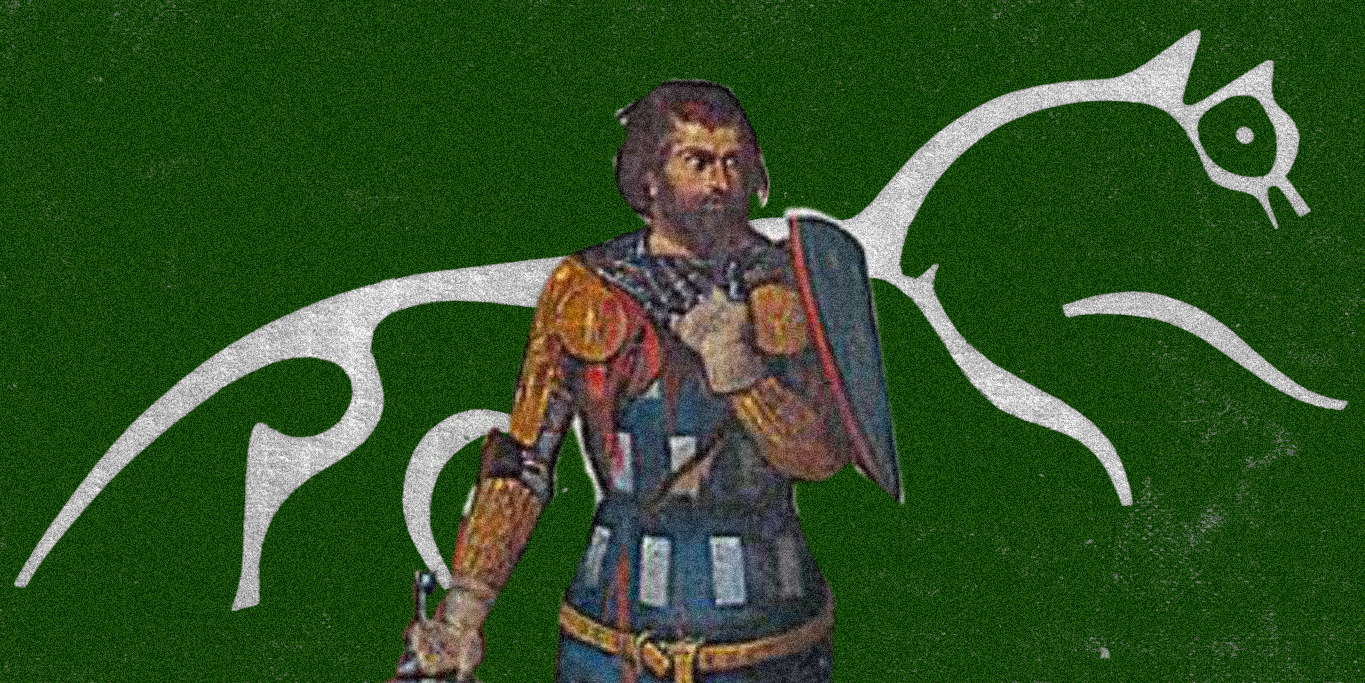
Viewed by some as the reincarnation of King Caelin, come to unite the Kingdoms of the Sea in their darkest hour, Caedmon is one of the major figures in the long wars between the Middelmerish petty kingdoms and the invading Hrimfaxi Vikings.
Inheriting the Middelmerish Kingdom of Westhus at a crucial period in Middelmerish history, Caedmon spent much of his earlier reign on the defensive. The Hrimfaxi Vikings controlled most of the island of Middelmere and had established petty kingdoms of their own throughout Morfilod, Carog, and Makeland — in fact, the modern Gardian name for Makeland is derived from a Hrimfaxi word for sword.
Although Westhus bent under the Hrimfaxi onslaught, it did not break. The Vikings conquered or sacked several prominent cities in Westhus, but Caedmon was able to fortify his remaining holdings sufficiently to repulse further Hrimfaxi sieges. Slowly but surely, he was able to weaken the Hrimfaxi position in his kingdom through a campaign of guerilla warfare, basing his army primarily in the swamps the invading Hrimfaxi were unable to navigate.
At the same time, Caedmon was able to forge alliances with other Middelmerish lords, as well as rulers from Morfilod, Carog, and Makeland, mustering an army that was able to meet the Hrimfaxi in open battle.
The climactic battle took place at the foot of a large hill where an ancient image of a white horse was carved. The so-called Battle of the White Horse was a resounding victory over the Hrimfaxi, though both sides suffered heavy casualties. Caedmon himself is recorded as pulling the Hrimfaxi leader down from his horse in single combat and compelling him to surrender. This was not the last Hrimfaxi invasion of Middelmere, though it would secure peace for more than a century.
As Westhus was the only Middelmerish kingdom to retain its independence from the Hrimfaxi, Caedmon was able to assert his overlordship over Middelmere. Although he did not formally have himself crowned, historians often regard him as the first King of Middelmere.
In addition to his fame as a warrior, in the extended period of peace and stability that followed his victory over the Hrimfaxi, he is also highly-regarded for the reforms he instituted in his kingdom, in addition the the fortified cities that withstood the Vikings, he also built roads and ports to improve transportation throughout Middelmere and encourage trade between Middelmere and the continent. He is also known as a patron of education. Caedmon himself translated several important ancient texts into Middelmerish for the first time.
Among the Kings of Middelmere, Caedmon is unusually well-regarded in the other Kingdoms of the Sea. His role in breaking the power of the Hrimfaxi throughout the Kingdoms of the Sea benefitted Morfilod, Carog, and Makeland as much as Middelmere. In light of the frequent attempts in Middelmerish history to conquer Morfilod, Carog, and Makeland, that Caedmon upheld his promise to affirm the independence of the other Kingdoms of the Sea ensures that he has remained a celebrated figure throughout all the Kingdoms of the Sea.
It should be obvious that Caedmon is Alfred the Great…
I’ve actually sort of used that picture before. Caedmon is being represented by one of the central figures in a painting of the Combat of the Thirty, a mass duel during the War of the Breton Succession that I previously used to represent the Disputation of the Baker’s Dozens.
The image in the background is the Uffington White Horse, which is indeed an ancient hill carving. It’s come to be associated with Alfred the Great, especially because of G.K. Chesteron‘s The Ballad of the White Horse, which uses the Horse as a metaphor to represent the state of England itself.
And if “White Horse on Green” looks familiar, that’s because even though Tolkien didn’t really like The Ballad of the White Horse, he did know about the Horse and presumably used it as the inspiration for the flag of Rohan — fittingly, the Rohirrim are basically Anglo-Saxons on Horses.
Follow me here:
If you’ve enjoyed my content, please consider supporting me through Ko-fi or Patreon, or through Paypal by scanning the QR code below:

Follow Realmgard and other publications of Emona Literary Services™ below:
Subscribe to the Emona Literary Services™ Substack newsletter here.

This work is licensed under a Creative Commons Attribution-NonCommercial-NoDerivatives 4.0 International License.
The author prohibits the use of content published on this website for the purposes of training Artificial Intelligence technologies, including but not limited to Large Language Models, without express written permission.
All stories published on this website are works of fiction. Characters are products of the author’s imagination and do not represent any individual, living or dead.
The realmgard.com Privacy Policy can be viewed here.
Realmgard is published by Emona Literary ServicesTM
