30 Days of Biographies:
Auriwandalo
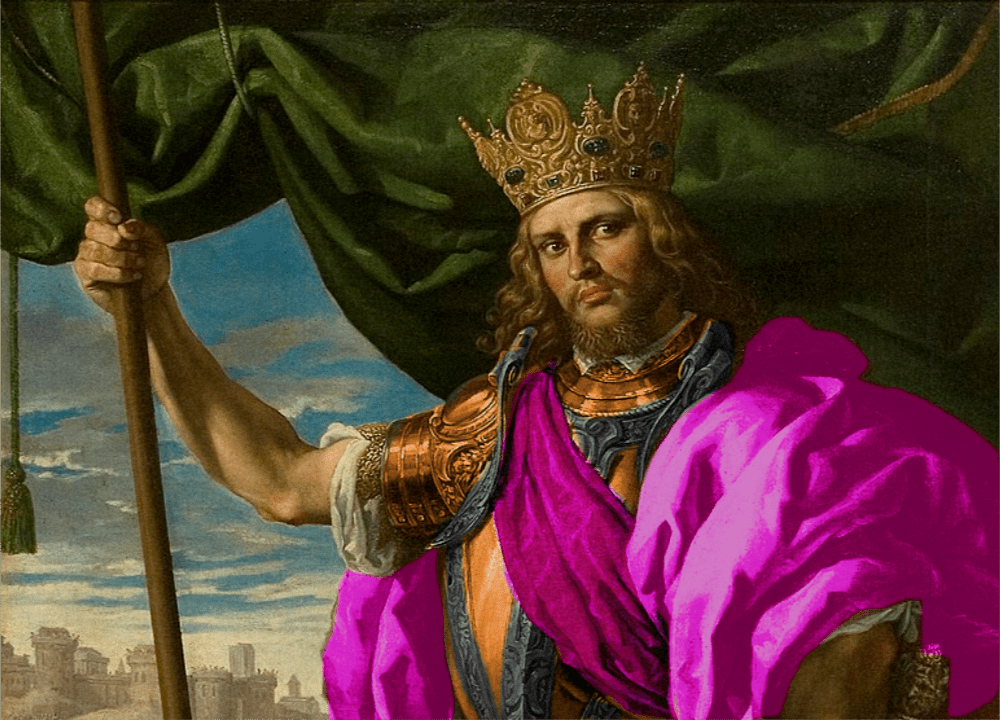
The collapse of the authority of the ancient Elven Empire was a long, slow process, characterised in part by the growth of local kingdoms and chiefdoms arising in former Imperial territories as the Empire contracted, slowly consolidating and expanding over the next few centuries.
One of the most consequential figures in this period was the warlord Auriwandalo. Accounts of his origins are contradictory and heavily mytholgised, though it is clear that he was the son of a minor Midlandic chieftain. His rise to power began with a civil war with his brothers to succeed his father. Auriwandalo emerged victorious over his brothers and continued his ascent by conquering several neighbouring tribes.
In a short span of time Auriwandalo came to control the largest kingdom in central Realmgard, ruling over a mixed Midlandic, Dwarf, Goblin, Hrimfaxi and Elven population. Although the Elven Empire had truly fallen by this point, the culture influence of the Empire remained felt throughout Realmgard. The barbarian rulers of former Imperial territories continued to model their administration on the systems used by the Empire.
Notably, to project an aura of legitimacy, Auriwandalo adopted the use of purple robes, a colour long associated with the Elven Emperors. The purple dye necessary was rare and expensive even during the height of the Empire and in the post-Imperial era, the expense necessary to acquire it also demonstrated Auriwandalo’s staggering wealth.
Auriwandalo’s most famous campaign is his attempted invasion of Aurora. His initial invasion faced stiff resistance from the nascent Kingdom of Aurora, but its sparse population was overwhelmed by the sheer number of Auriwandalo’s horde. This invasion would profoundly shape Aurora’s future — the desperate Aurorean call for aid was answered primarily by Middelmerish and Gallicantien armies. In addition to providing Aurora with the numbers necessary to repulse Auriwandalo’s invasion, this influx of Middelmerish and Gallicantien culture would influence Aurora’s own culture, with the Middelmerish dialect of Gardian and Gallicantien being the two official languages of present-day Aurora and the majority of Auroreans being or either Middelmerish or Gallicantien ancestry or a mix of both.
It is said that the ruling Aurorean King, Hivernus IV, defeated Auriwandalo in single combat. Although their fateful combat is another historical episode clouded by later literary tradition, it is generally accepted that the story is true, at least broadly. With their leader slain and overawed by the martial prowess of the Aurorean King, the bulk of Auriwandalo’s horde was peacefully absorbed into Aurora, while those remnants of the horde that returned south to Realmgard’s Midlands are known to have included the ancestors of Emperor Theobald, the first monarch to restore Imperial rule in much of Realmgard, including the former territories of Auriwandalo’s kingdom.
Remembered primarily as either an audacious warrior-king or a vicious tyrant, Auriwandalo has remained a popular figure in stories, poems, and dramas. Among the most famous operas in Realmgard is a six-part epic Natalian retelling of Auriwandalo’s life, reign, and death in battle in Aurora — famously, the fifth part consists solely of his death monologue.
Etymologically, “Auriwandalo” is the Lombardic of the Old English “Earendel”, the Germanic mythological figure associated with Venus and the sunrise, by virtue of Venus being the Morning Star visible at dawn close to the Sun. Notably, the Anglo-Saxon Advent poem Christ I famous contains the phrase “Hail Earendel, brightest of angels/Sent to men over middle-earth” which inspired Tolkien to use the character Eärendil as a central figure in his mythos.
Historically, Auriwandilo doesn’t correspond to a single real person, so much as broadly being inspired by the various Germanic chieftains and kings that moved into Europe during and after the Fall of the Romen Empire in the West and whose dynasties came to dominate the next several centuries.
Though I did settle on using a painting of Theodoric I, mostly because it was the best image I could find.
Follow me here:
If you’ve enjoyed my content, please consider supporting me through Ko-fi or Patreon, or through Paypal by scanning the QR code below:

Follow Realmgard and other publications of Emona Literary Services™ below:
Subscribe to the Emona Literary Services™ Substack newsletter here.

This work is licensed under a Creative Commons Attribution-NonCommercial-NoDerivatives 4.0 International License.
The author prohibits the use of content published on this website for the purposes of training Artificial Intelligence technologies, including but not limited to Large Language Models, without express written permission.
All stories published on this website are works of fiction. Characters are products of the author’s imagination and do not represent any individual, living or dead.
The realmgard.com Privacy Policy can be viewed here.
Realmgard is published by Emona Literary ServicesTM
