30 Days of Biographies:
Arnau the Traveller
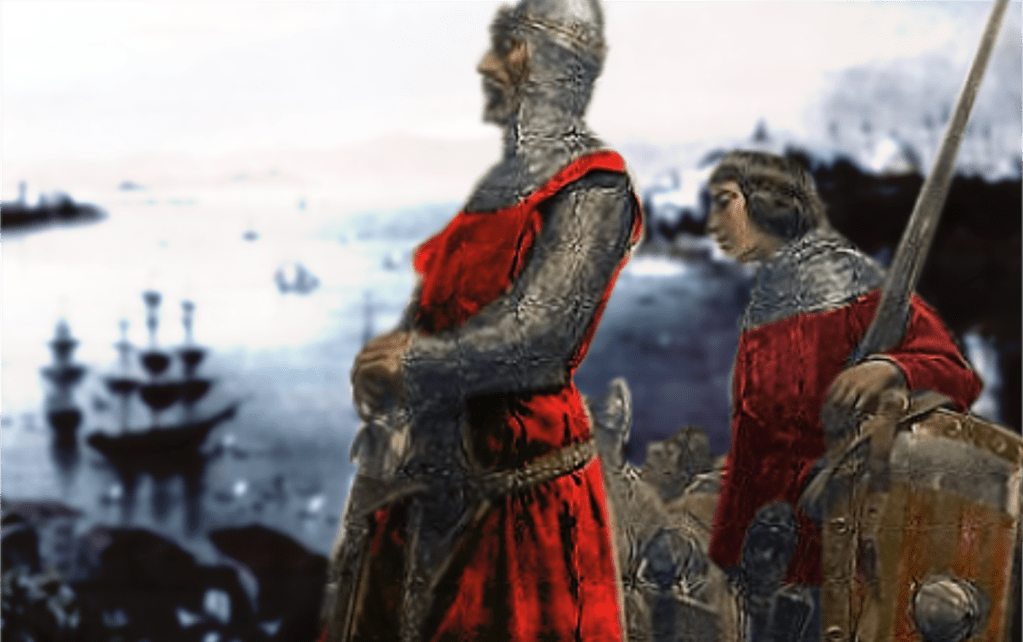
via Wikimedia Commons. Public Domain.
Descended from a noble house whose members were originally vassals of Emperor Theobald in the Principality of Marca Muntanya — now one of the constituent polities of the Kingdom of Pelayo — Arnau the Traveller was one of several Realmgardian adventurers to carve out his own domain in the continent of Laodike.
Gaining military experience fighting for Pelayo towards the end of the long wars of the Melkartite Kingdom on the Sea’s Edge, Arnau then crossed the sea to fight on behalf of the Archipelagian Empire against the nascent Arslani Dynasty. His army consisted primarily of Pelayan mercenaries and frontiersmen with little prospects in Pelayo and still eager to find more enemies to fight. These mercenaries are well-known for beginning their battles by striking their swords with flint to create sparks to demoralise and startle their enemies. Their warcry “Desperta Ferro” remains common among Pelayans.
As Archipelagian politics are infamously treacherous, Arnau and his mercenary company found themselves betrayed by various Archipelagian factions on multiple occasions, leading to a punitive expedition against the Archipelagian and a temporary alliance with his former Arslani allies — this is not altogether uncommon, as the Archipelagian attempts to pre-emptively prevent foreign mercenaries from growing to powerful by striking first had a tendency to backfire.
What followed was the capture of several cities and a subsequent complicated series of exchanges of territory between Arnau’s forces, the Archipelagian, and the Arslani. The end result was Arnau establishing his lordship over a small but wealthy strip along the coast of the mainland of Laodike, which he was able to secure through a more permanent alliance with the Arslani through his marriage to an Arslani princess. Despite its relatively small size, Arnau gave this newly-won territory the lofty name of “the Lordship of Laodike.” The initial Archipelagian attempts to reconquer Arnau’s territory were repulsed thanks to the aid of both his Arslani allies and more mercenary reinforcements from Realmgard.
Attempts to have Arnau assassinated via poison also failed and while the Archipelagians denied any involvement — a claim historians deem plausible, if not particularly likely — Arnau responded with a series of punitive raids against Archipelago, culminating in his capture of the Archipelagian Emperor’s favourite niece, whose safe return he was able to leverage into a peace treaty with Archipelago.
In yet another ironic turn and further illustration of the precarious, ever-shifting nature of alliances in Laodike, Arnau was immediately hired by the Archipelagians to drive out yet another Realmgardian mercenary company that had come into conflict with the Archipelagians. Notably, the Emperor’s same niece would be taken captive by this company, rescued by Arnau, returned to Chrysokeras, and ultimately depart for Realmgard seeking a less volatile and dangerous political situation.
Over the centuries, much former Archipelagian territory has come under the control of Realmgardian adventurers. While the majority of these have proved short-lived and unstable, a few have continued to exist and prosper. Arnau’s descendants continue to rule over the so-called Lordship of Laodike, which was grown rich as a major trading post and port for Realmgardian merchants bound for Laodike.
The Lordship of Laodike is also a major destination for Realmgardian architects and artists, struck by the unique blend of Realmgardian, Archipelagian, Arslani and ancient Laodikean styles.
Western European mercenaries coming into conflict with the Byzantines is a fairly common trend in Medieval history. The Fourth Crusade is, of course, the most famous and important example. But even before the Fourth Crusade, Venice fought Byzantium several times (and continued to fight several times after). The Normans fought the Byzantines in Southern Italy. And, honestly, everybody was basically betraying everybody…
My major influence here is the Catalan Company, which was originally hired to help the Byzantines, ended up becoming a nuisance to the Byzantines who attempted to wipe them out, attacked the Byzantines in revenge and set up their own Duchy in former Byzantine territory.
Yet another example of “everybody betraying everybody”…
That inspiration came mostly because the almogavars are one of my favourite medieval military units and the whole “create huge sparks, yell ‘Desperta Ferro!'” thing is one of my favourite battle cries in history.
The Arslani are Terrace’s equivalent of the Ottomans, but with some major differences for the sake of my worldbuilding. Notably, the real Ottomans did not intermarry with other dynasties, as that would imply said other dynasties were their equals. In fact, the Ottomans being forced to recognise the Hapsburgs as “emperors” rather than “kings” was a big deal.
And then, of course, the Winged Hussars arrived and things kinda went downhill for the Ottomans’ prestige…
Follow me here:
If you’ve enjoyed my content, please consider supporting me through Ko-fi or Patreon, or through Paypal by scanning the QR code below:

Follow Realmgard and other publications of Emona Literary Services™ below:
Subscribe to the Emona Literary Services™ Substack newsletter here.

This work is licensed under a Creative Commons Attribution-NonCommercial-NoDerivatives 4.0 International License.
The author prohibits the use of content published on this website for the purposes of training Artificial Intelligence technologies, including but not limited to Large Language Models, without express written permission.
All stories published on this website are works of fiction. Characters are products of the author’s imagination and do not represent any individual, living or dead.
The realmgard.com Privacy Policy can be viewed here.
Realmgard is published by Emona Literary ServicesTM
