30 Days of Biographies:
Orlando Aristotele
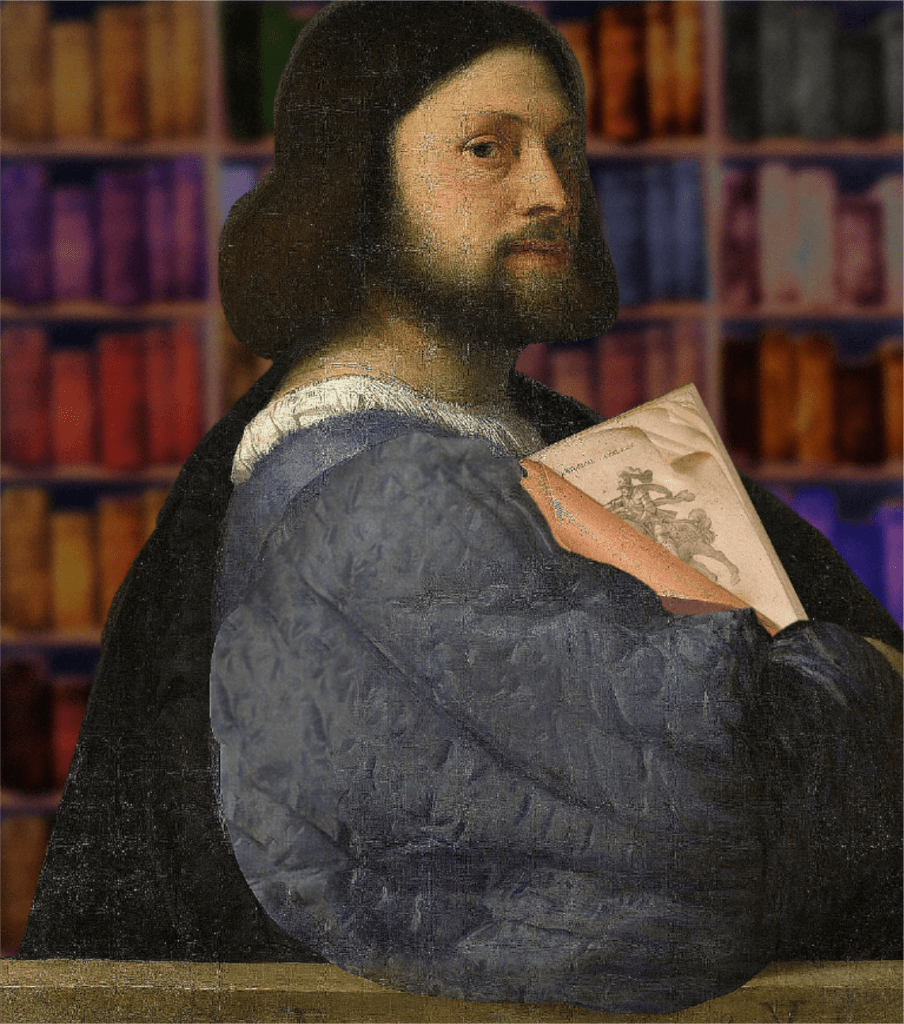
via Wikimedia Commons. Public Domain.
Although Orlando Aristotele was recognised as one of the Natalian language’s finest poets even within his own lifetime, he spent most of his adult life as a civil servant in the government of the Duchy of Mercurio. Given the turbulent state of Natalian politics, this saw Orlando imperilled by torch and pitchfork wielding mobs, bandits, assassins, kidnappers, the armies of rival Natalian states, floods, thunderstorms, and at least one ill-tempered wild boar.
Orlando spent most of his civic career as the personal secretary of the reigning Duke Giasone, with whom he once escaped an attempted kidnapping disguised as old women.
While Orlando demonstrated a lifelong aptitude and passion for literary pursuits, the death of his father at a young age and his status as the eldest child and only son among his eleven siblings saw him forced to become the breadwinner of his family.
Despite the demands of his civic career and frequent brushes with death, Orlando did find time to devote himself to his great poetic work, an epic retelling of the deeds of the legendary knight Enrico (generally called Heinrich in Gardian), the nephew of Emperor Theobald — while historical sources do attest to a knight named Heinrich in Theobald’s court, he is overall a fairly minor figure and there is no evidence that he was related to Theobald in any familial capacity.
Building on the tradition established by other poets, Orlando’s poem about Enrico focuses on the knight being driven to madness by his futile romantic pursuit of the shipwrecked foreign princess Celestina — who ultimately reconciles with Enrico but ends up falling in love with a peasant footsoldier. As established in the earlier literary tradition, Orlando himself is destined to marry Emperor Theobald’s beautiful ward Edda.
The other most significant aspect of this poem is that Orlando intended it as a mythological account of the origins of the bloodline of his employers and patrons, the Dukes of Mercurio. He traces the foundation of the bloodline back to the female knight Beatrice and the Melkartite adventurer Asdrubale (the Natalian form of an actual name attested to in the ancient Melkartite Kingdom), two star-crossed heroes who face much adversity before finally marrying and, according to Orlando’s account, becoming the distant ancestors of Duke Mercurio and his later successors as Duke down to Giasone’s generation.
Over the course of the poem, Theobald’s other knights, along with many knights in the enemy armies, are depicted as having adventures that span both the entire continent of Realmgard, far-flung regions of Terrace, and even occasionally ride all the way to the Moon on a fiery magic horse.
Orlando published several revisions of the poem over the course of his life. Although he was never personally satisfied with the result, it quickly became one of the most popular poems in Natalis and was translated into several other languages which helped its popularity spread. Even more than a century after its initial publication, Orlando’s poem remains one of the most widely-read pieces of literature on the entire continent of Realmgard.
The Gardian translation of Orlando’s original poem has proven hugely popular and influential in Middelmere and Orlando is widely regarded by Middelmerish scholars as an unmatched literary talent.
If I haven’t mentioned that I’ve recently started re-reading Orlando Furioso, I’ve certainly mentioned that it’s one of my favourite books. Hence, Orlando Aristotele is pretty much Orlando Furioso‘s author Ludovico Ariosto. The details of both Orlando Aristotele’s biography and his most famous work are largely consistent with their real-life inspiration.
“Orlando” is a reference to Orlando Furioso; “Aristotele” is the Italian from of Aristotle is a reference to the fact that I’ve misread “Ariosto” as “Aristotle” at least once…
The image I used is Titian’s A Man with a Quilted Sleeve, which was originally thought to depicted Ariosto, though the connection is now generally regarded as spurious.
Follow me here:
If you’ve enjoyed my content, please consider supporting me through Ko-fi or Patreon, or through Paypal by scanning the QR code below:
Follow Realmgard and other publications of Emona Literary Services™ below:
Subscribe to the Emona Literary Services™ Substack newsletter here.

This work is licensed under a Creative Commons Attribution-NonCommercial-NoDerivatives 4.0 International License.
The author prohibits the use of content published on this website for the purposes of training Artificial Intelligence technologies, including but not limited to Large Language Models, without express written permission.
All stories published on this website are works of fiction. Characters are products of the author’s imagination and do not represent any individual, living or dead.
The realmgard.com Privacy Policy can be viewed here.
Realmgard is published by Emona Literary ServicesTM
