
Rune Factory: Marvelous and Xseed Games.

Photo by Alex Andrews on Pexels.com
My Little Pony: Friendship is Magic: Habsro Studios.
Since release, Rune Factory 5 has caught a lot of flak on the Internet, but I’ve personally enjoyed it, and as of this writing, have played through it about twice-and-a-half.
The biggest complaint are the technical aspects, specifically the frame rate and the animations. And, yeah, they’re there, but they’re not significant enough to really bother me.
Now, that all being said, I think they’ve patched in improvements. My first and most recent playthroughs were months apart, and the second time around, it seems like it’s running better and smoother. Though it’s entirely possible I’m mis-remembering what it was like in the early days…
Honestly, I think I liked 5 more than 4, which is going to be a near-blasphemous statement to most of the fanbase.
For one thing, the re-release of 4 didn’t really handle being ported from a handheld to a home console (which is, of course, also usable as a handheld…) very well. 5 have may technical issues, but at least it feels like it was designed as a console game — as good as the art direction and character design is, it gets more chances to shine in full 3D than the isometric style of the portable games.
Though, mechanically, it didn’t quite stick the landing in terms of transitioning to full 3D. Incidentally, Oceans didn’t quite, either, but I wouldn’t be surprised if most of 5‘s issues are the result of being the work of a new developer.
More substantially, though, way too much of 4 was dependent on completely random events that the player had minimal ways of actually influencing and mostly just involved waiting around for the RNG to cut you a break.
Incidentally, we’re sort of in a golden age for Rune Factory right now. Especially considering the original developer went bankrupt.
5 has proven popular, with the fanbase warming up to it as time goes on — if not beloved. As of Fall 2022, a new Rune Factory is in development, though I’ve read that it’s going to be a spinoff rather than a next number entry. 4 got re-released on Switch, as did 3, there’s talk of 1 and 2 getting re-releases.
And even other developers are putting out games that really owe a debt to the Rune Factory concept.
Incidentally, I have played Harvestella. It’s less of a straight-up Farming Sim than it was promoted as and kinda ends up feeling like a more actiony Final Fantasy game with several Rune Factory aspects that ends up being less good than either Final Fantasy or Rune Factory…
Also, the story’s kind of a nonsensical mess that makes a really weird swerve into full-on Sci Fi. Now, that shouldn’t be considered a spoiler — it’s not so much a twist as it is the first major plot beat. The spoiler is exact implications of that really weird swerve into full-on Sci Fi.
Though, honestly, I should have been able to see that coming. The “stella” is right there in the title…
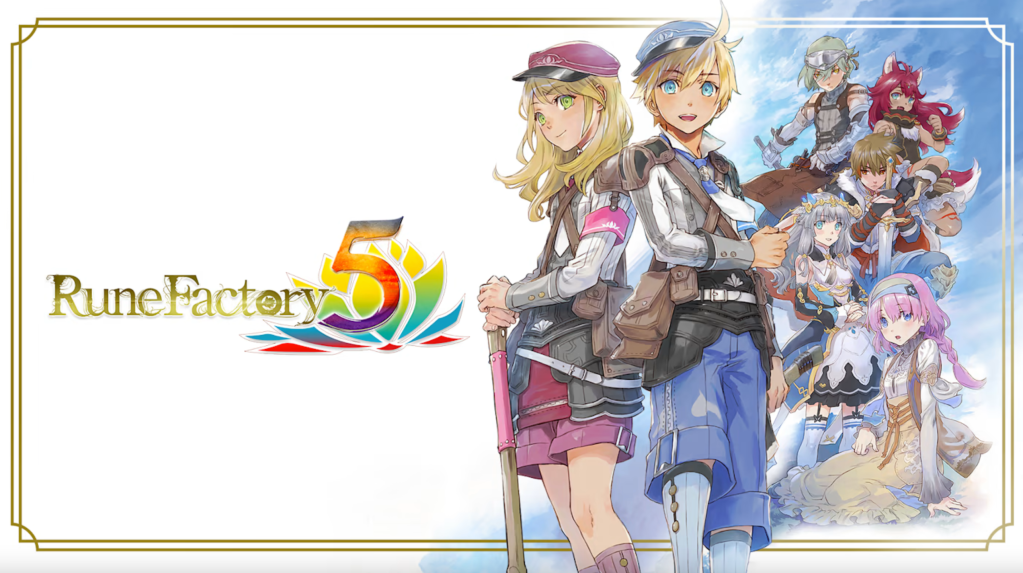
The North American ad campaign for Rune Factory 5 centres around the slogan “Fight. Farm. Fall in love.” And, yeah, that about sums it up.
Although Rune Factory is very much a JRPG and have become more story-driven as the series has progressed, it’s never entirely discarded its origin as a Bokujō Monogatari spinoff. And whereas Bokujō Monogatari is a farming game, Rune Factory is an RPG with a prominent farming subsystem.
You don’t necessarily progress the game by farming, but the farming is your most stable source of both income and skill/stat improvement, especially in the early game.
It’s not necessarily the main point of the game, but it’s important enough that you can’t really play a Rune Factory game without also farming.
Incidentally, it does sort of tie into the lore of the games. The majority of playable characters in the series are something called an Earthmate.
Really, it’s exactly what it sounds like: basically a person with a special connection to the earth and a unique ability to utilise the magic that keeps the natural world in balance — the runes that I’m assuming are the reason the series is called Rune Factory…

Photo by Erik Mclean on Pexels.com
So, there is ultimately a plot-relevant reason why you’re farming.
The stories of the Rune Factory games have never been great, but they’ve always been serviceable.
Usually, it boils down somebody or something disrupting the balance of the runes and it’s up to you to stop it and restore the balance. The series has had an ongoing story around the conflict between the Sechs Empire and the Kingdom of Norad (which doesn’t have an article of the wiki), and although the Empire is usually the bad guys, most of the geopolitical details and implications of the conflict are consigned to the background.
You’ll be making your way through a series of dungeons that tend to cleave to recurring themes and settings. Both Rune Factory 4 and 5, for example have a Forest dungeon, a Lava dungeon, and a Vaguely Gothic Horror-themed dungeon (5 actually has a couple).
Mechanically, the gameplay is pretty simple but well-executed for what it is. At the baseline difficulty, the games — at least as of 4 (the oldest game in the series I can still remember in details) — aren’t particularly difficult and it’s very easy to become over-levelled relative to your progress through the story.
My one complaint in regards to difficulty isn’t even about the difficult itself, it’s that a lot of the bosses in 4 had way too much health/defence and took forever to beat. A problem, incidentally, largely solved in 5. On the other hand, 5 runs into the opposite problem, with a couple of exceptions, even most of the bosses can feel like pushovers if you’ve been working on levelling up.
Also, it’s way too easy to get your hands on a weapon that’s hilariously overpowered and can take out even most of the bosses in a couple hits. As of 5, if you give characters five handmade gifts in one day, they’ll reciprocate by giving a gift in return.
These gifts are related to what the character in question: the doctor gives you potions, the flower shop lady gives you flowers, the apprentice blacksmith gives you forging material, the actual blacksmith gives you weapons.
Now, what exactly they’re giving you is random and there’s no ceiling to the level of stuff they give you, so it’s entirely possible they’ll be giving you stuff completely out of proportion to your progress in the game, meaning it can be ludicrously easy to make a whole bunch of money in a short time or end up with a weapon that will absolutely wreck everything right up to the endgame.
You also can’t really die in Rune Factory as of 3 (again, 4 is where my clear memories the series start, so don’t quote me on that). There are a couple places in 4 where you do die if you run out of health, but it’s not a major threat at those points. Most of the time, you just wake up in the given game’s town clinic with slightly lighter pockets.
It makes sense. Rune Factory is a pretty laid-back, low-stakes, low-pressure series aimed at a youngish audience. There are some legitimately emotionally powerful scenes and the games do touch on heavy themes like loss and mortality. For the most part, though, it’s at about the level of a typical Disney movie and has a pretty Realmgard-ian sense of humour and one gets the sense that the localisation team had a lot of fun with their jobs.
Now, maybe a script full of memes and Pop Culture references won’t appeal to everyone, but I think it’s enjoyable. For example, during the Harvest Festival, you can hype up your potato by noting you can “boil ’em, mash ’em, stick ’em in the stew“…ish. I working from memory here and I don’t remember if it’s the full, actual Lord of the Rings quote, or just a paraphrase. But it is clearly a reference.
All in all, there are probably better games than Rune Factory, but there aren’t many that fill the same niche. The original Bokujō Monogatari has the farming, but not the Fantasy aspect, and there aren’t many laid-back, idyllic, approachable Fantasy games out there.
My other recommendations are here.
And check out my socials and my email list:
If you’ve enjoyed my content, please consider supporting me through Ko-fi or Patreon, or through Paypal by scanning the QR code below:

Follow Realmgard and other publications of Emona Literary Services™ below:
Subscribe to the Emona Literary Services™ Substack newsletter here.

This work is licensed under a Creative Commons Attribution-NonCommercial-NoDerivatives 4.0 International License.
The author prohibits the use of content published on this website for the purposes of training Artificial Intelligence technologies, including but not limited to Large Language Models, without express written permission.
All stories published on this website are works of fiction. Characters are products of the author’s imagination and do not represent any individual, living or dead.
The realmgard.com Privacy Policy can be viewed here.
Realmgard is published by Emona Literary ServicesTM
