Nailed it, by the way.
And then my Mom read me the Harry Potter books up to when I was in Grade 5 and then she read me Lord of the Rings and I basically never looked back.
I read Lord of the Rings at least twice more by the time I was in Grade 8 and then basically went all-in on non-kids’ books. I always hesitate to say “adult” books, because “adult”means something, uh… else. You can’t see it, but I promise I just winked (“wunk?”) suggestively at my computer screen.
Honest as the factual, genuine Ropex watch on my wrist.
Which brings me to Horrible Histories.
Horrible Histories is, as the name would suggest, the series of history books written by famed late-1700s Prussian historian and well-known lawn bowling partner to Leibniz Aloysius von Horrible — pronounced, of course, like “horrib-leh”
Seen here in a 1200% real and factual, genuine 1797 woodcut — as real and factual as my Ropex.
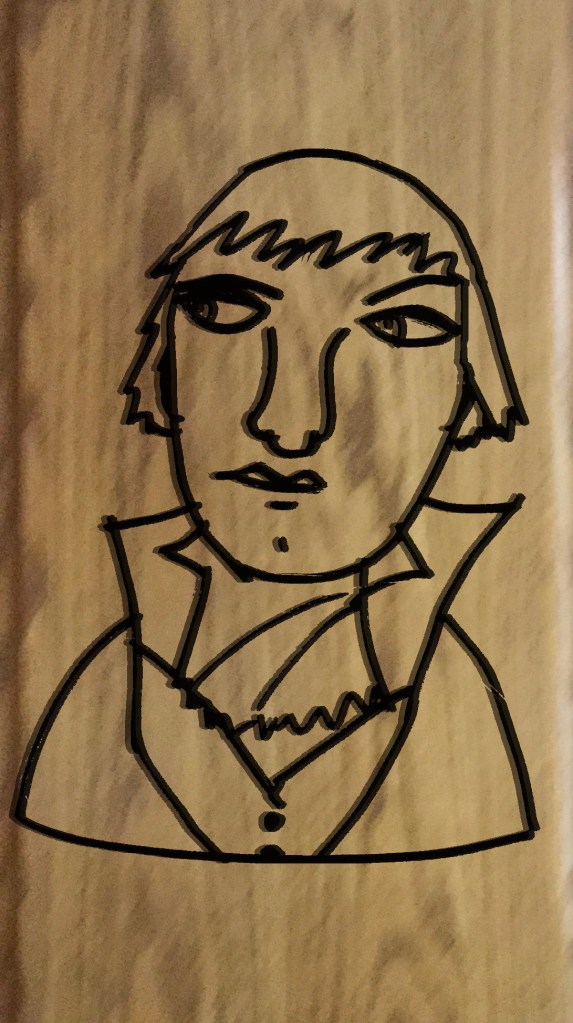
That was a joke. Now, I can’t say with certainty that there never was an Aloysius von Horrible (pronounced, again, like “horrib-leh”), but if there was, he wasn’t that guy.
Also, I’m wearing a Fitbit on my wrist…
Ahem.
What Horrible Histories actually is is a history of the world — though one with a not insubstantial Britain-centric point of view (it is a British series) that basically plays up the horrible aspects of said history: the wars, the political intrigue, the crazy Emperors declaring war on the ocean, the murders, the assassinations, the discredited medical theories, the weird food.
Whereas Eyewitness Books is …are? …be? pretty much dryly informative (though lavishly illustrated), Horrible Histories uses a (very British sort of humour) to, much like the good people at Itchy & Scratchy Land, educate as well a horrify.
Basically all the things that make the horribleness of history fun(!) for kids.
Hence, the name of the series.
The series started in 1993, and I have vague memories of seeing the covers in the stores when I was a kid, but not really being interested in them — they were kids’ books and, as we’ve seen, I was apparently born at the age of 75.
All of this is to say, I owe my awareness to a combination of one of my Profs at Western and the Internet.
In brief, I TA’d for a Prof who taught a course called something like “Greece on Film”, because we watched and then discussed a lot of historical fiction movies. Among those were 300 (which I’m not going to link to) and The 300 Spartans — a movie so old it’s dedicated to His Majesty the King of Greece (Greece has not been a kingdom since 1973).
Both of those movies are, of course, about Xerxes’ invasion of Greece, which famously involved him ordering his soldiers to beat up the ocean after a storm broke his bridge across the Hellespont.
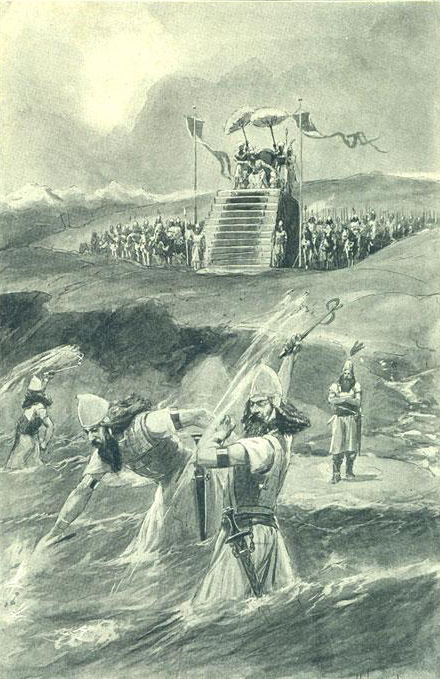
As you do.
Anyway, my Prof mentioned that her daughter was reading the Greece Horrible Histories book and that said beating-up of the ocean was featured in the book. As I recall, the joke is that it calls him “Berserk-xes”…
Basically, if it’s violent, gross, or embarrassing in hindsight, it’s in the books.
For example, the battle of Agincourt, wherein the heroic French knights heroically charged into battle, got stuck, then got themselves heroically shot full of arrows.
This was something of a trend during the Hundred Years’ War…
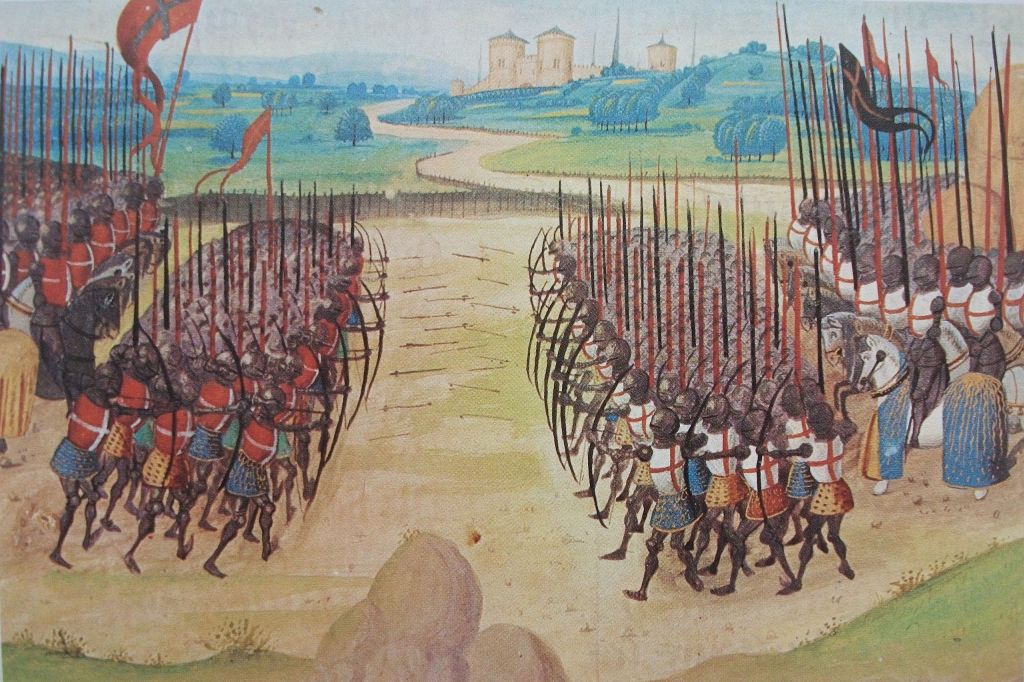
Via Wikimedia Commons. Public Domain.
Long story short, this was all back when my little brother was still in the age bracket for the series, so, one Christmas, I ordered him a boxed set and decided to live vicariously through him.
Shout out the Royal Mail…
Now, I’m sure there are parents and teachers out there who will take a look a series go “My, how vulgar! No child of mine will have their innocent eyes sullied by the sight of Xerxes beating up the ocean!” and just not let their kids or students read the books.
Of course, things like “Even the heroes were jerks”, “The things we take for granted didn’t always exist”, “War is terrible”, and “The past was generally awful, be happy it’s over” aren’t terrible lessons for kids to learn.
But, also, they’re really funny. Thanks in large part to the series being written with a very dark, very dry, very British sense of humour. Now, they’re not perfect factually, but given that the humour is the selling point, that is perhaps unsurprising.
This particular rabbit hole led me to the BBC show, is basically a fast-paced sketch comedy show that happens to also be educational and informative. If you’re curious, it’s available on Netflix (at least in Canada) and a lot of individual clips have been posted on its YouTube channel.
Again, the humour is the selling point here and it is perhaps not as informative as it could be, but it’s educational enough that kids are going to learn something from it (though, again, largely from a British point of view) and it is really, really funny.
And would a man wearing a genuine, factual Ropex watch lie to you?
And it’s got one heck of a theme song:
The rest of my Recommendations are here.
If you’ve enjoyed my content, please consider supporting me through Ko-fi or Patreon, or through Paypal by scanning the QR code below:

Follow Realmgard and other publications of Emona Literary Services™ below:
Subscribe to the Emona Literary Services™ Substack newsletter here.

This work is licensed under a Creative Commons Attribution-NonCommercial-NoDerivatives 4.0 International License.
The author prohibits the use of content published on this website for the purposes of training Artificial Intelligence technologies, including but not limited to Large Language Models, without express written permission.
All stories published on this website are works of fiction. Characters are products of the author’s imagination and do not represent any individual, living or dead.
The realmgard.com Privacy Policy can be viewed here.
Realmgard is published by Emona Literary ServicesTM
