To briefly provide some context, Midnight Suns (as in “Yellow Sun of Earth“) the game is based on Midnight Sons (as in “male offspring“) the comic, referring to Marvel’s paranormal-focused superhero team.
“Sons” was changed to “Suns” on the one hand to presumably be more inclusive and on the other just to be more factually accurate. The game’s version of the team is basically gender-equal and actually ends predominantly female if you’re playing as a woman.
Conceptually, the team is the same and still dealing with predominantly fighting against paranormal and supernatural threats — though mostly Hydra, who tried to control the demons and ended up getting taken over by the demons…
Marvel’s Midnight Suns: 2K, Firaxis, and Marvel.
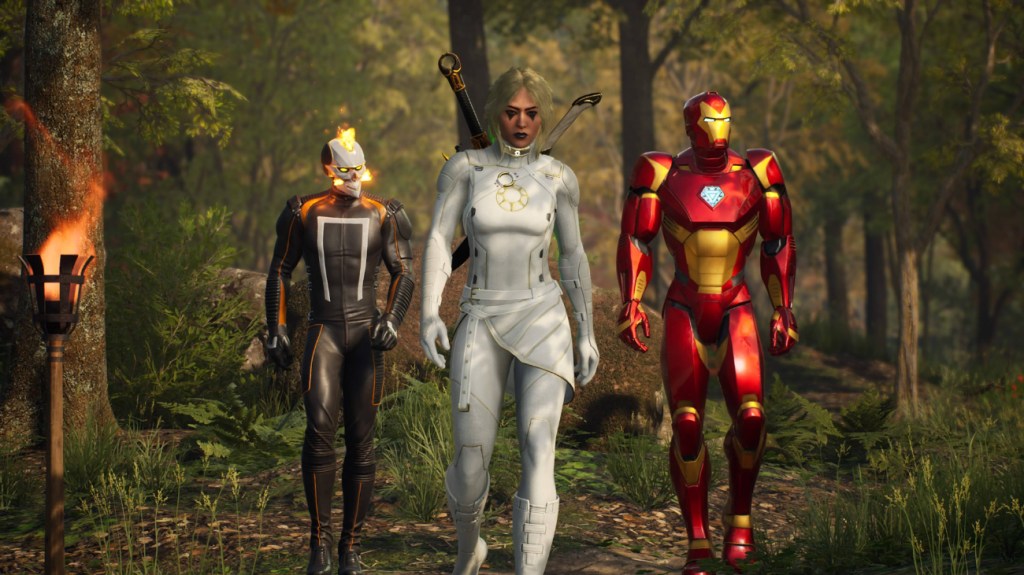
For the most part, the in-game version of the team mostly has an obvious connection to the supernatural. Dr. Strange is a wizard, Blade is a Vampire (technically a dhampir), Nico Minoru is literally a witch, Ghost Rider is a demon (also, not Johnny Blaze), Magik is… self-explanatory, really.
On the other hand, several of the playable heroes decidedly aren’t supernatural-oriented. The Avengers are represented by Iron Man and Captains Marvel and America. They don’t really have any connection to the magical aspects of the Marvel universe, but it at least makes sense to include them because they’re obviously associated with Dr. Strange.
On the other hand, Spider-Man (incidentally basically the same version as from the PS4 Spider-Man) and Wolverine were included probably just because it would be stupid to release a Marvel video game without including Marvel’s two most popular characters. That being said, their inclusion ends up making sense as the plot progresses given that Venom and Sabretooth end up also being taken over by the demons and becoming major bosses.
The player character is a completely original hero called the Hunter, created specifically for the game by 2K with creative input from Marvel. FYI: the Hunter isn’t just called the Hunter as your superhero name; “Hunter” is also established to be your actual given name.
Without getting either too much into spoilers or an overly in-depth explanation: you’ve been dead(ish) for 300 years, your (actual) mother is Lilith, the (metaphorical) Mother of all Demons, she’s been dead(ish) for 300 years too, Hydra woke her up, she took over Hydra, things promptly go south, as they do when the bad guys try to bind the eldritch evil power to their will…
The heroes wake you up to stop Lilith.
All in all, the plot isn’t that much different from the old Ultimate Alliance games, in that it’s a fairly episodic series of events largely just intended to let you see as much of the Marvel universe as possible, though with an obvious focus on the magical and paranormal aspects. There are some interesting twists and plot developments, but it’s not really that anything other than exactly as serviceable as it needs to be.
The gameplay is probably the most novel and interesting thing about Midnight Suns. It’s decidedly not like the Ultimate Alliance games.
Marvel’s Midnight Suns: 2K, Firaxis, and Marvel.
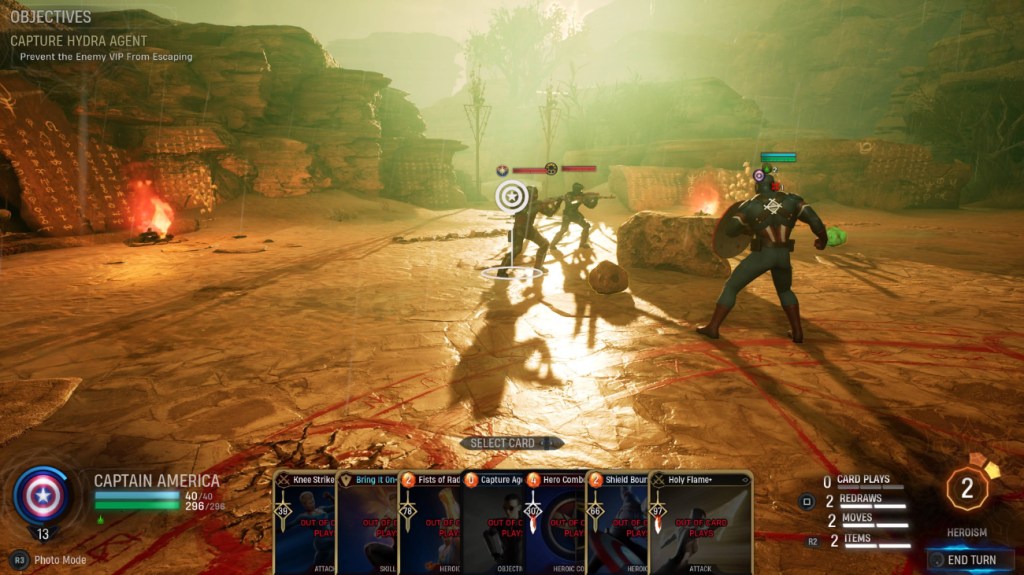
Simply put, Midnight Suns is a card-based game. Unlike something in the vein of Hearthstone, it’s not a virtual card game. Your characters’ abilities are represented as cards and playing a card is how you use an ability.
The gameplay loop works by using your basic abilities to build up Heroism, which is the resource used by your more powerful abilities, as well as triggering environmental attacks like, say, throwing a dumpster at somebody or dropping a crane on them.
With the exception of shoving enemies, which can be used to score instant KOs by pushing them off edges, there’s no basic, simple “Attack” option. Everything other than moving or shoving needs to be activated by playing a card and you only have so many non-card actions per turn.
Although every character has the same basic categories of card abilities, each characters abilities work in different ways that encourage different playstyles. Most of Iron Man’s abilities are powered by discarding and redrawing them, Captain America builds up defense points called Guard and his abilities are stronger the more of it he has, Spider-Man moves around a lot and gives himself bonus actions, Nico’s powers have effects triggered randomly, Magik can teleport and create portals that function as stage hazards.
The Hunter has the most adaptable playstyle and starts off able to go a little bit of everything. However, as the game progresses, you have chances to influence the Hunter’s personality. Superficially, it’s a standard morality system, but it has no consequences in terms of the story. By playing the Hunter as more Light or Dark, all you’re really doing is unlocking new slates of abilities. Light is focused on support and healing and Dark is focused on offence and raw power. On paper, Dark probably sounds better, but a high-level Light Hunter is one of the most effective support characters in the game.
Honestly, the system is a little daunting and it took few a few hours before I was comfortable with it. Midnight Suns isn’t necessarily hard but there’s definitely a learning curve and some of the fights, especially the bosses, have pretty annoying gimmicks that can feel really cheap and basically every enemy causes some kind of status effect with every attack.
Marvel’s Midnight Suns: 2K, Firaxis, and Marvel.
Between missions, there’s a fully-explorable hub called the Abbey, where the heroes hang out and which is full of various side missions and little mysteries to unravel. That’s all basically entirely optional, which is good because the Abbey grounds are too big and too labyrinthine for their own good. On the other hand, unravelling said mysteries does reveal some pretty interesting supplementary materials about the game’s backstory, as well as being necessary to getting the Hunter up to full potential by unlocking exploration abilities that in turn unlock opportunities to gain new in-mission powers.
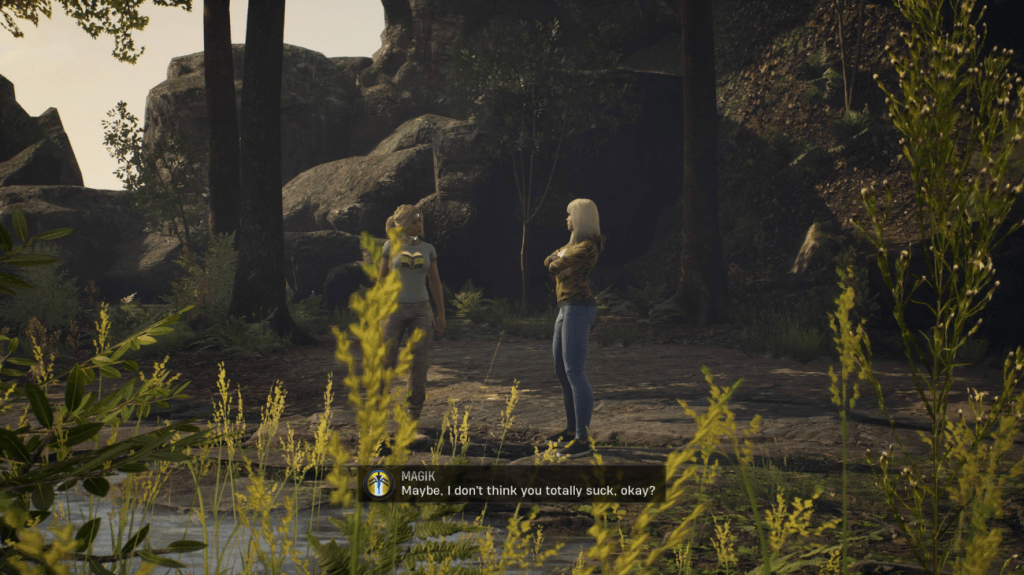
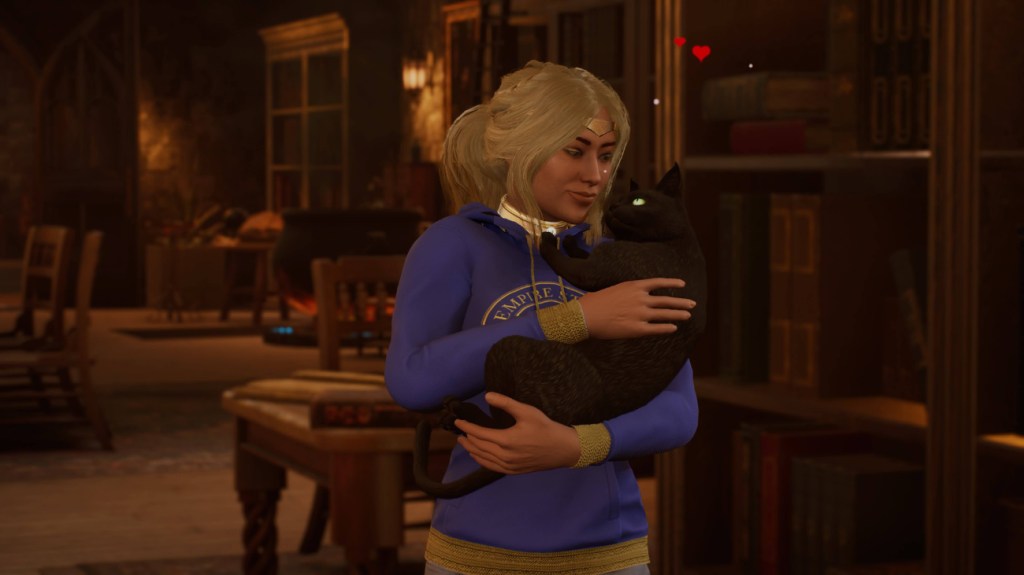
The real appeal to the between-mission time in the Abbey is the interactions and relationships between the Hunter and the other heroes. Again, this is all purely optional, but does help the other heroes get stronger and the dialogues between the Hunter and the other heroes are actually really, really well-executed.
Marvel’s Midnight Suns: 2K, Firaxis, and Marvel.
Befriending the other heroes ends up feeling a lot like a Dating Sim, actually. In fact, the original plan was for the other heroes to be romanceable but this was ultimately walked back when the devs realized it had the potential to create some real contradictions to the established Marvel canon.
But, hey, having Spider-Man get together with anybody but Mary Jane would be entirely in character for Marvel…
Even without actual romances, the relationships the Hunter can develop with the other characters are still really compelling. Hunter and the other heroes clearly end up genuinely caring about each other and even some of the more aloof or self-centred heroes really open up to Hunter. And, honestly, given that it’s pretty much taken for granted that a modern RPG will have romanceable companions, the focus on deep, but purely platonic friendships is actually a pretty cool change of pace.
While Midnight Suns is left open-ended enough to imply a sequel and is compelling enough but as a story and a gameplay experience that it probably deserves one, it probably won’t be getting one. I can’t find concrete numbers, but various sources, up to and including 2K’s execs have described it as a flop — with the potential silver lining that those same execs have also noted that Firaxis games tend to have pretty long tails, though a sequel does seem to have been ruled out by the studio.
Never say never, and all, but don’t hold hold your breath, either.
Still, Midnight Suns is a unique enough experience that it’s worth checking out. Especially in Halloween season, given the spooky spin it puts on the Marvel mythos.
My other recommendations are here.
My social media pages and email list are here:
If you’ve enjoyed my content, please consider supporting me through Ko-fi or Patreon, or through Paypal by scanning the QR code below:
Follow Realmgard and other publications of Emona Literary Services™ below:
Subscribe to the Emona Literary Services™ Substack newsletter here.

This work is licensed under a Creative Commons Attribution-NonCommercial-NoDerivatives 4.0 International License.
The author prohibits the use of content published on this website for the purposes of training Artificial Intelligence technologies, including but not limited to Large Language Models, without express written permission.
All stories published on this website are works of fiction. Characters are products of the author’s imagination and do not represent any individual, living or dead.
The realmgard.com Privacy Policy can be viewed here.
Realmgard is published by Emona Literary ServicesTM
