The Imperial Golden Age
For the first time in its history, most of Realmgard was unified under a single authority. Only the extreme north and northwest of the continent would remain beyond Imperial control.
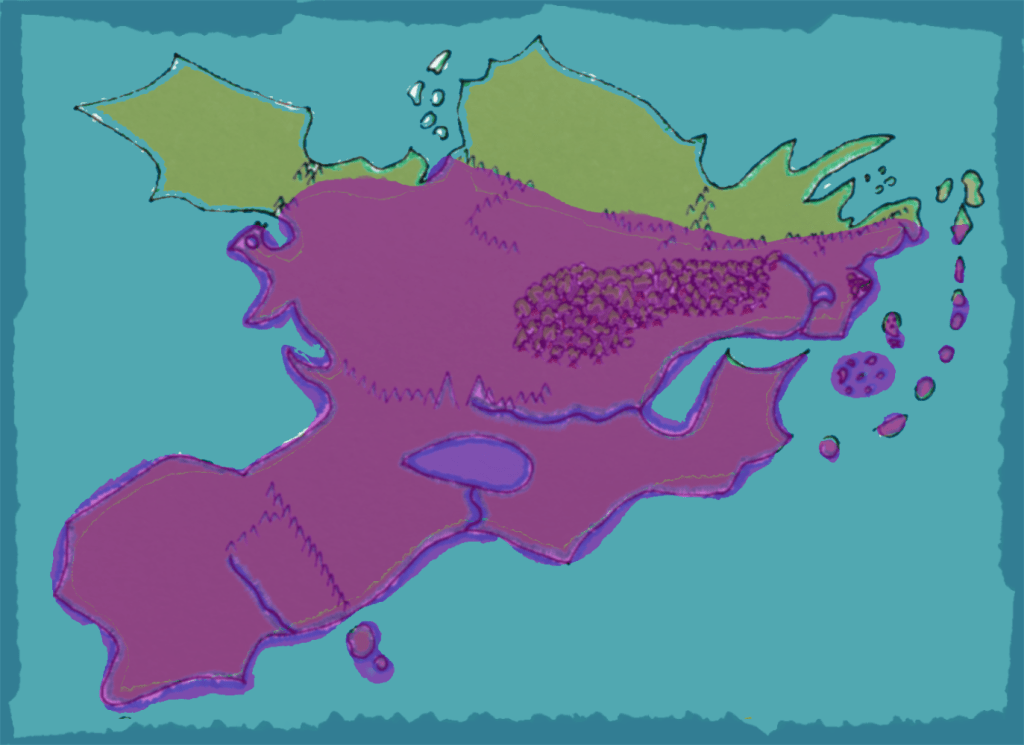
Imperial territories beyond the geographical boundaries of Realmgard are not included.
Though known to later — and predominantly non-Elven — historians as the Elven Empire, the Elves referred to their own state simply as the Empire without qualification. In truth, no such qualification was necessary. For centuries, the Elven Empire was the sole claimant of any semblance of Imperial centralised on the continent. In addition to unifying nearly the entire continent of Realmgard, the territories of the Elven Empire included most of the northern cost of the continent of Arena to the direct south of Realmgard, the islands of Archipelago where the ancestors of the Elven Emperors orginated, and extensive territories of the coastal regions of other eastern continents.
Even while expanding into an intercontinental polity and coming into contact with other large-scale, sophisticated societies, the Elves pointedly avoided referring to other rulers as “Emperors” as a means of projecting their own superiority and seniority in international affairs, a policy adopted regularly by other rulers throughout the history of Terrace.
Similarly, the states that arose after the decline of the Elven Empire — such as the domain of Emperor Theobald — deliberately referred to themselves as Empires in order to establish themselves as the rightful successors of the ancient Elven Empire. After centuries as the sole major power on the continent of Realmgard, it is hardly surprising that the legacy of the Elven Empire would continue to influence future states in such a way.
Though the early decades of the Empire’s existence were a time of continuous warfare and aggressive territorial expansion, after the rapidly-expanded borders of the Empire stabilised a long era of peace settled over the continent. For the first time in its history, most of Realmgard was unified under a single authority. Only the extreme north and northwest of the continent would remain beyond Imperial control. The Empire’s borders would contract in its later centuries, it nevertheless remained the pre-eminent power on the continent and would be the largest polity seen on Realmgard for centuries after its dissolution.
Expanding trade routes and occasional military campaigns beyond the continent brought Realmgard into contact with foreign cultures and ushered in an era of cultural and technological innovation as the Elves freely adopted ideas from other cultures both in Realmgard and beyond.
Similarly, the Empire became increasingly diverse in terms of language, ethnicity, and belief. Even from the beginning, the Empire was never truly “Elven” — many non-Elves served in positions of power and influence and, as we have seen, a Melkartite Queen became a prominent Empress.
Though different peoples co-existed for the most part in harmony and equality, the Elven language and culture was given a place of prominence in the Empire’s culture as a unifying principle of Imperial identity. Those were did not adopt Elven culture or language were often viewed and dismissed as mere barbarians and outbreaks of hostility and even outright violence between the different peoples of the Empire were not uncommon throughout the Empire’s history.
That being said, the middle period of the Empire was largely peaceful both domestically and internationally and led to a flourishing of art, culture, building, and wealth throughout the Empire’s territory, which is remembered by Realmgardian historians as one of the continent’s great golden ages, even long after the decline and end of the Empire.
However, even the dramatic period of the Empire’s end would have a formative effect on the future of Realmgard, surpassed only its previous golden age. The first traces of a recognisable modern Realmgard would emerge from the ruins of the original Elven Empire.
Discover the rest of the Encyclopedia Realmgardica here:
If you’ve enjoyed my content, please consider supporting me through Ko-fi or Patreon, or through Paypal by scanning the QR code below:
Follow Realmgard and other publications of Emona Literary Services™ below:
Subscribe to the Emona Literary Services™ Substack newsletter here.

This work is licensed under a Creative Commons Attribution-NonCommercial-NoDerivatives 4.0 International License.
The author prohibits the use of content published on this website for the purposes of training Artificial Intelligence technologies, including but not limited to Large Language Models, without express written permission.
All stories published on this website are works of fiction. Characters are products of the author’s imagination and do not represent any individual, living or dead.
The realmgard.com Privacy Policy can be viewed here.
Realmgard is published by Emona Literary ServicesTM
