Nainen,
The Goddess
with Gleaming Hair
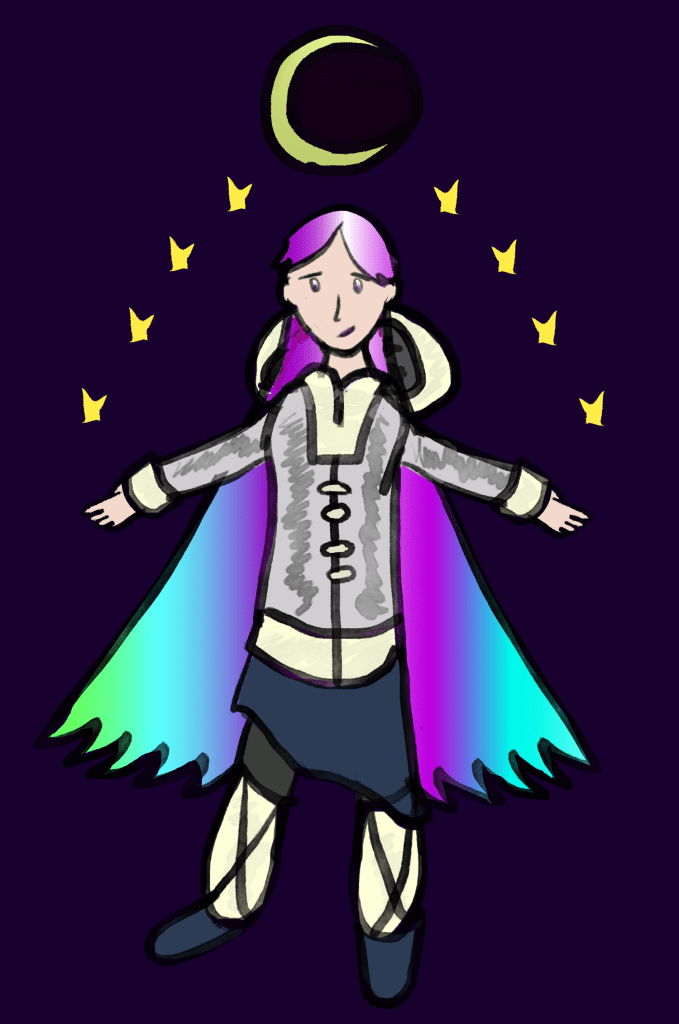
Goddess of the night sky, the Moon & Stars, patron of Aurora.
One of several gods unique to the Aurorean pantheon, Nainen has long been viewed as the most important of these local gods in her role as the patron of the land of Aurora. While predominantly a sky goddess — particularly the night sky — Nainen also has aspects of a goddess of beauty and love.
Invariably depicted as a beautiful woman with long, gorgeous hair, the aurorae in the night sky which given the land its name are said to be caused by the shimmering of Nainen’s hair. Similarly, a common metaphor in Aurorean poetry is to refer to the Moon as “Nainen’s lamp.”
Worship of Nainen predates the arrival of settlers from the Elven Empire and elsewhere in southern Realmgard — most notably the large influx of Middelmerish and Gallicantien soldiers several centuries after the fallen of the Elven Empire. Notably, although Gardian and Gallicantien have become the languages of the majority of Auroreans, the name of Nainen (along with the other traditional Aurorean gods) is derived from the ancient Aurorean language of the original inhabitants of what is now the Kingdom of Aurora — dialects of which are historically the traditional language (and remain spoken by) the Trollic, Wilderling, and Tarandarius populations of Aurora.
Although the arrival of the Elves and other southern peoples in Aurora introduced many Imperial practices and rituals, including introducing the cults of the gods found elsewhere in Realmgard, Nainen was never supplanted as the most important deity in Aurora and has been worshipped as the patron goddess of Aurora for centuries, if not millennia.
Nainen is also a major figure in Aurorean stories and poems, a recurring helper of the Aurorean folk hero Sauvaherra. Many Aurorean verses begin with a poetic invocation of Nainen:
Let us clasp our hands together, let us form a circle,
as recited by the Aurorean sorceress Apolline Castor
Let us dance together, til Nainen’s lamp is lighted,
Til all the stars are shining and the moon is brightly kindled.
Let us sing the songs that have come down from our fathers:
Tell the tales of heroes, the ancient ages of Aurora.
Interestingly, although the Kingdom of Aurora and the Duchy of Tanith are located at almost the furtherest possible points of Realmgard from one another, that Nainen and the Tanithite patron goddess Malketa are both sky goddesses has created a good deal of cultural affinity between Aurora and Tanith. Taken to its logical conclusion, a general consensus has arisen between the two peoples that Nainen and Malketa are, in fact, simply the same single goddess worshipped under different names at opposite ends of the continent.
Although aurorae rarely occur as far south as Tanith, this ongoing association of Nainen to Malketa has lead to the rise of Tanithite depicts of their patron goddess with the shimmering, variegated hair typical of Aurorean depictions of Nainen. Similarly, it is becoming increasingly common in Aurora to depict Nainen with the appearance of a Tanithite woman.
It is also becoming increasingly common for Tanithite travellers to venture across Realmgard to Aurora to view the aurorae in the night sky for themselves as a sort of religious pilgrimage.
Aurora was also supposed to be Realmgard‘s Canada, but I was actually started Worldbuilding, it’s probably at least also 40% Finland. That wasn’t intentional, but I decided to roll with it — Finland has some cool folklore and borrowing from Finnish allows for some pretty cool names.
And, all in all, it sorta fits with the fact that Realmgard itself is sort of a midpoint between North America and (at least Western) Europe.
So, anyways, “Nainen” is just the Finnish word for woman, maybe with the connotation that she’s The Woman — as I explained before, not unlike how in Ancient Greek, “Despoina” and “Potnia” (an older form of the same word) is used for several Mycenaean goddesses, where the word/name simply means “the Lady” or “the Mistress.”
There’s a certain parallel here between Nainen and the Greco-Roman goddess Eos/Aurora — the former is Greek, the later is Latin. FYI: be cautious looking them up on Wikipedia, the header image for both articles are painters which depict the goddess in question as very beautiful and very naked…
The goddess Aurora is where we get the word for the Aurora Borealis (and corresponding Australis in the southern hemisphere). The Kingdom of Aurora is named for the lights themselves.
The “Malketa and Nainen are the same goddess with different names” thing is invoking the real-world Interpretatio Graeca — the phenomenon where ancient polytheistic societies (named after the Greeks, but also extensively done by the Romans, among others) would freely adopt foreign gods into their pantheons and/or identify foreign gods with their own odds: Melqart came to associated with Hercules after the Punic Wars, Isis (Egyptian) and Cybele (Phrygian; inland modern Turkey) were both non-Roman gods widely adopted by the Romans, Thor was identified with Zeus as the Romans went north, the Celtic god Camulos was identified with Mars as the Romans encountered the Gauls.
And so forth.
I couldn’t quite artistically manage to draw her in traditional Sámi or Finnish-style clothing, but since she’s the goddess of a kingdom where it’s always winter and (only occasionally Christmas), I figured I could at least draw her in cold-weather gear.
As always, follow me here:

This work is licensed under a Creative Commons Attribution-NonCommercial-NoDerivatives 4.0 International License.
The author prohibits the use of content published on this website for the purposes of training Artificial Intelligence technologies, including but not limited to Large Language Models, without express written permission.
All stories published on this website are works of fiction. Characters are products of the author’s imagination and do not represent any individual, living or dead.
The realmgard.com Privacy Policy can be viewed here.
Realmgard is published by Emona Literary ServicesTM
