Akmon,
The Fire-Tamer
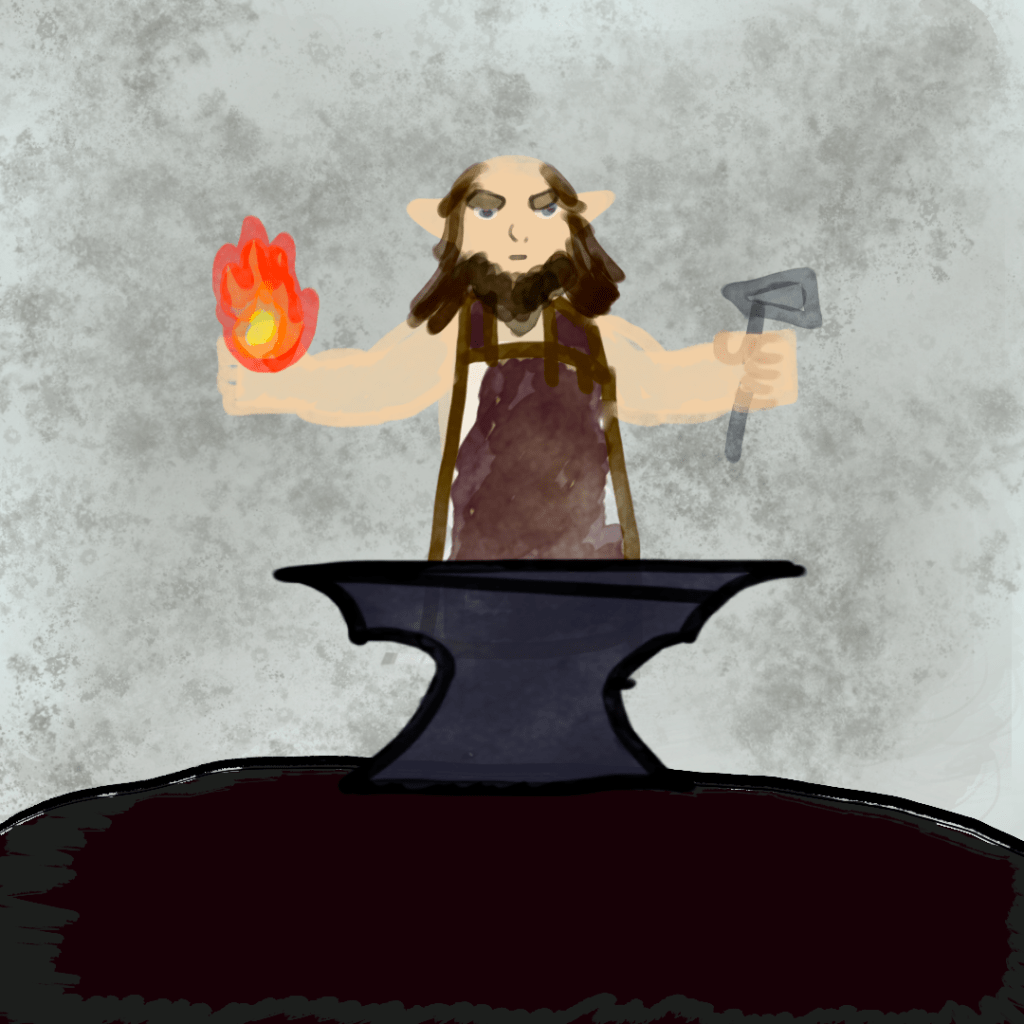
God of fire, the forge, manufacturing, and alchemy, patron of blacksmiths, builders, and alchemists
The brother of Aeto, Akmon is not usually paired as closely to another member of the Ennead as the rest of the nine deities. In the myths, he is often associated with his brother and it is worth noting that Akmon is universally depicted as the first god to follow Aeto from the Distant Verdant Star to join him in the new world of Terrace.
As told in the stories of the creation of Terrace, Akmon’s primary role was to construct the divine dwelling place of the gods and craving each of their thrones. It is said he first forged a multitude of solid gold automata out of divinely-enchanted living metal to assist him in this endeavour and act as the servants of the household of the gods.
Iconographically, Akmon is often depicted alongside Aeto as the two brother-gods are understood as ruling over domains which, when taken together, represent mortals’ attainment of civilisation and technological advancement — metalworking and the development of law codes are not generally considered by scholars to be the prevue of “primitive” societies.
Although Akmon is not generally paired with another member of the Ennead, he is widely paired up, both in the mythology and in iconography with his wife, the nature goddess Treza, who is not properly considered a member of the Ennead.
Although the Ennead are usually considered the most important gods of Realmgard, the grouping of the nine together is less an indication of importance and primarily a designation based on familial ties, as the gods of the Ennead are all related to one another either by birth or by marriage.
Treza and her daughters are not properly considered deities of the Ennead, and the myths tell of them coming from elsewhere — perhaps the Distant Verdant Star as the gods of the Ennead once did, but the myths are vague on their exact origin.
While presented in the mythology as a diplomatic means to unify the two groups of gods, the marriage between Akmon and Treza is also broadly understood as symbolising the coexistence between civilisation and the natural world, which Akmon providing the ideal example of prudent and sustainable use of natural resources.
Although Akmon is the god of many domains centred around manmade phenomena, his respect for the natural world ruled over by his wife is well-attested in the myths. In his capacity as the god of fire, Akmon takes on a role of a nature god, working with his wife to facilitate the cycle of renewal and rebirth — demonstrated, for example, in forest fires allowing for the generation of new life in old forests.
Primarily associated with metalworking, Akmon is broadly understood as the god of any act of engineering, construction, or transform. Due to this ultimately being understood as including any act which effects a change on something else, he is also venerated as the patron god of Alchemy and alchemists.
Famously ugly, Akmon is well-attested as having a friendly demeanour that belies his brutish appearance. He is known to be generous and open-handed and one of the quickest gods to lend his aid to mortals. There are many examples in the mythology of Akmon bestowing divine weapons and armour to mortal heroes at the request of the other gods.
I’m on a bit of a timeline today, so I’m going to have to be brief in explaining the thought process here.
Akmon is Ancient Greek for “anvil“, and Akmon himself is largely inspired by Hephaestus, though all in all more likeable, and respected by his fellow gods. Notably, while Hephaestus was married to Aphrodite, Aphrodite is attested as been involved in a lover affair with basically everybody but Hephaestus.
The idea behind a potential conflict between two groups of gods is at broadly inspired by the Aesir-Vanir War in Nosre mythology, but I’ll explain the thought process more when I get to Treza.
New chapter tomorrow. Follow me here:

This work is licensed under a Creative Commons Attribution-NonCommercial-NoDerivatives 4.0 International License.
The author prohibits the use of content published on this website for the purposes of training Artificial Intelligence technologies, including but not limited to Large Language Models, without express written permission.
All stories published on this website are works of fiction. Characters are products of the author’s imagination and do not represent any individual, living or dead.
The realmgard.com Privacy Policy can be viewed here.
Realmgard is published by Emona Literary ServicesTM
