Thonadis,
Maiden of the Golden Axe
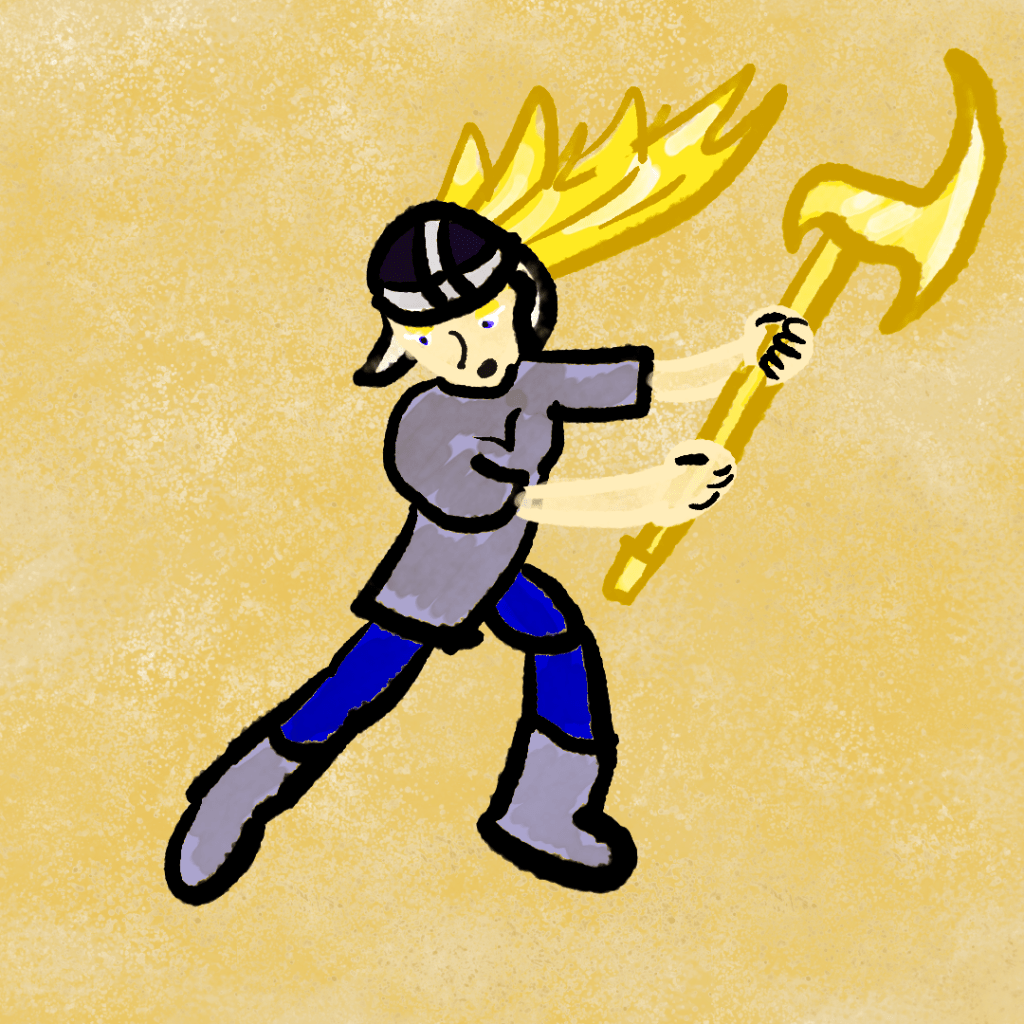
Hrimfaxi goddess of thunder, lighting, and storms.
Among the most popular of the Hrimfaxi gods, Thonadis is the island’s goddess of thunder and lightning, as well as storms in general.
Depicted as a young, hot-headed woman with long golden hair and a large golden axe, Thonadis is said to travel across the sky in a chariot pulled by boars to do mighty battle with the Giants — the longtime enemies of the gods in Hrimfaxi mythology. Thunder and lightning are said to be the sign of these battles, Thonadis’ golden axe flashing and falling as she sets to her grim work.
Although Thonadis is viewed as the Hrimfaxi god most protective of humans, due to her quick temper and rash nature, she sometimes goes to far in bringing the fight to the Giants, said to be the cause of the destructive nature of thunder storms and their propensity to damage human settlements and farms.
At the most fundamental, Thonadis is a benevolent but unrestrained goddess.
Depicted as guileless and straightforward to a fault, there are few myths, if any, about Thonadis triumphing over her enemies through her wits rather than her sheer strength.
While not necessarily a war goddess, given the naturally warlike nature of Hrimfaxi culture and the innumerable myths of her battles with the Giants, Thonadis is a popular deity among Hrimfaxi warriors, and thus a large segment of the Hrimfaxi population and is often depicted riding in the company of the Valkyries, the divine warrior women of Hrimfaxi mythology, whose image has spread to Realmgard at large and captured imagines across the continent, particularly among female adventurers.
Oak trees are considered sacred to Thonadis and every temple dedicated to her has an oak on its grounds. The oaks at several of these temples are known to be several centuries old. The health of the sacred oak is held to be a sign of Thonadis’ favour, with a thriving tree viewed as a clear sign of divine approval and a sickly tree viewed as a warning of the goddess’ displeasure.
Similarly, boars and pigs are closely associated with the cult of Thonadis, due to boars being her chosen beasts of burden. Although there is no parallel practice on Hrimfax itself, Hrimfaxi explorers and invaders are known to have immediately sought to ally themselves with the battle-boar riders of Morfilod, and many of the Hrimfaxi warriors to settle in Morfilod — whether as conquerors or peaceful settlers — were eager to embrace the Morfilodish custom of riding into battle on the back of a giant pig, placing upon their battle-boars a religious significance not present among the native Morfilodish battle-boar riders, for whom the use of battle-boars as mount is purely a practical matter due to the beasts’ tenacity and ferocity.
The historical tendency of Realmgardian societies to attempt to draw comparisons and connections between their own deities and foreign deities — as, for example, the belief that the deities Nainen and Malketa are in fact the same individual worshipped under native Aurorean and Tanithite names — has led to the common belief that Thonadis is the Hrimfaxi name for Pherais.
“Thonadis” is pretty much literally “Thunder Goddess.”
Now, my inspiration here should be obvious.
That’s right, the post-Christian Slavic tradition of syncretising the Judeo-Christian prophet Elijah with the native Slavic thunder god Perun as the figure of St. Elias the Thunderer.
But, seriously, she’s Thor…
Well, with an axe, instead of a hammer.
On the one hand, that’s largely so I could make a reference to classic Sega beat-em up Golden Axe. On the other hand, most continental European thunder gods — the aforementioned Perun, the Finnish Ukko, the Baltic Perkūnas — do have axes. In fact, I’ve read that the fact that Mjolnir looks the way it does is because it was originally supposed to be an axe that was garbled into a hammer in later mythological accounts.
Mostly, though, it’s because Golden Axe…
Also, oaks were sacred to Thor — perhaps the most famous being the Oak of Thor in Hesse which was chopped down by St. Boniface.
Boars are important in Norse mythology, and we’ve established that Hrimfax is Realmgard’s Scandinavia. Off the top of my head, there isn’t an actual Norse god with a boar-chariot, though Freya does sometimes ride a boar. And, incidentally, there was a Norse battle formation called the “Swine Array.”
That whole long digression about the Morfilodish (Realmgard-Welsh) battle-boar riders is a way to tie in to something I established in one of my previous writing exercises. Pigs were occasionally used in battle — the Romans, for example, would slather them in pitch, set them on fire and set them loose on the Carthaginian elephants — but Morfilodish battle-boars are mostly just a way to have people riding something or than horses or wolves…
As always, follow me here:

This work is licensed under a Creative Commons Attribution-NonCommercial-NoDerivatives 4.0 International License.
The author prohibits the use of content published on this website for the purposes of training Artificial Intelligence technologies, including but not limited to Large Language Models, without express written permission.
All stories published on this website are works of fiction. Characters are products of the author’s imagination and do not represent any individual, living or dead.
The realmgard.com Privacy Policy can be viewed here.
Realmgard is published by Emona Literary ServicesTM
