It’s been a longstanding realisation of mine that, in light of a certain tiny pirate — and her family and hangers-on — doing most of my narrative heavy lifting, I should probably be talking more about pirates.
On the other hand, I haven’t always been able to find that much stuff to recommend that’s all-ages appropriate at the level I try to keep Realmgard and/or is not already well-known enough not to need me hyping it up.
At this point, I’ve got, um, One Piece…
Maybe a couple episodes of Conan the Adventurer.
I think one of the Redwalls is about pirates…
And, well, strange as it may sound, hope you like Space.

Photo by David Kopacz from Pexels.
Much like its classic genre forebear Space Pirate Captain Harlock, Bodacious Space Pirates pretty much delivers exactly what it promises. Which is Space Piracy.
Which is a lot like Regular Piracy, all things considered, except in Space.

Photo by GEORGE DESIPRIS on Pexels.com
Though, in fact, most (Bodacious) Space Pirates are — much like the Pirates of Realmgard — in fact technically Privateers. The short version, as established in the opening narration, is that the Space Pirates were hired by the various colony planets during their wars of independence to supplement their fleets by being granted letters of marque sanctioning their activity on behalf of said colonies.
Most simply, a Privateer is a Pirate who’s been hired by someone else, basically the nautical version of a mercenary.
This is, as it happens, largely consistent with the actual Golden Age of Piracy.
Also, Space Piracy is basically an elaborate form of dinner theatre. More on that later.
Honestly, for a show that’s just “Regular Pirates, but in Space”, it actually puts in a lot of effort to explain how the piracy actually works.
I mean, One Piece is technically about pirates, but in terms of what’s actually going on in One Piece, it’s mostly a fairly standard action anime that happens to be taking place on a boat…
All in all, despite being set in the far future and light years from Earth — specifically in Tau Ceti — the depiction of (bodacious) Space Piracy is honestly surprisingly realistic. Or at least plausible. I guess there isn’t actually any Space Piracy to compare it to…
In addition to the aforementioned letters of marque, the series puts a lot of thought into what Space Pirates would actually do — both in terms of what the job itself is, and how ship-to-ship combat in space would work, and the writing even takes into consideration fairly mundane but reasonable aspects of the job like the fact that high-schoolers aboard a ship working under a legally-defined sanction would probably not be able to get around child labour laws.
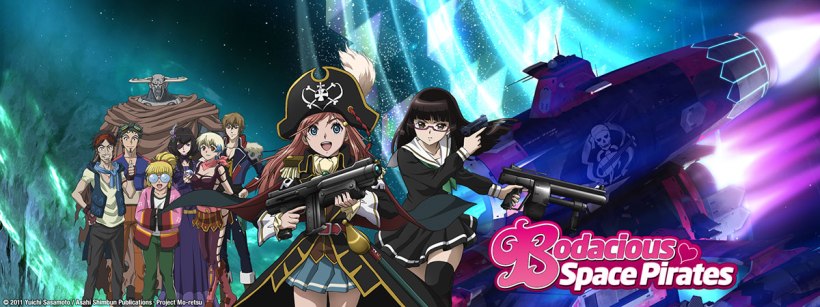
Bodacious Space Pirates: Satelight and Sentai Filmworks.
Originally based on a light novel series that does not seem to be available in English, Bodacious Space Pirates is, again, essentially the story of exactly what it sounds like.
Quick sidebar: the original Japanese title is Miniskirt Space Pirates, which, incidentally, is also still basically accurate — at least where most of the female characters are considered…
I actually find it really funny that there’s another author out there who basically reached much of the same conclusions I did about piracy actually works in his fictional world as I did. Now, for what it’s worth, I had started at least laying the foundation for Realmgard’s Pirates before I ever even heard of Bodacious Space Pirates — which, admittedly, took way too long; it’s called Bodacious. Space. Pirates.
I think it’s not hard to see why two different authors would independently reach the same conclusions about the best way to write Pirates. Unrepentant criminals make bad protagonists and real-life Pirates were not generally good people. Especially when you’re trying to write a story for younger and/or family-friendly audience, it’s necessary to make your Pirates kinder and gentler than they historically were.
The series follows a high-school girl named Marika Kato, who spends about half of the first episode as a typical high school student, before promptly finding out that 1) she’s actually the daughter of a famous Space Pirate and 2) she’s being conscripted by her father’s old crew so their ship, the Bentenmaru doesn’t get decommissioned.

Bodacious Space Pirates: Satelight and Sentai Filmworks.
Sidebar: maru literally means “circle”, but can also mean “enclosure”, so it’s applied to the names of defensive fortifications (cf. the Sanada Maru) and also to ships with the implication that ships are basically floating castles (cf. this double meaning being a major thematic point in the NHK drama Sanada Maru)
That Marika is basically shanghaied into being a (Bodacious Space) Pirate does handily allow for the members of the Bentenmaru crew to explain the various aspects of the profession to Marika and all this exposition is probably handled more gracefully than it could be. It is an infodump, but it at least as a clear narrative justification and the explanations that are being given are immediately relevant to the matter at hand.
Similarly, there’s a story arc where the actual Bentenmaru crew all get sick, so Marika in turn basically shanghais her school Yacht Club into serving as her crew,
Circling back to the dinner theatre thing, the most common thing (bodacious) Space Pirates do in their capacity as Space Pirates is launch staged attacks on luxury cruise ships for the entertainment of the wealthy passengers who get to vicariously experience the excitement of a pirate attack without any of the downsides of actually being attacked by pirates.

Bodacious Space Pirates: Satelight and Sentai Filmworks.
Now, that being said, while there isn’t that much genuine piracy, all things considered, Marika and her crew do take on real jobs. There’s a several-episodes long arc in the first half of the series that involves the Bentenmaru helping a princess track down a ghost ship connected to her planet.
Eventually, the action and the stakes do ramp up, though Bodacious Space Pirates is a fairly light-hearted and comedic series for the majority of its run. Even with the stakes at the highest, Bodacious Space Pirates never really stops being a rollicking Space Opera yarn.

While there isn’t a complete lack of spaceships shooting at each other with big lasers, most of the combat actually boils down to electronic warfare, with the crews of opposing ships trying to infiltrate and compromise the other ship’s computer systems, in part to facilitate shooting them with big lasers. Much like in real-life ship-to-ship combat, the trick is less “attack until it runs out of hitpoints” and more “get them into position to actually hit them.” It’s refreshingly grounded given the prominence of Star Wars-esque — and in turn World War II-esque — point-blank dogfighting.
The opening and ending themes are rather standard anime fare, but are undeniably catchy.
The in-episode soundtrack is another piece of “Basically Regular Piracy, but in Space”, being acoustic, jaunty, and vaguely Celtic and feeling more out of the Golden Age of Piracy than the far future.
Every episode is bookended by expository narration. Unlike plenty of other animes I could point to, the narrator is neither one of the characters in the series, nor a character in his own right. But he does provide some very helpful exposition and context for the episodes and delivers a pretty great and oddly-philosophical and poetic performance.

Bodacious Space Pirates: Satelight and Sentai Filmworks.
Realistically, One Piece is probably never going to be supplanted as the most popular anime about Pirates — and, incidentally, probably not supplanted at all; it is the best-selling comic book series, period.
[With the potential qualifier of counting series sold as compiled volumes rather than single issues, in which case Superman has sold slightly more.]
That being said, it’s not like Bodacious Space Pirates is trying and failing to go for One Piece‘s crown. The two series are really only similar to the extent that they’re about pirates, but if that’s how we’re measuring things, the comparison is as valid as comparing One Piece to the General History of the Pyrates.
There’s no real rivalry here, because the two series fill completely different niches. Despite bring set in Space, Bodacious Space Pirates is actually a better depiction of real Piracy than One Piece is.
One Piece is primarily an action series that happens to be kinda-sorta about Pirates. Bodacious Space Pirates is actually about Piracy and a major aspect of the series is examining how that Piracy works.
Look, I’m not trying to say that Bodacious Space Pirates is a series for intellectuals and One Piece is for stupid people. Again, I’m not trying to set them up as rivals, because there’s no rivalry there in the first place. But if you’re into Pirates and you’ve enjoyed One Piece, there’s probably enough of a broad, general similarity between the two series that you’ll enjoy Bodacious Space Pirates.
What I will say, though, is that Bodacious Space Pirates has the undeniable advantage over One Piece is not completely leaving behind people who haven’t been keeping up with the series for the past 25 years. Bodacious Space Pirates has the fairly standard 26-episode run (plus a movie), making it a lot more accessible to newcomers and manageable than One Piece‘s eight million or so episodes…
If you’ve enjoyed my content, please consider supporting me through Ko-fi or Patreon, or through Paypal by scanning the QR code below:

Follow Realmgard and other publications of Emona Literary Services™ below:
Subscribe to the Emona Literary Services™ Substack newsletter here.

This work is licensed under a Creative Commons Attribution-NonCommercial-NoDerivatives 4.0 International License.
The author prohibits the use of content published on this website for the purposes of training Artificial Intelligence technologies, including but not limited to Large Language Models, without express written permission.
All stories published on this website are works of fiction. Characters are products of the author’s imagination and do not represent any individual, living or dead.
The realmgard.com Privacy Policy can be viewed here.
Realmgard is published by Emona Literary ServicesTM
