I’m a sucker for a good Pulp adventure story — there’s a reason why Robert E. Howard is one of my great literary idols. Honestly, I’m more at home reading stuff from decades or even centuries — or even millennia ago — than most recent books.

See its wall which is like a strand of wool, view its parapet which nobody can replicate!”
Translation of the Epic of Gilgamesh by A.R. George et al, via the Ludwig Maximilian University of Munich’s Electronic Babylonian Library Project.
Photo by Bilge u015eeyma Ku00fctu00fckou011flu on Pexels.com
I’m going somewhere with this, I promise.
Pirates are a fairly common literary subject: Captain Blood, The Sea Hawk, Treasure Island, The Long Ships (for a certain value of “pirate”, at least), a major subplot of The Count of Monte Cristo, if not the entire thing…
Until fairly recently, the most popular literary pirate I’d never heard of is probably Sandokan.
For a series that I’d never even heard of, Sandokan has actually been pretty influential, serving as the basis for several films — done with primarily Italian casts and crews, including Sandokan (a Dayak from Borneo in the books) himself being played by either an Italian or American actor — a series of TV, um, series (also Italian) with Sandokan played by an Indian actor, a Spanish cartoon where everyone is animals that also aired in the UK and Ireland, and even a Mexican wrestler.
Part of this is likely due to the fact that while the original novels were published in Italian and the last years of the 1800s and the opening of the 1900s — original author Emilio Salgari died in 1911; other authors continued the hugely popular series — they were not published in English until 2008.
Incidentally, this means that the English translations are not in the Public Domain, unlike the Italian originals…
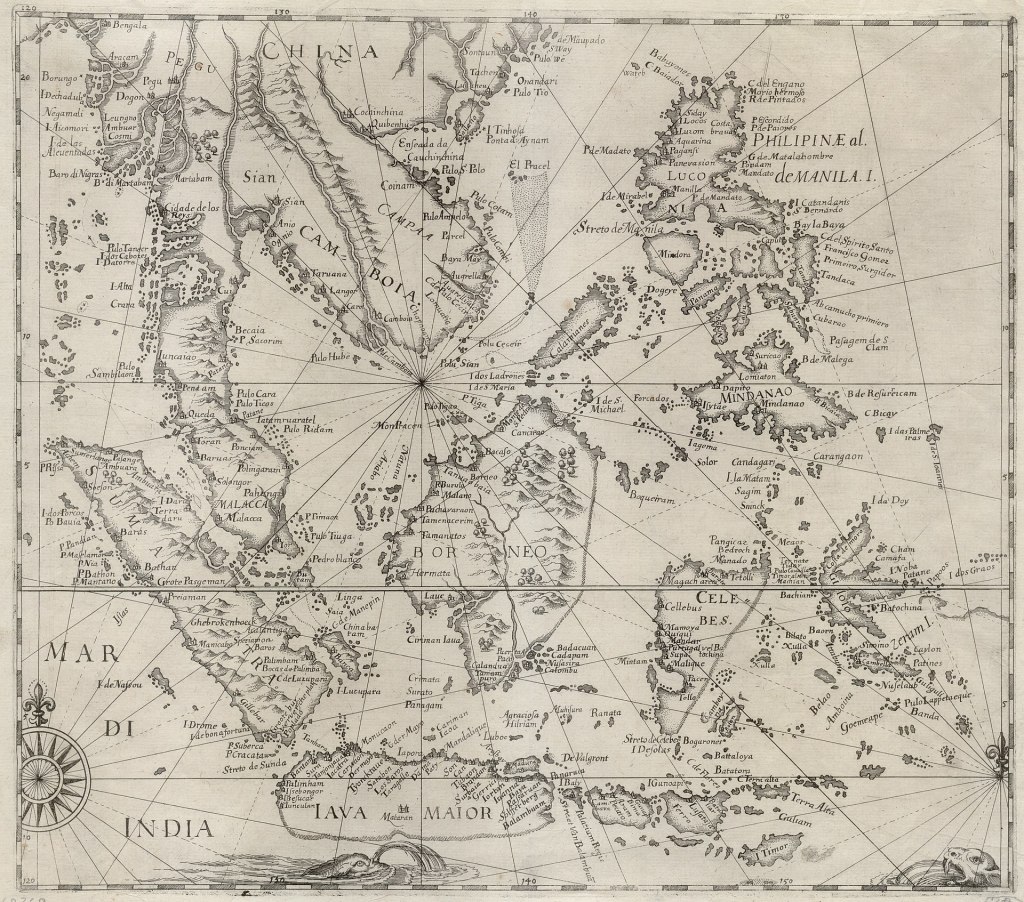
Map by Theodore De Bry, via the Singapore National Library Board. Public Domain.
Notably for a series that is more than a hundred years old, Sandokan portrays the European colonial project as unequivocally negative. Sandokan and his overwhelmingly non-white pirates are the protagonists — though, of course, as pirates, they are exactly nice people — whereas the British, Dutch, and Portuguese Empires are very much the bad guys.
“Colonialism is bad” while basically the consensus at this point, did admittedly take a while to become the consesus…
Known in the novels as the Tigers of Mompracem, an old name for the island of Kuraman (also the name of the first book in the series), Sandokan’s crew consists mostly of pirates from East and Southeast Asia, not exactly shocking given the setting. The two most prominent non-evil white characters are Yanez, Sandokan’s Portuguese second-in-command and Marianna, Sandokan’s Anglo-Italian love interest. The heroic white characters are depicted as capable and intelligent, but as capable and intelligent individuals, not because they’re white and therefore better than everyone else.
Similarly, while the British and other colonial powers are depicted as technologically or military superior to Sandokan’s pirates (not for nothing, the Royal Navy was the most powerful navy in the world for several centuries), they are at best depicted as villains who don’t realise they’re the villains.
Sandokan himself is portrayed a bit like Conan, or least Conan as depicted in the original stories: not necessarily well-educated, but shrewd and crafty, though primarily a fighter and a frontline leader. Notably, Sandokan is sensible enough to realise when the pirates need a plan beyond “Attack the Bad Guys” and will defer to Yanez’s tactics.
Incidentally, Conan has also been a pirate in several stories and, at the very least, his years as a pirate are a well-established part of this backstory.
Even notwithstanding how impressive (though not perfect) the series’ presentation of non-white characters is for a book from a century ago, it’s a notable story about non-Caribbean piracy.
Despite how Pop Culture associates “Pirate” with the Caribbean in the late 1600s and early 1700s, piracy has basically existed for as long as boats have been used for commercial purposes — Julius Caesar was famously kidnapped by pirates (whom upon being ransomed, he promised to come back and see them all crucified, which he did); his rival Pompey first rose to prominence for purging the pirates of the Eastern Mediterranean — and has happened in basically ever major body of water in the world.
Notably, perhaps the single most profitable act of piracy in history took place in the Indian Ocean when Henry Every attacked and captured a trade ship owned by the Mughal Imperial Family, and one of the contenders for the single most successful pirate in history was a Chinese woman.
Wikipedia categorises Sandokan as a Young Adult series, and I’ve seen it come up on several “Essential Books Every Boy Should Read”, so the series isn’t exactly brimming with particularly violent or lurid material. If anything, I expect younger readers to be more likely to get bored by the prose than traumatised by what that prose is describing.
Still, I think Sandokan is a bit of a hard sell for young(ish) readers a century later. Literary taste, especially for kids’ books and YA books, has changed a lot in the intervening decades. The prose, or at the least the currently-available translation, is perfectly serviceable. It’s mostly “[Thing] happened, character thought [thing]”, but there are a few pretty good descriptions and turns of phrase in the narrative.
Yeah, there’s violence, but mostly in the form of “Sandokan was struck by a bullet” or “Sandokan was bleeding”. It happens, but it’s not especially graphic and there’s a certain level of dispassionate narrative detachment. Honestly, it’s not as bad as the on-screen violence in something like Lodoss War or even Star Wars and probably on par with what’s happening in a more recent YA series like Ranger’s Apprentice.
I’m really only familiar with the first book in the series, but unless the later books take a pretty drastic swerve, I don’t expect much worse in the rest of the series…
Realistically, I think the century-plus old writing style is not going to be for everyone, but Sandokan is still a interesting series for a number of reasons. It’s a fascinating time capsule of Turn-of-the-Century adventure novels, though that does include some attitudes about gender and race that haven’t aged well. On the other hand, Emilio Salgari’s is also shockingly progressive for the period and comes across as notably less problematic (which, in hindsight, doesn’t really sound like a compliment) than other authors from later in the first half of the twentieth century — again, Robert E. Howard is one of my literary idols, but I’d never look to him for insight on women or non-white people.
Or, honestly, anything other than the best way to succeed at fighting evil wizards or bareknuckle boxing, really…
At the very least, Sandokan stands out among pirate works for featuring the rarest of all literary protagonists: a non-Caribbean pirate.
My other recommendations are here.
And follow me here:
If you’ve enjoyed my content, please consider supporting me through Ko-fi or Patreon, or through Paypal by scanning the QR code below:

Follow Realmgard and other publications of Emona Literary Services™ below:
Subscribe to the Emona Literary Services™ Substack newsletter here.

This work is licensed under a Creative Commons Attribution-NonCommercial-NoDerivatives 4.0 International License.
The author prohibits the use of content published on this website for the purposes of training Artificial Intelligence technologies, including but not limited to Large Language Models, without express written permission.
All stories published on this website are works of fiction. Characters are products of the author’s imagination and do not represent any individual, living or dead.
The realmgard.com Privacy Policy can be viewed here.
Realmgard is published by Emona Literary ServicesTM
