Let’s just take a moment to appreciate that I didn’t make a “Monado Mo’ problems” joke…
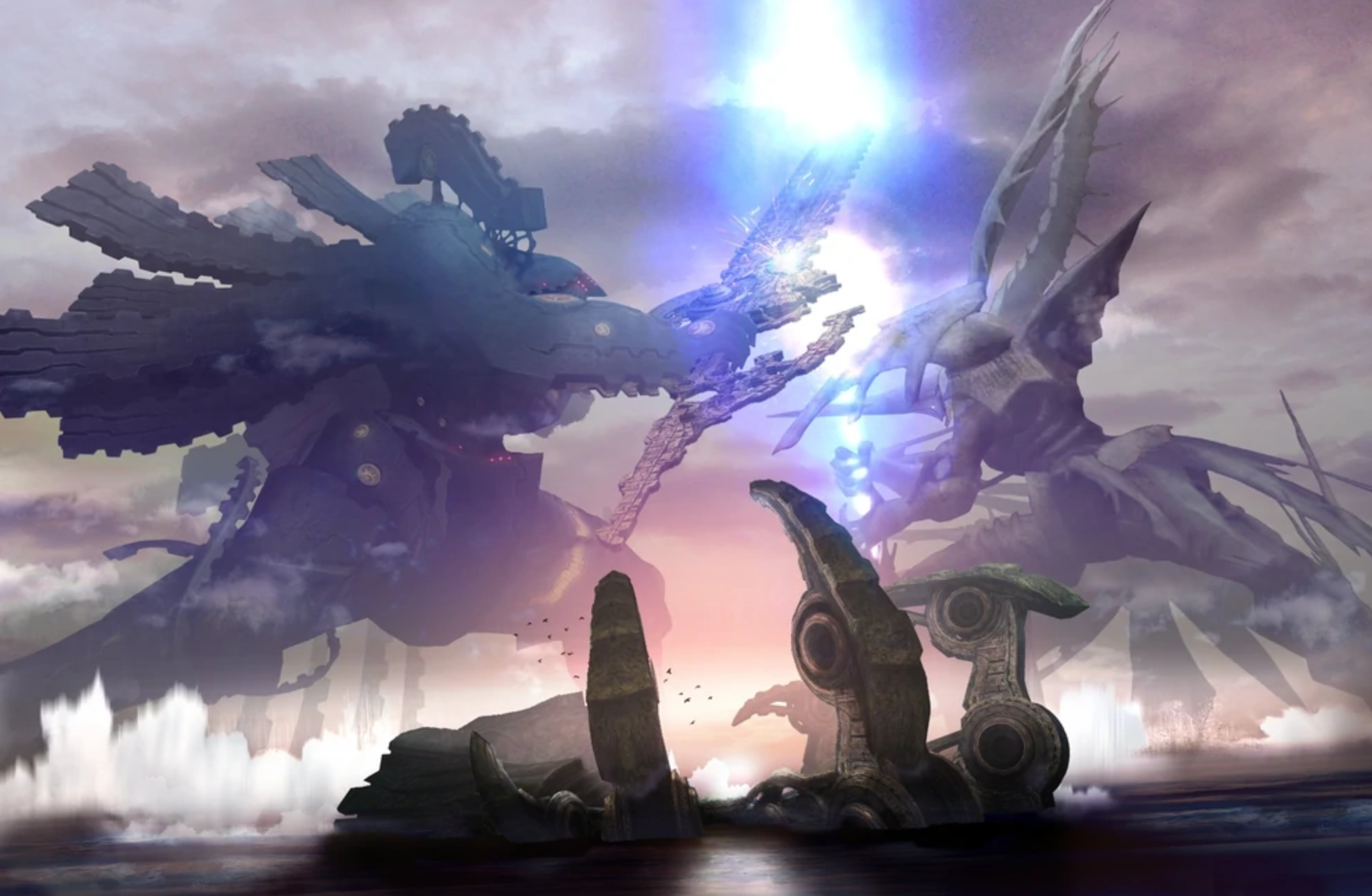
Xenoblade Chronciles: Monolith Soft and Nintendo. Via Xenoblade Wiki.
I got the Switch remaster of Xenoblade Chronicles my birthday in 2020.
By my calculations, this means that I have now owned all four versions of Xenoblade that have thus far been released.
And the Switch remake is a godsend.
Xenoblade has always had fantastic art direction, but the original Wii version was an ugly game. Two console generations’ worth of graphical and technical improvements mean that the quality of the graphics finally lives up to the quality of the art direction.
Unless you’re significantly younger than me, you probably remember that there was a whole big thing about trying to convince Nintendo to release the original Xenoblade in North America.
Strictly speaking, I think the campaign technically failed, since Xenoblade didn’t actually get a North American localisation — it was localised by Nintendo of Europe and the European English version was what got released in North America.
That’s not necessarily a meaningful distinction, though, given that the overall was “Let me play Xenoblade“, which is ultimately what happened. Plus, because the English dub was done in Europe, everyone is British which adds a touch of character to the game that might not exist otherwise.
So, all in all, everything worked out.
Overall, the series has a sort of Final Fantasy thing going on, in that the games aren’t direct sequels or even immediately connected to each other, but still share certain recurring character archetypes, game mechanics, and elements of world-building.
For example, Final Fatnasy has these guys, and Xenoblade has these guys showing up in each game.
Even Xenoblade as a whole is sort of the same connected-but-not-quite thing with Monolith’s earlier series Xenogears and Xenosaga. I haven’t played either of these, but as I understand it, they’re all united by the same philosophical and thematic underpinnings.
Basically (wow, I really do say ‘basically’ a lot), Xenoblade plays like an MMO like World of Warcraft, Lord of the Rings Online, or Old Republic. Your characters automatically attack during battle, you’ve got a set of special abilities for your characters to use on command. Each Xenoblade game has a big open world, that (with the possible exception of Xenoblade X) despite its bigness never feels so big as to be unmanageable.
Luckily, Xenoblade lacks the worst part of MMOS: other people.
The Xenoblade Games all have the same basic gameplay style, but each game has specific unique gimmicks.
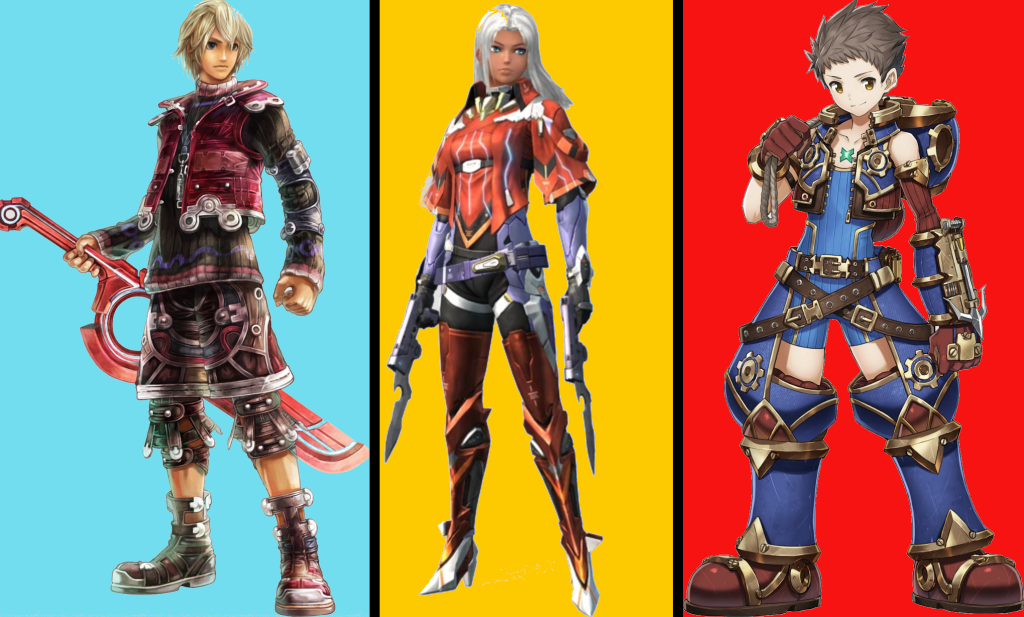
Xenoblade 3 had not yet been released when I did the first version of this post and made that image.
Xenoblade: Monolith Soft and Nintendo. Images via Xenoblade Wiki.
As the first game, Chronicles probably has the least-developed gameplay gimmicks. The big thing is that the main character Shulk is really feeling it has a magic technology-sword that can see the future and allow him to prevent your enemies your from using their most damaging attacks before they happen.
Every other character has a less interesting and less plot-relevant special ability, but one that fits their overall gameplay role pretty well.
X has more emphasis on exploration and the open world, to fit with the game’s plot revolving around colonising a planet, gives you a Gundam that can turn into a car, and has a special super-powered mode in combat called Overdrive that I don’t think I ever really quite got the hang of.
One of the things I really like about X is that your character isn’t the hero. It’s established from the very beginning that Elma is the biggest badass in the galaxy. She’s the hero, you’re the sidekick and you’re just along for the ride.
And, uh, hey, Sakurai-san, if you happen to be out there reading this: Elma for Smash, please?
2 is based (both in terms of gameplay and in terms of story) primarily around Blades, who are sort of like your characters’ guardian angels that give them their powers.
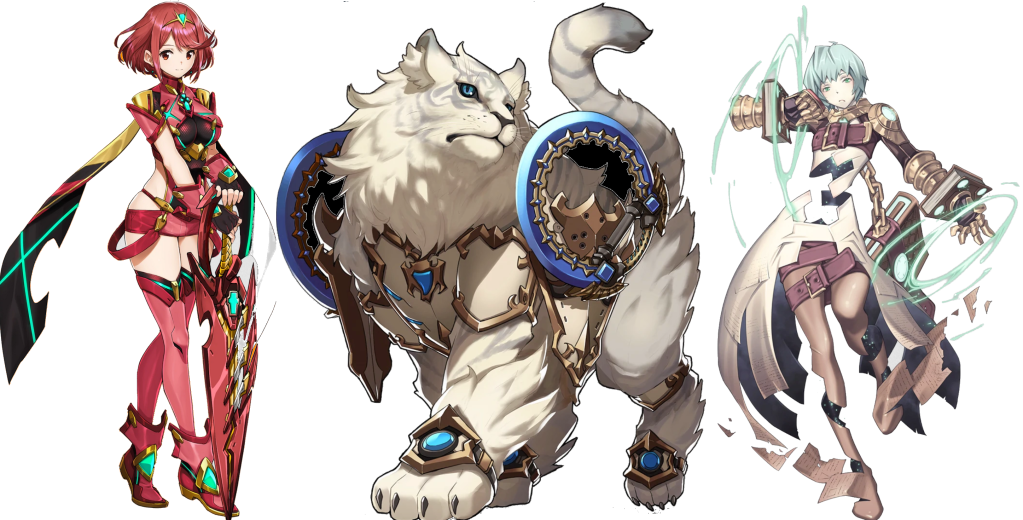
Dromarch (one of the major party members), and Adenine (a completely optional Blade, and the first unique optional Blade I ever unlocked).
Xenoblade Chronicles 2: Monolith Soft and Nintendo. Images via Xenoblade Wiki.
You have a team of five playable characters and each of those can assemble a team of Blades that have different abilities, fighting styles, and elemental powers both in combat and in exploring the world.
That explanation is woefully inadequate, but to explain it in enough detail could be a blog post in itself.
Despite being numbered entries (unlike X, which was never presented as anything other than a spin-off), the original Xenoblade and 2 don’t really have a direct connection beyond a fairly brief thing that I can’t really talk about without getting into some pretty huge spoilers.
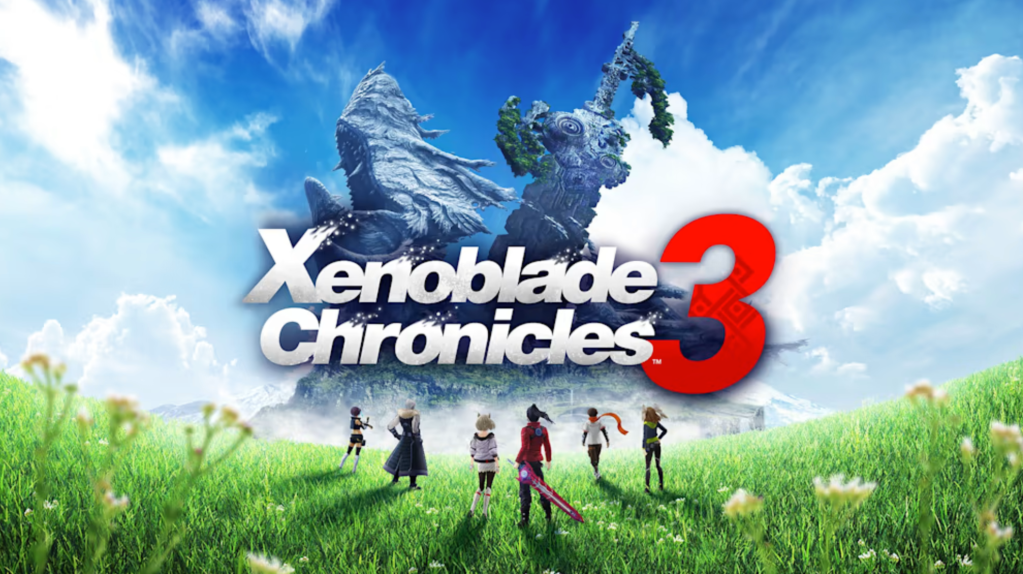
As for Xenoblade 3, the gameplay is pretty much the same as it’s ever been. Xenoblade still feels like a single-player MMO, which is good because other people is indisputably the worst aspect of MMOs. There are however, a few quality of life improvements and tweaks. Any character can freely switch (storyline-mandated restrictions notwithstanding) between any class, equipment is limited to one initial slot, then several more unlocked with level progression, rather than full sets of armor. Healers are more important because they’re now the only ones who can revived downed party members — sidebar: I actually really enjoy playing healers in RPGs.
Most significantly, the total number of playable party members has been raised to seven, which is tactically interesting but feels like it makes certain encounters too easy.
Also there are recruitable, non-playable “Hero” characters that are sort of like the Blades from Xenoblade 2. I only know this reading about the game and haven’t reach the point of the game where they actually get involved, so I’m unclear on how these characters actually function.
Now, in terms of the story, I think the worlds of Xenoblade Chronicles and Xenoblade 2 have somehow ended up merged together into a single universe where the two worlds are now locked in a hopeless Forever War not unlike the Mechonis and Bionis in Chronicles.
There are other callbacks and even appearances from past characters, but nothing that I think requires having played the previous games. Xenoblade games have pretty high-concept, convoluted plots dealing with pretty deep philosophical ideas that are pretty hard to understand irrespective of knowledge of the previous games.
Also, I was convinced that the main character’s fat, inept childhood friend who seemingly died will end up turning out to be one of the major bad guys. And, for the reference, that’s speculation, not a spoiler.
Also, it’s exactly how I would write it…
You don’t need to play a previous game to know anything about the others, but knowledge of the first game will allow for a better understanding of the exact significance of the, uh … things I can’t talk about without getting into huge spoilers.
Though, playing 1 and 2 definitely helps contexualise 3, especially because 3 literally involves the worlds of 1 and 2 colliding and merging into a third unique world, coupled with previous characters appearing in a significantly more meaningful and plot-relevant way than ever before in the series.
Again, I can’t really explain much more than that without huge spoilers, though 3 is still probably nevertheless functional as a completely standalone story.
And the music — man, the music is so good!
Each of the games has some awe-inspiring set-piece scenes which really come alive thanks to the combination of solid voice work, good storytelling and phenomenal music.
Climbing the World Tree in Xenoblade 2 for the first time (trust me, you’ll know it when you see it) is one of my favourite sequences I have ever experienced in my entire video gaming career: your journey is almost done, you’re climbing the stairway to meet your world’s god (that’s not a spoiler, that’s your stated goal pretty much as soon as the game begins), the environment is unprecedented in the rest of the game, and the music is swelling to its high point.
Honestly, I was almost in tears from how awesome the moment was.
So, yeah, Xenoblades are good. Play them. And perhaps, you, too, can be really feeling it.
Monado Mo’ problems up there.
(Yes, by the way, it was worth it…)
Mo’ recommendations here.
And my social media links and email list here:
If you’ve enjoyed my content, please consider supporting me through Ko-fi or Patreon, or through Paypal by scanning the QR code below:

Follow Realmgard and other publications of Emona Literary Services™ below:
Subscribe to the Emona Literary Services™ Substack newsletter here.

This work is licensed under a Creative Commons Attribution-NonCommercial-NoDerivatives 4.0 International License.
The author prohibits the use of content published on this website for the purposes of training Artificial Intelligence technologies, including but not limited to Large Language Models, without express written permission.
All stories published on this website are works of fiction. Characters are products of the author’s imagination and do not represent any individual, living or dead.
The realmgard.com Privacy Policy can be viewed here.
Realmgard is published by Emona Literary ServicesTM
