30 Days of Biographies: Sibylla of Isidorus
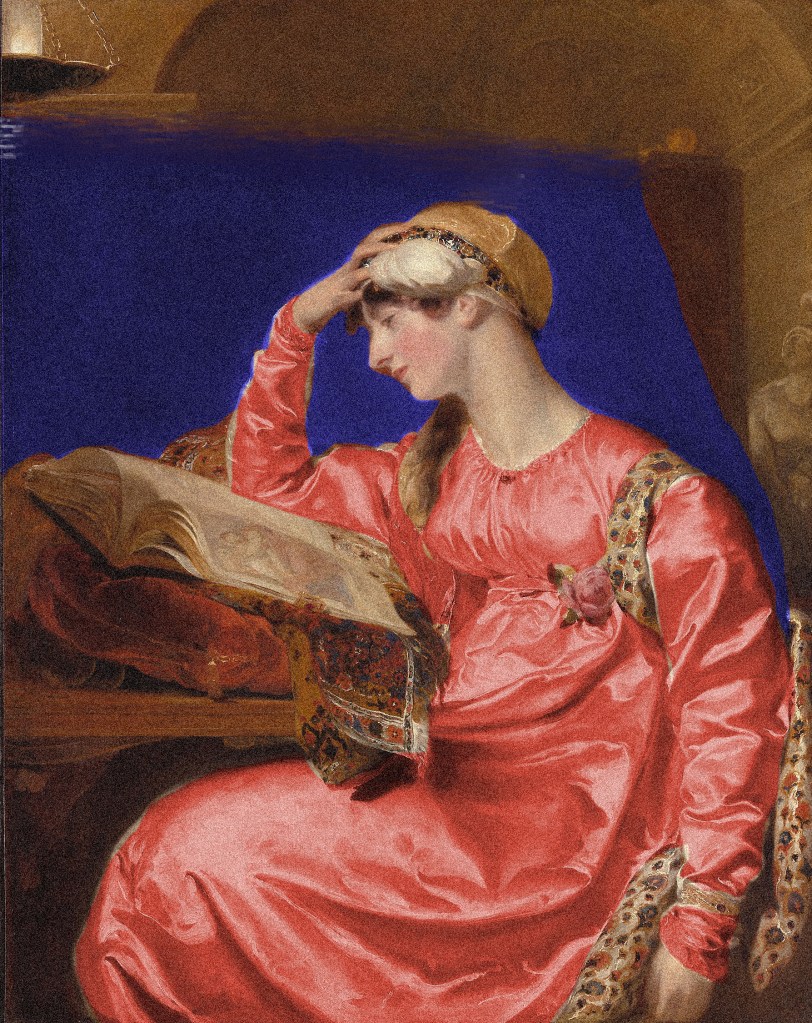
Image via Wikimedia Commons. Public Domain.
One of the most prominent female intellectuals of the Elven Empire, Sibylla of Isidorus is best known for her book of Descriptions, one of the most thorough compendiums of scholarly knowledge coming from the Imperial era.
Born on the Sea’s Edge peninsula at the height of the Elven Empire, Sibylla was well-educated from a young age as her parent’s only child. As a young woman, Sibylla resolved to compile as much information as possible in a single text and set off across the length and breadth of the Elven Empire and beyond to observe and describe its peoples, places, and natural phenomena.
Sibylla is regarded as unusually reliable for a scholar of the Elven Empire, focusing almost entirely on recording her observations in the most basic, factual manner rather than taking the opportunity to make moralistic points, which was generally regarded as an inevitable part of scholarship during the era. While Sibylla’s information is now known to be incomplete or incorrect in places, this is largely the result of her working from information that was insufficient in the first place, rather than the result of deliberate bias.
Written as an encyclopedia, the Descriptions consist primarily of short accounts of its subjects, though the text is vast in scope and Sibylla is lauded for the sheer amount of subjects she thought to give attention to in her writing.
After travelling for almost 40 years, Sibylla personally presented her final Descriptions to the Emperor, though she remained dissatisfied with the result and felt that she had failed to include too much to consider the text complete, despite the reassurances of the Emperor and the court that she had achieved a task unprecedented in the history of Realmgard.
The Descriptions are still considered the best available reference text for the period of Realmgardian history up to Sibylla’s own lifetime.
Although the Descriptions are far and away her most famous and influential work, after completing the Descriptions, he wrote several other texts, primarily focused on the history of her hometown of Isidorus. She was also a prolific writer of letters, keeping up correspondence with many important figures of her day.
After her death, Sibylla came to venerated as a folk saint and a patron of scholarly endeavours. She was well-respected even by the Melkartite rules after the conquest of the Sea’s Edge and her tomb was renovated into a major shrine by the Melkartites. The Melkartite additions to her tomb have remained intact even after the Pelayan reconquest of the Sea’s Edge and further renovations and additions to the tomb complex, making Sibylla’s tomb one of the most architecturally striking and unique buildings in all of Realmgard.
Sibylla remains an enduringly popular figure and her patronage is invoked particularly for young female scholars. Her work on the Descriptions have inspired generations of other writers to follow her example and attempt to compile all available knowledge into a singular text of their own, though none of these works have become as well-regarded as the original Descriptions.
You may recall that Sibylla is also the name of one of the Ten Most Worthy Women, the ten most important Amazons. On the one hand, in fiction, it’s probably generally advisable to avoid reusing names. On the other hand, it’s not really unlikely that you’d get at least two people with the same name across the span of centuries.
But, also “Sibylla of Isidorus” is also basically a pun. Short version, “Sibylla” sounds like “Sevilla” (though mostly if you don’t pronounce the Spanish double-L properly…), as in “Spanish for Seville“, as in “Isidore of.”
Now, Isidore of Seville is best-known for his Etymologies, an encyclopedia compilation and explanation of basically everything. Which is pretty much what Sibylla’s Descriptions is supposed to be.
Incidentally, Isidore of Seville is considered the patron saint of the Internet by virtue of making an attempt at putting all available information at people’s fingertips, which I do believe is what Al Gore had in mind when he invented the Internet…
[That’s not actually true, but it is funny…]
Incidentally, I’ve previously discussed that Sibylla is the Latin form of “Sibyl”, the word for the female seers known throughout the ancient world. The picture I used is a painting of Isabella Ann Hutchison, wife of the Danish Consul in London circa the 1790s, dressed as the Erythraean Sibyl, said to have resided on the Anatolian coast across from Chios and believed by later Christians to have prophesied the coming of Christ — hence why the Sibyls are depicted in the Sistine chapel.
Follow me here:
If you’ve enjoyed my content, please consider supporting me through Ko-fi or Patreon, or through Paypal by scanning the QR code below:

Follow Realmgard and other publications of Emona Literary Services™ below:
Subscribe to the Emona Literary Services™ Substack newsletter here.

This work is licensed under a Creative Commons Attribution-NonCommercial-NoDerivatives 4.0 International License.
The author prohibits the use of content published on this website for the purposes of training Artificial Intelligence technologies, including but not limited to Large Language Models, without express written permission.
All stories published on this website are works of fiction. Characters are products of the author’s imagination and do not represent any individual, living or dead.
The realmgard.com Privacy Policy can be viewed here.
Realmgard is published by Emona Literary ServicesTM
