Now, the whole “If you liked X, you’ll liked Y” thing gets often tossed around pretty haphazardly. So, I’m aware of the irony here, so bear with me:
If you like Realmgard, you’ll like Goblins.

Written by Philip Reeve, whom you may recognise as the author of the Mortal Engines Quartet (having never read them, I did not) — that’s the book series where cities on wheels eat other cities, there was a movie; it didn’t do so hot — I first encountered Goblins while I was killing time at the library waiting for my parents to buy a carpet a couple doors over.
Based on the dedication at the front of the book, Goblins appears to have been written by specifically as something his kid could read and enjoy.
This was, incidentally, the same trip to the library I picked up the first several volumes of Otaku Elf.
It wasn’t quite love at first sight, but my curiosity was piqued by the fact that the title “Goblins” simultaneously tells you everything and nothing about the book. Like, yeah, there’s clearly Goblins, but what specific angle is the story going to be work?
Also, at least the edition that I found in the library has actual cover art. You cannot, in fact, judge a book by its cover, but I prefer books with something from the book on the cover, rather than the abstract, artsy and minimal covers that seem to be the most popular in Current Year.
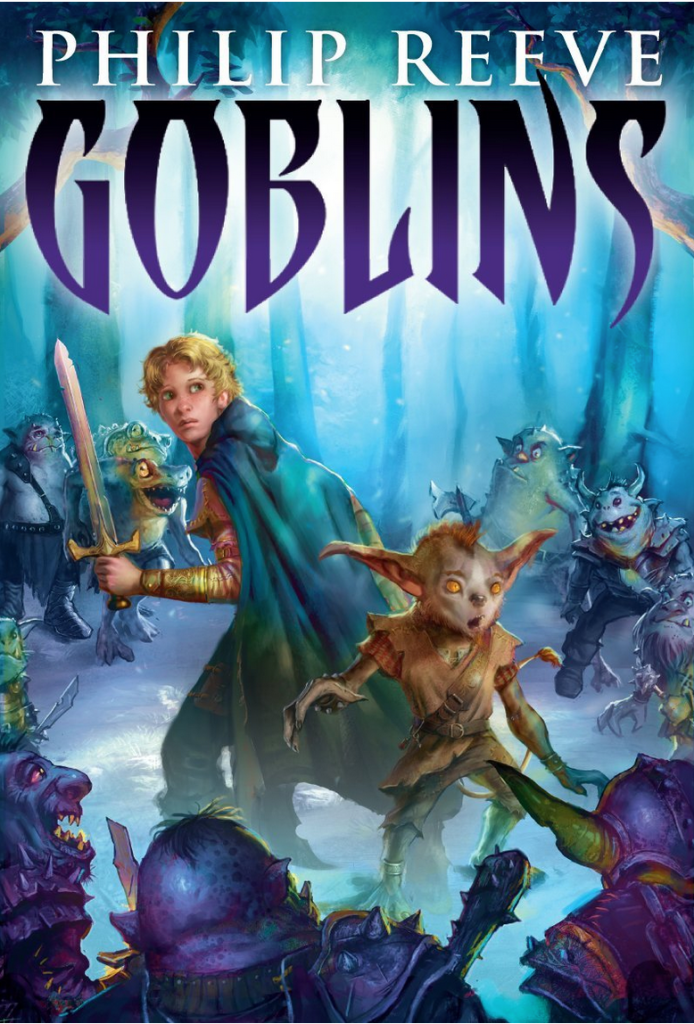
Goblins: Philip Reeve, Scholastic. Image via Amazon.
I knew I was going to have a good time when the book’s blurb started off by describing its protagonist being exiled. By catapult. This is, of course, a concept I’ve mentioned several times in my own writing.

Image by Silvia from Pixabay
I’ve mentioned this before, but I feel like I have a very British sense of humour. So, in addition to both Reeve and I being the sort of author whose mind goes to “Exile. By catapult.”, we have a lot of other similarities in mindset and sense of humour that made Goblins resonate so much with me.
For one thing, Goblins has very deadpan, very wry narration. It’s even a bit like The Hobbit, though Tolkien’s narration is a bit more conversational. While the narrator isn’t a character in the events of the story, The Hobbit is clearly a story that somebody is telling. The Hobbit, while having its moments of deadpan humour, is overall a lot more unironic than Goblins is.
The Hobbit is funny because it’s funny, Goblins is funny because its overall gimmick is “The Fantasy genre, am I right?”.
We’ve seen it before, but Goblins probably one of the better Fantasy stories to derive most of its humour from the fact that real life, even in a vaguely British Fantasy world, isn’t a Fairy Tale and real life doesn’t work under Fairy Tale logic. It never goes into full-on Subverting Expectations and is never particularly mean-spirited in its parody. Goblins doesn’t really ever suggest that heroes don’t exist or that you’re stupid for believing in heroes, so much as that the events of the plot, and therefore much of the humour, is predicated on decidedly non-heroic characters having to deal with a heroic quest for which they are eminently ill-suited.
Our heroes, such as they are, are the Goblin Skarper (that name choice is probably deliberate), the disgraced son of a cheesemonger Henwyn (possibly a reference to the magic pig from Prydain), the middle-aged Princess Eluned (a real Welsh name, though I’m unclear if it’s supposed to be significant), and a trio of self-professed sorcerers who appear to be inept charlatans until they’re magic accidentally starts working.

The basic premise is that long after the Lych Lord was defeated, his magic fortress of Clovenstone has been abandoned, fallen into ruin and largely left to the various Goblins birthed out of the apparently magic lava underneath Clovenstone. All in all, the Goblins of Clovenstone are fairly typical Fantasy Goblins, though Reeve presents them with enough nuance that it’s clear they aren’t necessarily inevitably and inherently evil, so much as that they don’t have a chance to grow up to be anything other than evil.
Skarper, for example, is born notably curious and intellectual and while probably the nicest Goblin shown in the story, is still enough of a product of his upbringing that he still usually defaults to cowardly and self-interested, though his interactions with the relentless do-gooder Henwyn and the relentlessly nice Princess Eluned does help bring out his better nature.
And how Reeve ultimately answers the question of “What happens to Goblins when they’re given a chance to not be evil?” is one of the most interesting and unique (and funny) things he does with the story.
There are some pretty cool glimpses of Reeve’s worldbuilding for the wider, um, world. Unfortunately, we don’t really more than glimpses. Granted, a large part of that is because the plot of the first book is contained largely in the ruins of Clovenstone and its immediate environs.
Similarly, a lot of characters, particularly villains, who feel like they have a lot of potential to be interesting characters and/or serious threats to the heroes are introduced only to be written off and/or dispatched before really getting a chance to do anything. Part of that, at least, is the fact that the plot of Goblins feels pretty episodic, so the new villains are introduced specifically to drive the plot for a chapter or two before the next enemy or challenge for the heroes to face is introduced. On the whole, it does work, but I was a little disappointed by the story arcs tending to play out as “Oh, cool. This guy’s gonna – Aaaaand, he’s gone.”
Photo by Mike on Pexels.com
Overall, the story arc of the first book at least does come to a satisfying conclusion, even if some of the plot beats along the day don’t quite get as much time to breathe as perhaps they could have. The conclusion of the first book is one of those endings that’s definitive and well-thought-out enough to make a perfectly good standalone story, but also open-ended enough to allow for the characters to have further adventures.
Which, incidentally, is exactly what happened…
After the original Goblins book, there were two more books in the series – Goblins vs. Dwarves and Goblin Quest. Interestingly, at least on Goodreads, the ratings of the three books get higher as the series goes on. The first book is a 3.82 and the third is a 4.15. Not a huge increase, sure, but not the general trend in most forms of media.
The series probably isn’t going to go down as a classic of Middle-Grade Fantasy, but it’s certainly an enjoyable read – and I’m not just saying that because Philip Reeve and I clearly operate on the same literary wavelength.
Plus, he wrote it for his kid. Plus, he didn’t just write his kid a book, he wrote his kid a pretty good book, so that’s, like, double points.
You can find the rest of my recommendations here.
And you can follow me via social media or my email list here:
If you’ve enjoyed my content, please consider supporting me through Ko-fi or Patreon, or through Paypal by scanning the QR code below:
Follow Realmgard and other publications of Emona Literary Services™ below:
Subscribe to the Emona Literary Services™ Substack newsletter here.

This work is licensed under a Creative Commons Attribution-NonCommercial-NoDerivatives 4.0 International License.
The author prohibits the use of content published on this website for the purposes of training Artificial Intelligence technologies, including but not limited to Large Language Models, without express written permission.
All stories published on this website are works of fiction. Characters are products of the author’s imagination and do not represent any individual, living or dead.
The realmgard.com Privacy Policy can be viewed here.
Realmgard is published by Emona Literary ServicesTM
