August 15, 778: after a campaign against the Emirate of Cordoba that sees the ruler of Zaragoza rendering tribute in exchange for the lifting of the siege of the city, Charlemagne — so named, of course, because his name was Carl and he was Le Man — crosses into Basque territory to assert his dominion in the region. After destroying the walls of the Basque capital along with other Basque settlements, the Frankish army begins crossing the Pyrenees back into France.
Enraged by Charlemagne’s conduct in their lands, a Basque guerilla army falls on the rearguard of Charlemagne’s army at Roncevaux Pass. Although the last stand of the rearguard allows for the successful withdrawal of the bulk of the army, the rearguard itself is killed to the last man. After that point, the Basques will remain largely independent for the next centuries — incidentally, a Navarrese King will eventually become King of France.

Among the casualties is the the Warden of the Breton Marches, Hrothiland, known in both Modern English and Modern French as Roland. The historical Roland is basically only attested in his death at Roncevaux and then only counted among the list of slain Frankish lords, rather than given any particular importance in his own right.
Folklore, however, being what it is, the literary Roland would grow to become one of the most iconic figures of Medieval and Early Modern Chivalric Romance.
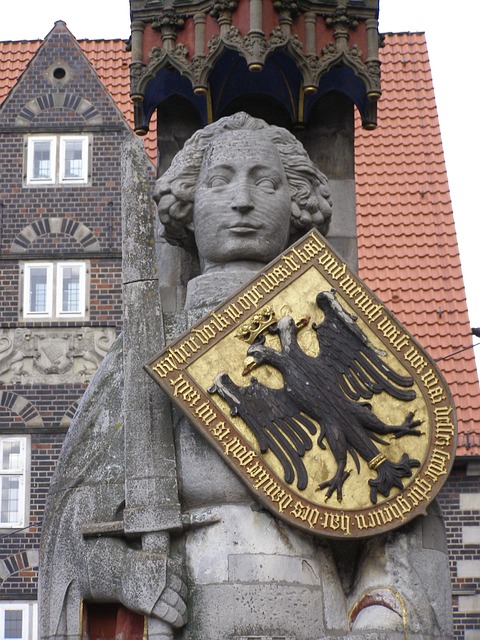
Image by Gabriele Reichel from Pixabay
And now seems like a good time to point out that romance in this sense is defined as:
[A] novel or other prose narrative depicting heroic or marvelous deeds, pageantry, romantic exploits, etc., usually in a historical or imaginary setting; a medieval narrative, originally one in verse and in some Romance dialect, treating the subjects of heroic chivalry and fantastic or supernatural events, often in the form of allegory.
From dictionary.com.
Most notably, the literary Roland was elevated to the status of the singular best of the foremost knights in Charlemagne’s court and identified as Charlemagne’s nephew. There is no indication that the real Roland was even remotely related to Charlemagne, as that probably would have been worth noting in the accounts of his death.
The first Romance about Roland was, as you might glean from the title, the Song of Roland, which elaborates on the events at Roncevaux. From there, the poetic tradition about Roland would grow, culminating in Italian Renaissance poet and occasional diplomat Ludovico Ariosto’s Orlando Furioso — Orlando being the Italian form of Roland.
“Orlando Furioso” literally translates to “Mad Orlando” (both in the sense of “angry” and “insane”), but is more commonly translated a bit more loosely as “The Frenzy of Orlando”.
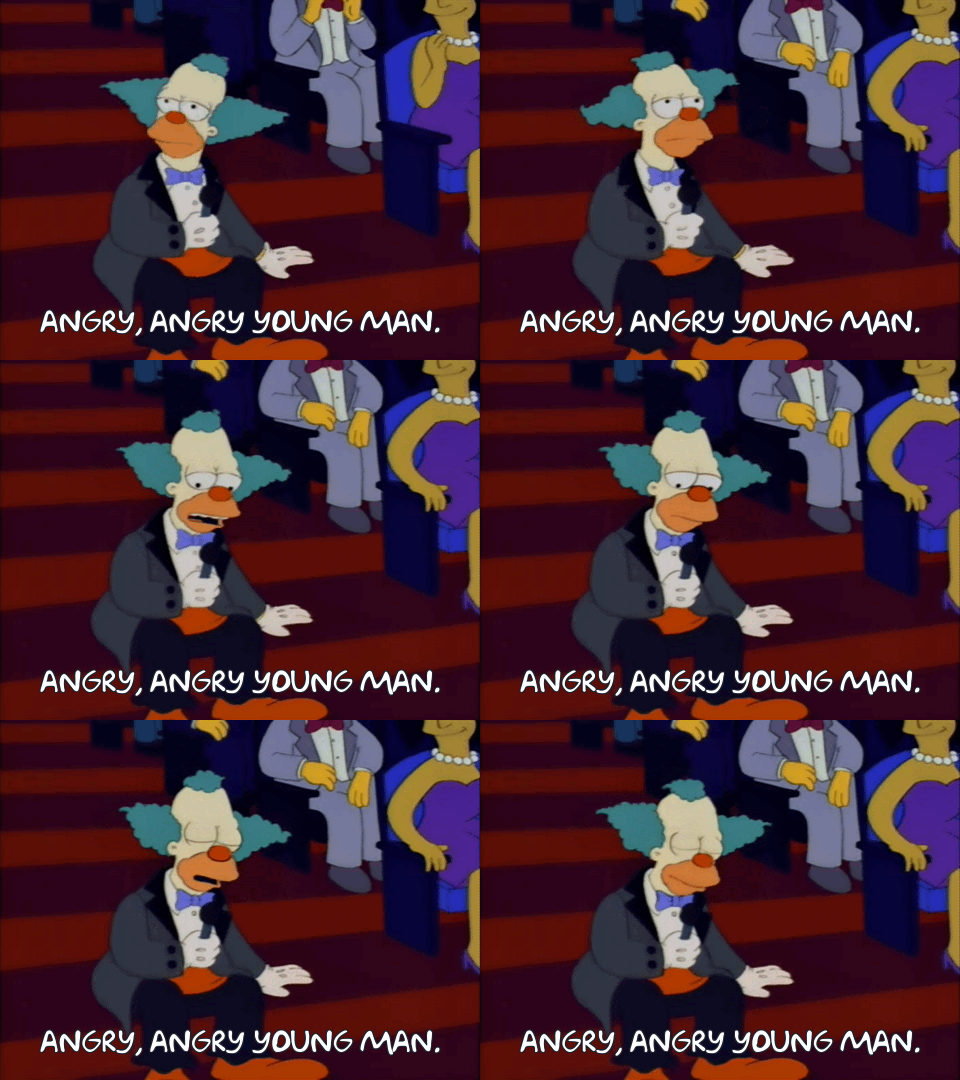
The Simpsons: Gracie Films and 20th Television Animation.
Written as a sequel to the early, less famous and generally less well-regarded Orlando Innamorato (“Orlando in Love”), Orlando Furioso delivers what it promises. To briefly recap Innamorato, the beautiful Angelica arrives in Charlemagne’s court. Basically everyone, but especially Orlando, falls in love with her. She runs away and Orlando goes off looking for her. There’s bit more to it than that and various magic wells of Love and Hate involved complicating the various Multi-Sided Love Shapes, but that Orlando is chasing after Angelica instead of fighting Charlemagne’s enemies sets the stage for Furioso.
Orlando Furioso is probably what Tv Tropes would call “Four Lines, All Waiting.” There are a lot of concurrent plotlines — Orlando looking for Angelica (link possibly NSFW; the header image is a painting of a very naked Angelica very much chained to a rock to be fed to a sea monster), Angelica running away from Orlando and then falling in love and eloping with a fairly inconsequential soldier named Medoro, causing Orlando to go crazy, leading to Astolfo (nowadays perhaps best known as a cross-dressing anime character with little resemblance to his literary inspiration) going on a lengthy quest to restore Orlando’s sanity.
Meanwhile, the African king Agramante is laying siege to Paris. And while all that is going on, Bradamante and Ruggiero (link also potentially NSFW for the same reason as above) are in love despite being on opposite sides of the conflict and trying to reunite, though events are constantly conspiring to prevent that.
Various chivalric chicanery involving giants, magic, hippogriffs (link also alsopotentially NSFW; take it up with the Renaissance, people) and sea monsters ensue — said sea monster is called the Orc, which my inspiration for Realmgard Orcs being sea dragons rather than more typical Fantasy Orcs.
As a final quick sidebar, Angelica is explicitly established to be from Cathay and while the poem can’t seem to make up its mind whether that means China or India, Angelica is invariably depicted as a very European-looking alabaster-skinned blonde.
As probably gleaned from that introductory paragraph, Charlemagne’s wars in Spain feature prominently in Orlando Furioso, though with little resemblance to any real events. Also worth noting that the climax is actually the siege of Paris by African and Spanish armies, which never happened. The closest thing in real-world history is probably the incursion by the army of al-Andalus, which was famously repulsed by Charlemagne’s grandfather Charles Martel at Tours.
Also, Charlemagne’s main Imperial residence was Aachen, not Paris…

The coronation of Charlemagne by Pope Leo III, from the Chroniques de France ou de St Denis, via Wikimedia Commons.
Public Domain.
Nevertheless, the whole Clash of Civilisations/Empires/Religions features prominently in Orlando Furioso. In fact, the whole “Christians (specifically Catholic) good, pagans bad” angle will probably leave a bad taste in a modern reader’s mouth. Ostensibly, the pagans in question are supposed to be Muslims, though the depiction in the poem (and a lot of Chivalric Romance) doesn’t bear much resemblance to any real culture.
Also, keep in mind that Ariosto was a Catholic European writer under the patronage of various prominent Churchmen and an envoy to the Pope at a time when “Christians good, pagans bad” was the prevailing attitude” was the prevailing. societal attitude. But, again, as depicted in the actual poem, there’s very little resemblance to the actual historical people or events.
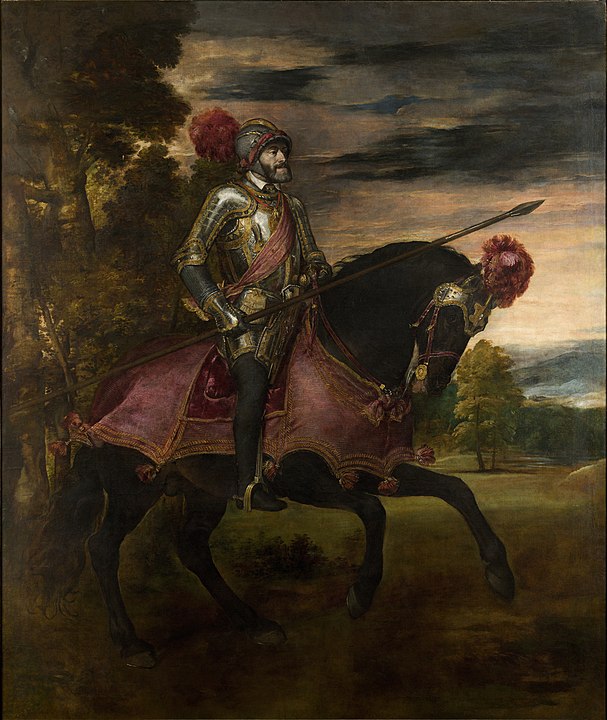
Equestrian Portrait of Charles V: Titian.
Via Wikimedia Commons. Public Domain.
Like I usually do whenever this kind of “Product of Its Time, Possibly Upsetting to Readers in the Present” thing comes up, all I’m going to really say is that you’re more than capable of making your own decision about whether this is or isn’t a deal-breaker for you, I’m not the boss of you, take this information however you will.
Still, while Ariosto is unironically working the “unite Christendom and drive out the infidels angle”, Orlando Furioso is not an entirely self-serious work. I actually wrote a paper about this in my European Literature class (aced by the class, by the way), but I’ll spare you the details. The short version is that the longer the Chivalric Romance genre existed, the more satirical and ironic the authors got.
The Lancelot-Grail (circa 1210) is a straightforward chivalric tale and probably even written by Cistercian monks to expound on Cistercian spirituality. Huon of Bordeaux (probably from within the next few decades) is a also a fairly typical Romance, though Huon himself is not the, uh, sharpest sword in the stone and his quest is basically a comedy of errors. When we get to Rabelais (five books between 1532 and 1564), we’re in full-on ribald satire territory.
Orlando Furioso isn’t really a satire. Although Tv Tropes does describe it is a Deconstruction of Chivalric Romance in the article, it really is closer to what Tv Tropes would call an Affectionate Parody. As discussed in Barbara Reynolds’ introduction (more on that later), Ariosto’s primary goal with the poem is to entertain. Again, he is actually a proponent of Christian Europe rallying behind Charles V, but that isn’t stopping him from having some fun with the story is telling to expound, like M*A*S*H‘s Mike Farrell in that one episode of The Simpsons, on his core beliefs.
The other major factor that’s most likely to affect a reader’s enjoyment is the translation you’re reader. Of course, certain people will insist “Just read the Italian”, which is, of course, not really feasible for the average reader, though perhaps more achievable than reading something like the Iliad or even the Divine Comedy in their original languages.
The first English translation of Orlando Furioso was written in 1591 (only about a generation about Ariosto died) and there have been plenty of others since then — including a fair few that are now in the Public Domain. I’m really only familiar with two English translations: the 1974 translation by Guido Waldman published by Oxford World’s Classics (which I first read for school and have several times since) and the 1975 translation by Barbara Reynolds published by Penguin Classics (which I bought specifically to compare with Waldman’s and which I’m still less familiar with).
The biggest thing to note about the two different translations is that Waldman’s is one volume, whereas Reynolds’ is two volumes, so there’s an obvious winner here if you’re pressed for either cash or bookshelf space. That being said, the tradeoff is that the text in the Waldman translation is tiny. The translation itself isn’t particularly difficult, but the typesetting means it’s full of paragraph-long sentences, page-long paragraphs and a text that feels like it’s been printed in a five-point typeface.
Comparing the introductions of the two translations is actually pretty amusing, given that there’s a certain level of passive-aggressive scholarly commentary going on. To contextualise this, bear in mind that Waldman’s translation is a prose translation and Reynolds’ is a poetic translation. Whereas Waldman is pretty insistent that it’s utterly impossible to accurately convey the Italian poetic style in English and that anyone who tries is an idiot, Reynolds is insistent that there’s no point in translating a poem as anything but poetry and anyone who says otherwise is a coward.

Photo by Andrea Piacquadio on Pexels.com
Keeping in mind that the two translations were published a year apart, I’m not entirely convinced that Reynolds is calling Waldman out…
Incidentally, stuff like this is why I decided not to keep going for my PhD…
Fundamentally, beyond the obvious previously-stated issue of Waldman’s being one volume and Reynolds’ being two, which version you’re going to prefer is going to come down to how important it is to you that the translation reads like a poem. Waldman’s prose obviously isn’t as impressive sounding as a poetic translation, but it’s still at least a step above “This happened, then that happened”. Reynold’s potentially has the opposite problem, with the need to match the rhyme scheme potentially obfuscating what’s happening.
That being said, this is still basically Dynasty Wariors: The Italian Poem, so no matter what form the words of the story are being delivered in, it’s still an epic story about larger than life heroes swooping in on hippogriffs, blasting each other with magic shields, fighting giants and sea monsters and generally being epic and impressive. Regardless of translation, the story itself is fantastic, by, multiple meanings of the word.
Also worth noting that Reynolds’ translation has an introduction that is frankly bemusing in its thoroughness. Waldman’s introduction is about 17 pages; Reynolds’ is 113. Now, you probably don’t need to read either introduction, but I’ve found that every time I’ve read the introduction to a Penguin Classics or Oxford World’s Classics book, it’s definitely helped me understand the book better.
Particularly helpful in Reynolds’ translation is the list identifying the poem’s characters — and there are a lot of them, many of whom have very similar names. Orlando and Rinaldo are probably the most liable to get confused, given that “Rinaldo” looks like “Roland” but “Orlando” is “Roland”. And there’s also Bradamante (a woman) and Brandimarte and Rodomonte (both men), among others.
For the sake of simplicity, I’d probably recommend Waldman’s version first. It’s not necessarily better, but it’s cheaper, it’s one book, and the prose translation is probably more straightforward to actually read through — though as it happens, I used the Reynolds translation as my page quote, because I felt like the rhyming made it catchier for a short passage.
But there’s no denying the typesetting of Waldman’s version is brutal. The text is too small and the paragraphs are too big with too few breaks, so, fair warning.
Fittingly, for a sprawling epic poem, this is probably the longest Recommendation I’ve ever written. But, like, Orlando Furioso is legitimately one of my favourite books ever since I read it in school.
It’s not for nothing that I’ve got a character named Roland with an Uncle Chuck…
And, honestly, I’m just glad I’ve done another recommendation that isn’t an anime.
The rest of my recommendations are here.
And follow me here:
If you’ve enjoyed my content, please consider supporting me through Ko-fi or Patreon, or through Paypal by scanning the QR code below:
Follow Realmgard and other publications of Emona Literary Services™ below:
Subscribe to the Emona Literary Services™ Substack newsletter here.

This work is licensed under a Creative Commons Attribution-NonCommercial-NoDerivatives 4.0 International License.
The author prohibits the use of content published on this website for the purposes of training Artificial Intelligence technologies, including but not limited to Large Language Models, without express written permission.
All stories published on this website are works of fiction. Characters are products of the author’s imagination and do not represent any individual, living or dead.
The realmgard.com Privacy Policy can be viewed here.
Realmgard is published by Emona Literary ServicesTM
